

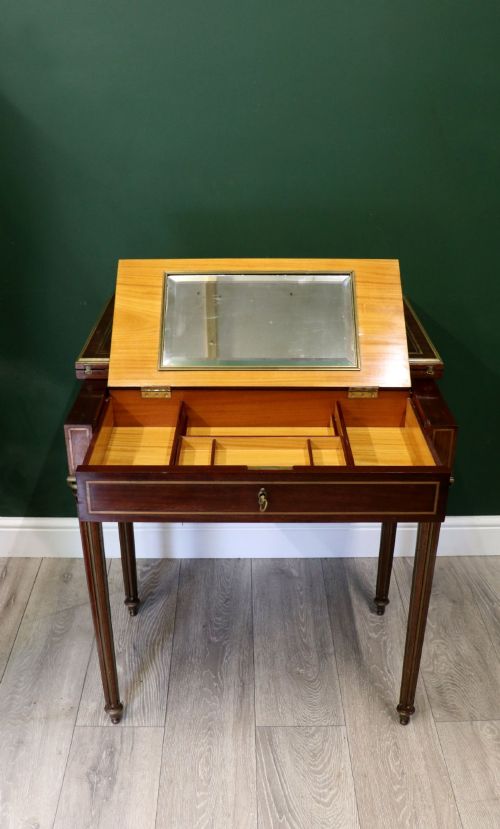
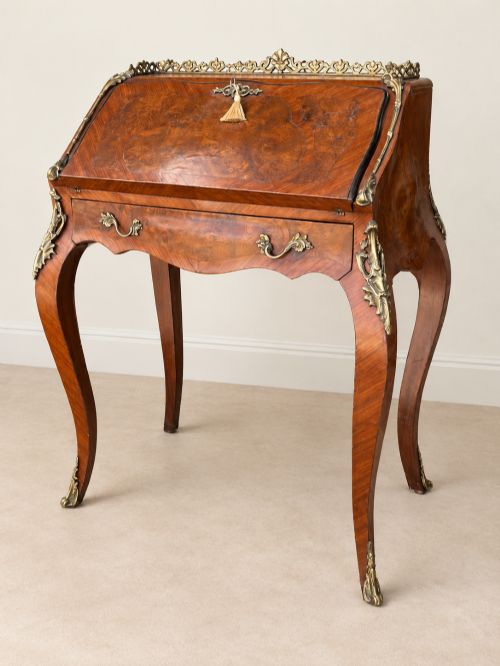
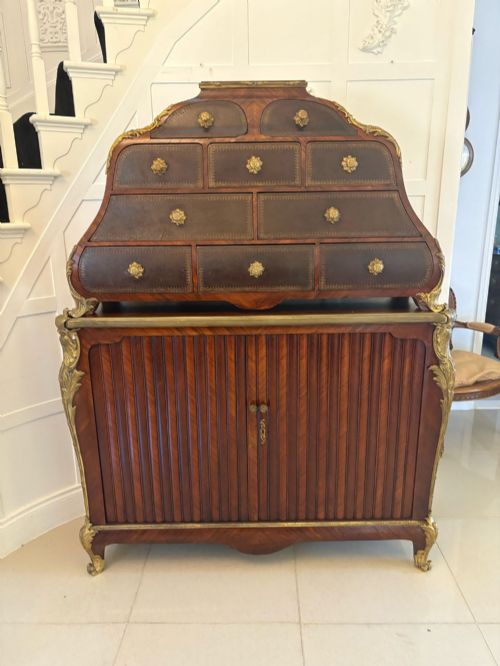
Louis Style Desk
These pieces for a louis style desk bring nineteenth-century French revival elegance and practical writing surfaces into a room.
Louis Style Desk
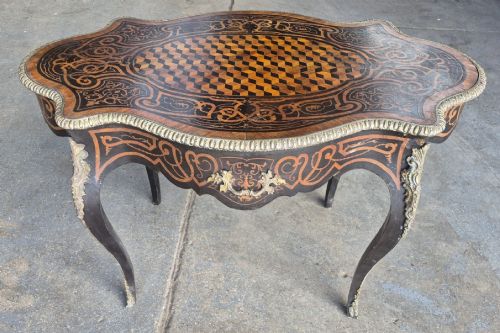
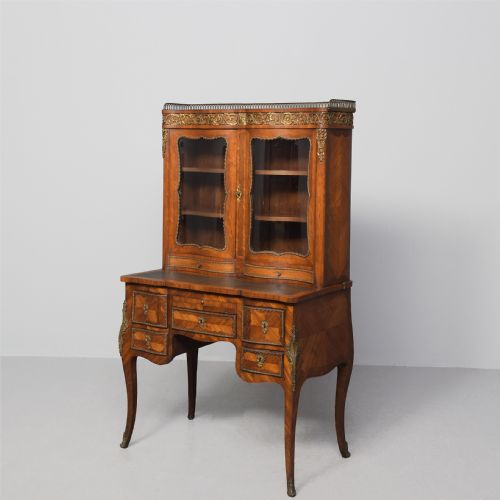
A louis style desk represents nineteenth-century interpretations of French court furniture, spanning the reigns of Louis XV and Louis XVI through Victorian revivals. Buyers searching for a louis style desk most commonly encounter bureau plats, writing tables, and secretaires dating between 1850 and 1900.
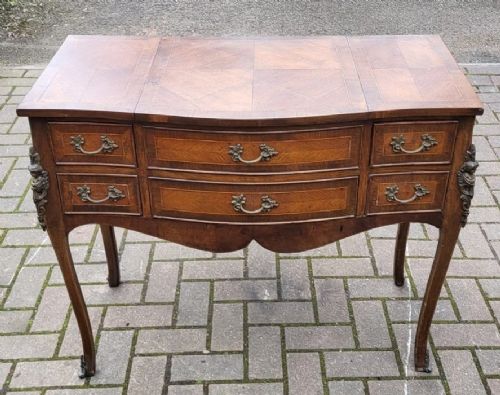
Makers working across France and Britain adapted these eighteenth-century forms into freestanding centre tables and compact writing desks. The output includes serpentine bureau plats, parquetry writing tables, and cylinder desks designed for domestic studies and salons.
The aesthetic draws heavily on French Rococo and neoclassical vocabularies, translated by nineteenth-century cabinet makers into functional pieces. Surviving examples demonstrate how Victorian and continental workshops met a sustained demand for ornate writing furniture.
Materials and Technique
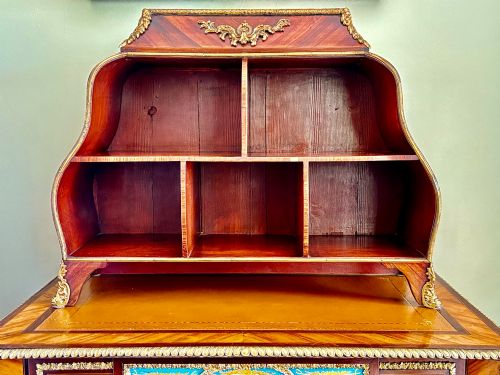
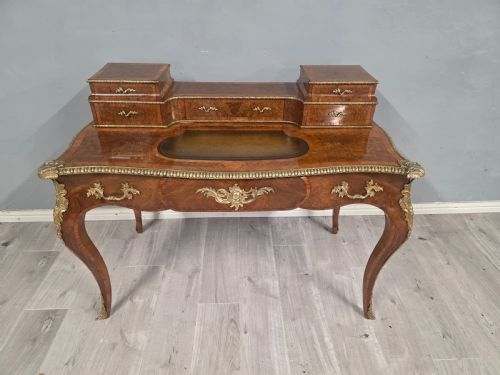
Workshops constructed these desks using native and exotic timbers including kingwood, walnut, rosewood, and mahogany, often laid as intricate marquetry or geometric parquetry patterns. Surfaces frequently incorporate fitted leather writing inserts framed by timber borders.
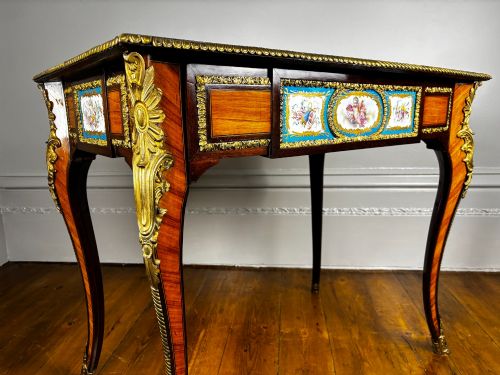
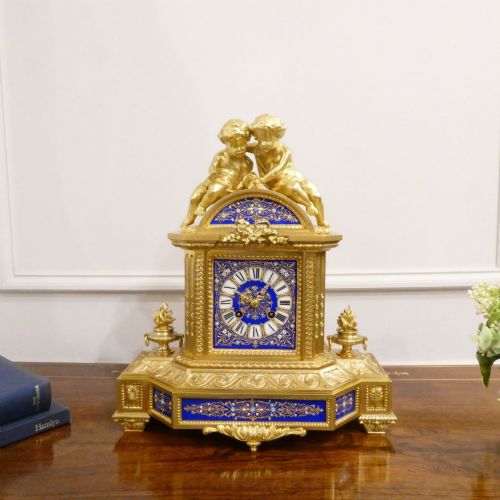
Gilt bronze and ormolu mounts, cast and chased, accent corners, drawer edges, and legs, paired with brass hardware and handles. Selected pieces integrate porcelain plaques or marble tops supported by hardwood carcases.
Louis Style Desk Retail Price Guide 2026
Typical asking prices for louis style desk among the pieces listed under this phrase on Sellingantiques today, from the lower quarter to the upper quarter. They describe what is for sale here now, not the wider market.
Listings feature nineteenth-century walnut, kingwood, and rosewood desks accented with ormolu and leather tops.
Craftsmanship and Proportion
Quality rests in the precision of the timber marquetry and the crispness of the chased ormolu mounts applied to the carcase. Finer pieces display seamless veneer matching across serpentine curves and well-balanced proportions that respect the original eighteenth-century prototypes.
The interior construction, drawer linings, and the integration of secondary woods reveal the level of workshop care. Superior desks maintain structural integrity in their joints while preserving crisp detail in the gilt bronze mounts and marquetry.
Blaise Maucuy·Jas Shoolbred·Achille Brocot·Japy Freres·Maples of London·CH Jeanselme·Durand
The Louis Style Desk Glossary
- Bureau plat
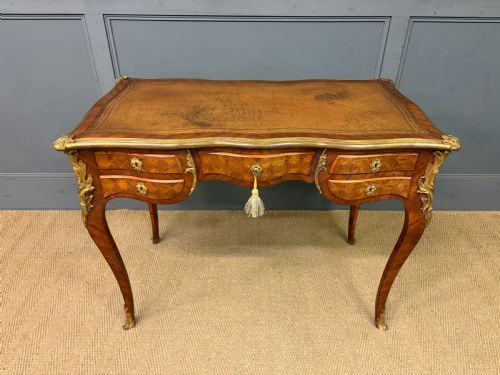
- A freestanding writing desk with a rectangular top and drawers in the frieze, unattached to a wall. These tables typically feature leather writing surfaces and gilt bronze mounts.
- Ormolu
- Gilt bronze ornamentation applied to furniture mounts, clock cases, and decorative objects. The technique involves coating bronze with a gold amalgam and firing.
- Marquetry
- The art of applying decorative veneer pieces in wood, metal, or shell to form pictorial or geometric patterns on a carcase. Craftsmen cut contrasting timbers to fit flush across tabletops and drawer fronts.
- Parquetry
- Geometric wood inlay forming repeating patterns such as cubes, lozenges, or squares. It differs from marquetry by relying on regular geometric arrangements rather than pictorial designs.
- Cartonnier
- A decorative cabinet or stationery case designed to hold papers, often mounted en suite with a desk. These pieces frequently incorporate ormolu mounts and leather-labelled compartments.
Louis Style Desk: Frequently Asked Questions
What is a louis style desk?
A louis style desk is a nineteenth-century revival piece modelled on French furniture from the reigns of Louis XV or Louis XVI. These desks feature characteristic curved cabriole legs, marquetry inlay, and gilt bronze mounts.
Cabinet makers in France and Britain produced these writing tables and bureau plats to satisfy Victorian demand for continental opulence. They combine historical design motifs with nineteenth-century construction methods.
How do I use a bureau plat?
A bureau plat functions as a freestanding writing table designed to sit away from the wall in the middle of a room. The finished back and sides allow the desk to be viewed from any angle.
Drawer space in the frieze provides storage for writing materials while the inset leather top offers a durable surface for daily correspondence.
How do I tell Louis XV from Louis XVI?
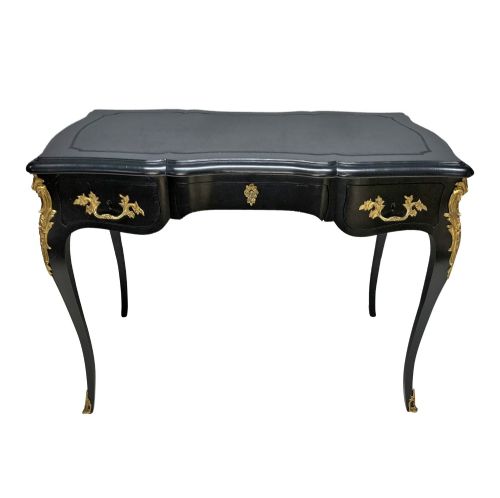
Louis XV furniture relies on asymmetrical curves, flowing rococo lines, and cabriole legs without straight angles. Ornamentation focuses on naturalistic scrollwork and floral marquetry.
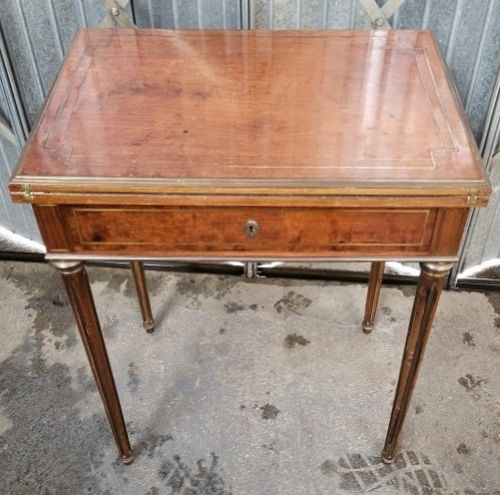
Louis XVI style shifts towards strict symmetry, straight fluted legs, and neoclassical geometry inspired by archaeological discoveries. Details include urns, swags, and rectangular proportions rather than undulating curves.
Are ormolu mounts original?
Original ormolu mounts demonstrate crisp hand-chasing beneath the gilding, showing sharp detail in the leaves and scrolls. They fit the contours of the timber carcase precisely without gaps.
Replacement mounts often lack the depth and refined finishing of nineteenth-century cast bronze work. Examining the fixing screws from the interior reveals whether the mounts belong to the original construction.