




Louis Style Cane Bed
A louis style cane bed brings light, textured French elegance into a bedroom through open woven panels and neoclassical framework.
Louis Style Cane Bed
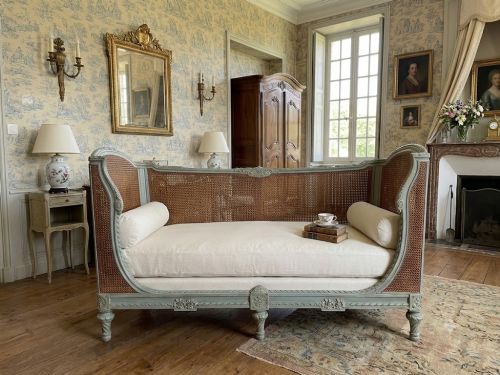
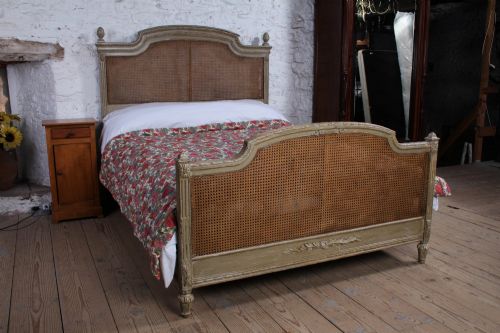
A louis style cane bed is typically encountered as a double, king size, or super king size frame drawing on eighteenth-century French design. The pieces available here span the late nineteenth century through to the 1920s, capturing revival periods that favour classical restraint and symmetry.
Most examples align with the Louis XVI style or French Neoclassical taste, featuring straight fluted posts and rectangular proportions rather than the more flamboyant curves of earlier reigns. Alongside standard bed frames and bedsteads, the selection occasionally encompasses daybeds, canapés, and matching bedroom suites.
Buyers also encounter variations styled after Louis XV, distinguished by softer lines and cartouche forms. Whether finished in natural wood tones or pale paint, these frames balance structural timber with woven panels that lighten the visual weight of large bedroom furniture.
Construction and Materials
Carpenters relied primarily on beech and walnut for the structural framework, selecting dense timbers capable of holding precise carved mouldings and slender legs. Beech accepted paint and gilt particularly well, which explains its frequent use in polychrome and gilded pieces from this era.
Natural cane forms the distinctive woven panels of the headboards and footboards, threaded by hand through drilled frames to create a sturdy yet breathable mesh. Artisans reinforced these panels with secondary framing to support the tension required for daily use.
Surface finishes include gold leaf, polychrome paint, and simple clear coatings over natural wood. Hand-painted portrait panels occasionally appear on headboards, adding individual artistic detail to structured revival pieces.
Some headboards feature hand-painted portrait panels, ensuring you wake up to the steady gaze of an anonymous nineteenth-century notable.
Judging Quality
The distinction between standard production and exceptional work lies in the crispness of the hand-carving on the beech frames and the tightness of the cane weave. Finer pieces display deeply undercut ribbons, acanthus leaves, and fluting that remain sharp through layers of paint or gilding.
Proportion and scale dictate the visual success of larger frames, particularly when standard designs are expanded to accommodate king or super king mattresses. Superior examples maintain balanced symmetry and appropriate rail thickness rather than appearing heavy or stretched.
The integrity of the woven cane panels separates well-preserved examples from those requiring extensive restoration. Uniform strands and firm tension indicate careful historical maintenance, whereas brittle or replaced cane shifts the character of the piece.
The Louis Style Cane Bed Glossary
- Cane
- Woven material made from the outer bark of rattan palms, used to create breathable panels in headboards and footboards. It provides structural flexibility and a light texture.
- Louis XVI Style
- A neoclassical aesthetic defined by straight lines, symmetrical proportions, and classical motifs such as fluting, ribbons, and urns. It contrasts with the curving asymmetry of earlier French periods.
- Bergere
- An enclosed armchair or daybed style featuring upholstered or caned sides integrated into the wooden frame. In bed listings, it denotes framed cane panels set within solid wood borders.
- Giltwood
- Timber coated with a thin layer of gold leaf or powder over a prepared gesso ground. This finish catches the light and adds a discreetly opulent sheen.
- Polychrome
- Painted in multiple colours, often incorporating decorative motifs or portrait panels directly onto the wooden structure. It was frequently employed to brighten bedroom suites.
Louis Style Cane Bed: Frequently Asked Questions
How do I fit a modern mattress?
Many older French frames require custom mattress sizes or subtle adaptations to internal side rails to support standard modern dimensions.
Checking the exact internal length and width of the bedstead before purchase ensures compatibility with contemporary bases.
How do I care for cane panels?
Cane requires moderate humidity and occasional cleaning with a damp cloth to maintain its natural elasticity and prevent snapping.
Avoiding direct heat sources keeps the woven rattan supple over decades of daily use.
Are these beds comfortable for sleeping?
While the structural framework is robust, comfort depends entirely on the modern mattress and slatted base placed within the antique rails.
The rigid wooden and cane headboard serves primarily as a decorative backdrop and support for sitting up.
How do I distinguish Louis XVI from Louis XV?
Louis XVI pieces feature straight lines, right angles, and neoclassical motifs like fluted columns and geometric panels.
Louis XV designs rely on flowing curves, cabriole legs, and asymmetrical cartouches without sharp corners.