
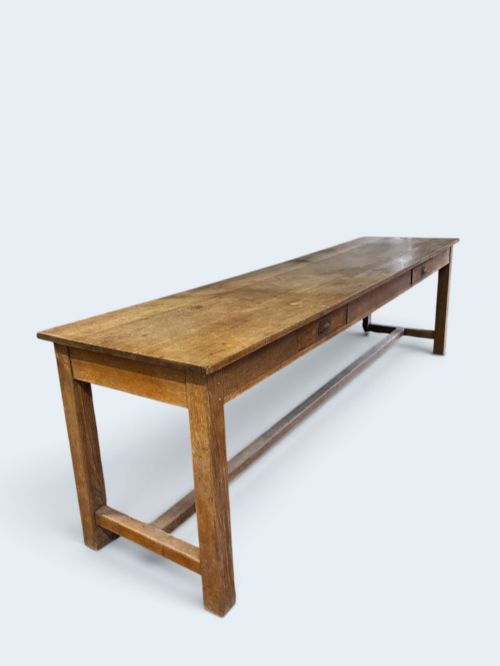
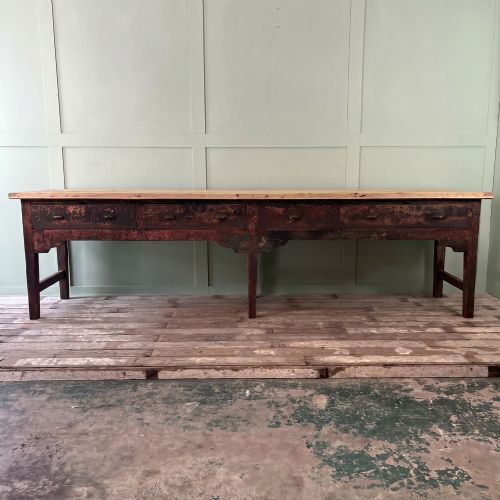


Long Wooden Sideboard Table
These long wooden sideboard table pieces are substantial serving surfaces and worktables shaped by country traditions and robust domestic use.
Long Wooden Sideboard Table
When you search for a long wooden sideboard table, you encounter a varied group of utilitarian serving tables, console tables, and dresser bases. The examples here span periods from the Georgian era through to the early twentieth century, rooted in English and French country house traditions.
Materials and construction methods
Cabinetmakers and rural joiners utilised solid timber such as oak, pine, and walnut to build these robust frames. Surfaces often show the natural grain of the wood or bear layers of early paint.
Hardware incorporates brass and iron pulls or hinges, securing drawers and doors on dresser bases and console tables. Construction relies on traditional joinery suited to heavy daily use in domestic or work environments.
Form types range from French provincial console tables to substantial English country house dresser bases and workshop benches.
Assessing quality in regional tables
The distinction between standard utility items and finer examples rests on timber selection and structural integrity. Solid oak and figured walnut command attention over simpler pine constructions.
Proportion and original surface treatment define the character of each piece. Retained original paint finishes and well-balanced proportions elevate a piece above standard utilitarian counterparts.
The Long Wooden Sideboard Table Glossary
- Potboard
- A lower slatted shelf fitted beneath a serving table or dresser base, traditionally used for storing pots and heavy crockery. This open shelf provides stability to the legs.
- Dresser base
- A low cabinet featuring drawers or cupboards beneath a wide top surface, designed for storage and serving in the dining room or kitchen. These pieces often lack the upper plate rack.
- Console table
- A table designed to stand against a wall, frequently secured with brackets or supported by distinctive legs. These tables served decorative and functional roles in hallways and reception rooms.
- Drapers table
- A long, narrow table historically utilised in mercers shops for measuring and displaying cloth. Their generous length makes them suitable for modern dining or workspace applications.
- Bowfront
- A curved convex front edge typical of certain Georgian sideboards. This shaping requires specialised joinery to bend the timber or construct the frame to a radius.
Long Wooden Sideboard Table: Frequently Asked Questions
How were these long wooden tables originally used?
These tables served primarily for food preparation, serving meals in large country houses, or displaying household goods in halls and kitchens. Their generous proportions accommodated heavy domestic tasks.
Over time, many transitioned from working spaces to formal dining rooms and hallways, adapting to changing household needs while retaining their sturdy utility.
What is the difference between a console and a serving table?
Console tables were typically designed to stand flat against a wall, sometimes supported by wall brackets or distinct legs, often serving a decorative purpose in reception rooms. Serving tables were built heavier for practical food service.
Serving tables frequently incorporate lower potboards or deep drawers for storage, whereas console tables tend to prioritise a lighter profile and decorative leg styling.
Are these tables suitable for modern kitchens?
Their robust timber construction and generous length make them practical additions to contemporary kitchen spaces as islands or serving counters. Solid oak and pine surfaces handle daily domestic activity well.
Buyers often place them in open-plan kitchens or dining areas to provide extra surface area and historic character without altering modern layouts.
How can I identify the period of a wooden table?
Dating relies on observing construction techniques, timber species, and overall design motifs characteristic of specific eras like the Georgian period or the nineteenth century. Hand-cut joints and original hardware offer clear chronological clues.
Secondary woods, tool marks on the underside, and wear patterns further help distinguish between eighteenth-century craftsmanship and later nineteenth or twentieth-century interpretations.