
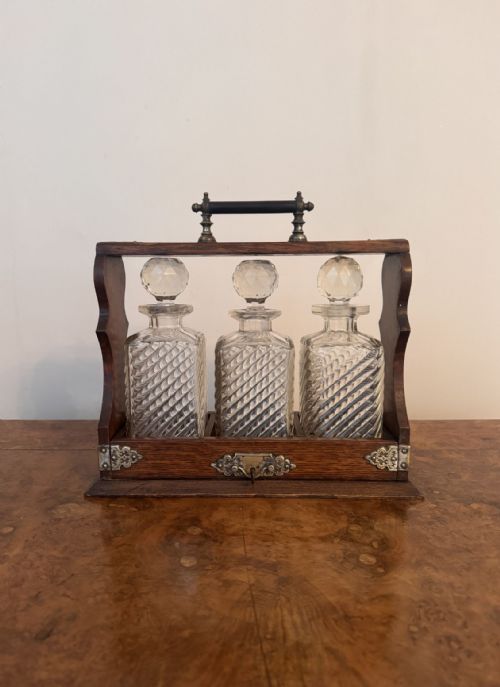


Lockable Spirit Frame
A lockable spirit frame is a secure drinks holder designed to keep your best whiskey and brandy safe from household staff.
Lockable Spirit Frame
A lockable spirit frame, most commonly encountered here as a tantalus, is a barware container holding two or three decanters securely beneath a metal locking bar. When the key is turned, the stoppers cannot be removed, preventing anyone from helping themselves to the contents.
The pieces listed on this page span from the late nineteenth century through to the Edwardian period and the Art Deco era, showing how domestic hospitality changed over several decades. Most examples take the form of an oak, walnut, or coromandel box fitted with cut glass or crystal decanters.
Beyond traditional wooden tantalus decanter sets, the inventory includes modernist chrome and glass designs that reflect later twentieth-century tastes. These variations demonstrate that while the primary function remained security, the exterior presentation shifted alongside prevailing interior styles.
Materials and construction
Makers built these frames using robust hardwoods such as oak, walnut, and exotic coromandel, often embellished with marquetry inlay to suit formal dining rooms and smoking parlours. These wooden bases required sturdy internal framing to support the heavy weight of filled glass vessels.
Metal components, including silver plated mounts, locks, and handles, provide both structural integrity and decorative contrast against the dark wood. The associated decanters feature heavy cut glass or cut crystal bodies paired with matching ground glass stoppers.
Victorian hosts locked their whiskey away not from thieves, but to stop the butler from sampling the best brandy.
Assessing quality and craftsmanship
Quality in a lockable spirit frame is found in the weight of the silver plating, the precision of the locking mechanism, and the depth of the woodwork's finish. Superior examples incorporate marquetry inlay and substantial mounts that operate smoothly when the key is turned.
The standard of the glassware further separates the tiers, with deeper hand-cut facets on the decanters indicating a higher grade of manufacture. Pieces bearing the marks of known makers demonstrate finer attention to structural detail across both the housing and the bottles.
Jacques Adnet·The Goldsmith Co.·Philip Ashberry
The Lockable Spirit Frame Glossary
- Decanter
- A glass vessel used for holding and serving spirits or wine. In these frames, they are shaped specifically to fit beneath the locking metal bar.
- Silver plate
- A thin layer of silver applied to a base metal such as copper or brass. This technique provided the appearance of solid silver at a lower production cost.
- Marquetry inlay
- Decorative patterns formed by fitting small pieces of contrasting veneer into the wooden surface. It adds visual complexity to the exterior of the box.
- Cut crystal
- High-clarity glass containing lead oxide, cut with decorative facets that catch the light. It offers greater weight and brilliance than standard glass.
Lockable Spirit Frame: Frequently Asked Questions
What is a lockable spirit frame?
A lockable spirit frame is a secure housing unit for decanters, featuring a metal bar that locks over the glass stoppers. This design prevented servants or unauthorized guests from consuming the owner's private liquor stock.
Such items sat prominently on sideboards in Victorian and Edwardian dining rooms, combining practical security with a display of hospitality and status.
How do you open a tantalus?
Opening the frame requires a matching key inserted into the lock at the front or side of the wooden base. Turning the key releases the vertical locking arm, allowing it to slide or tilt upward so the decanters can be lifted out.
Without the key, the metal bar stays firmly in place over the necks of the decanters, blocking the removal of the glass stoppers.
What periods do these pieces come from?
The available pieces primarily date from the late nineteenth century, including Victorian and Edwardian examples, alongside later Art Deco designs from the twentieth century. Oak and walnut versions are typical of the 1870 to 1900 period.
Later modernist interpretations shift toward chrome and glass materials while maintaining the core locking function of the traditional barware format.
How should I clean the decanters?
Cleaning antique cut glass decanters requires warm water and mild soap, avoiding sudden temperature changes that might crack the aged material. Wooden frames should be treated with appropriate furniture wax rather than harsh liquid cleaners.
Leaving stoppers slightly loose while the decanters dry prevents moisture from becoming trapped inside the cut crystal bodies.