

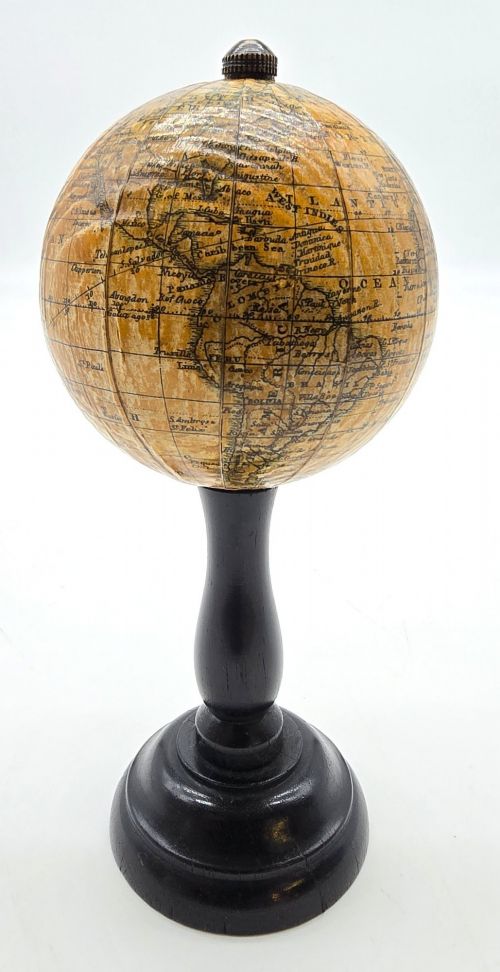


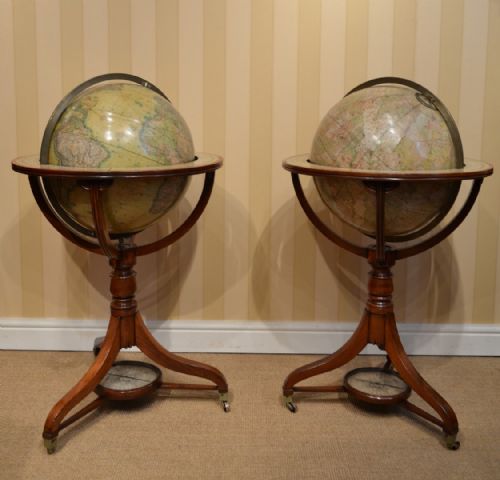


Library Globe on Stand
These library globe on stand pieces bring geography into the room, combining printed paper cartography with turned stands of mahogany or brass.
Library Globe on Stand
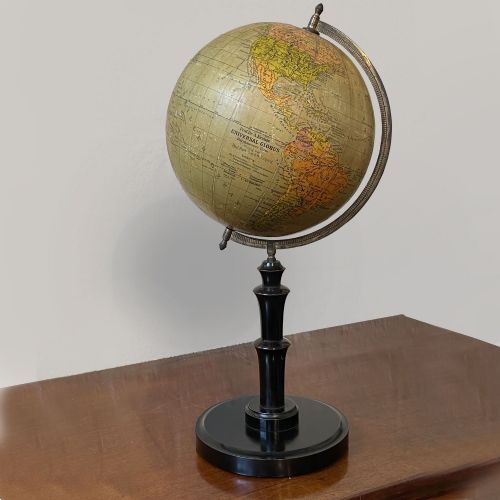
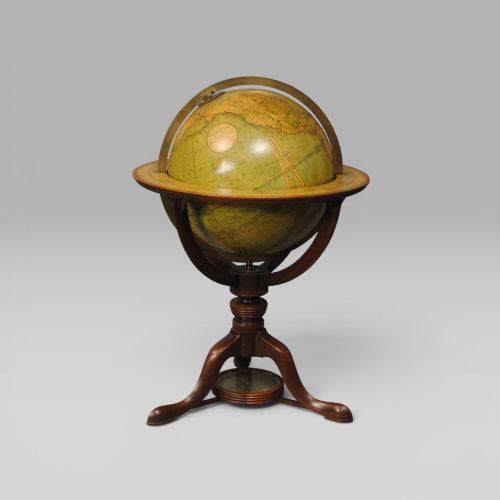
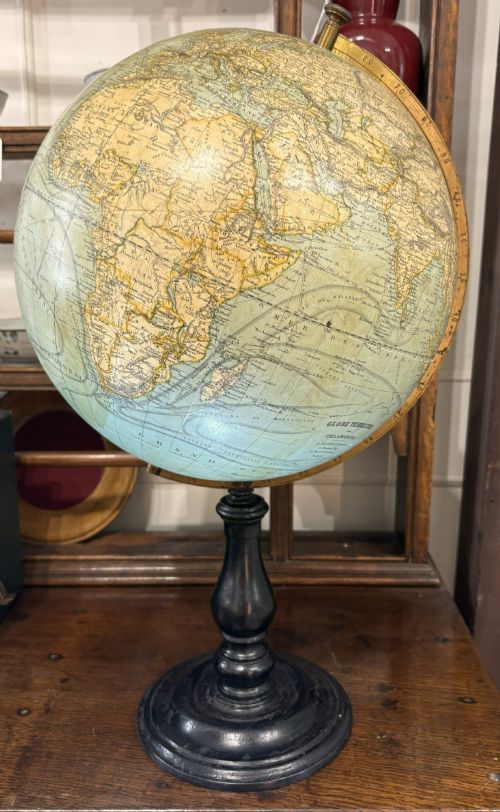
A library globe on stand selection encompasses terrestrial and celestial spheres mounted upon miniature desk frames, sturdy table supports, and tall floor mountings. These objects appear in various sizes, ranging from small miniature desk globes to large library editions measuring eighteen inches across.
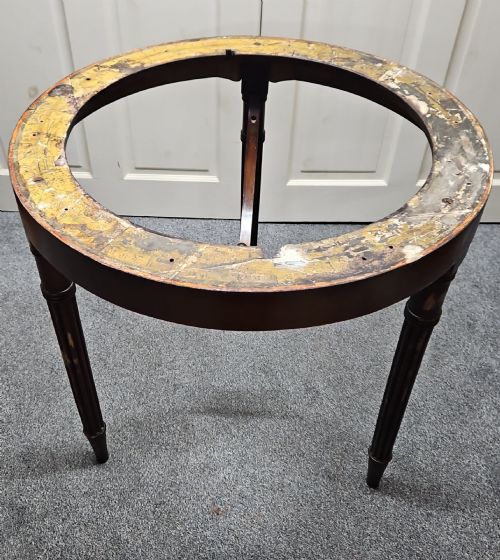
The material combinations span paper gores applied over plaster spheres, held by brass meridian rings and supported by mahogany, ebonised wood, or cast iron stands. Alongside the standard globes, related furniture forms such as glazed standing bookcases also emerge within the records.
Origin and period markers link these items to eighteenth-century workshops, nineteenth-century Victorian output, Edwardian makers, and interwar productions from the nineteen-thirties. French and English geographical houses dominate the output seen in the inventory.
Quality Variations
The clarity and detail of the printed paper gores dictate the cartographic fidelity of each sphere. Early hand-coloured map sections carry different visual depth compared to later printed editions.
Joinery and metalwork finish on the supporting stands separate standard productions from more ambitious library pairs. Turned wooden framing and substantial brass rings demonstrate greater care in construction than simple iron mounts.
Library Globe on Stand Retail Price Guide 2026
Typical asking prices for library globe on stand among the pieces listed under this phrase on Sellingantiques today, from the lower quarter to the upper quarter. They describe what is for sale here now, not the wider market.
Listings feature items from the eighteenth century, the Victorian era, the Edwardian period, and nineteen-thirty productions utilising paper, brass, mahogany, and cast iron.
Cary·G & J Cary·J. Forest·Malby's·Thomas Malby·Geographia
The Library Globe on Stand Glossary
- Gores
- The paper strips, printed with map details, applied to the plaster sphere to form a continuous globe. These segments narrow towards the poles to prevent overlapping.
- Terrestrial globe
- A representation of the Earth showing landmasses, oceans, and political boundaries. These spheres form the majority of the geographical pieces.
- Celestial globe
- A sphere mapping the stars and constellations relative to the Earth. These pieces often accompany terrestrial examples as matching pairs.
- Meridian ring
- The graduated brass or metal ring surrounding the globe that holds it in place. It allows the sphere to rotate and tilt along specific axes.
Library Globe on Stand: Frequently Asked Questions
How do I date a globe?
Dating relies upon the political boundaries and place names printed on the paper gores, alongside the style of the wooden or brass stand. Historical cartographic changes provide clues to the year of production.
Makers' signatures printed on the map or stamped on the stand further help establish the period of manufacture.
Are terrestrial and celestial globes different?
Terrestrial globes display the geography of the Earth, including countries, oceans, and trade routes. Celestial globes map the night sky, depicting constellations and star positions from an outward-looking perspective.
Pairs featuring both types were commonly produced for nineteenth-century libraries.
How should I place a globe in a room?
Library globes require stable surfaces away from direct sunlight and damp conditions to protect the delicate paper gores and plaster cores. Desk and table versions suit bookcases and partner desks.
Floor-standing editions need adequate clearance around the stand to allow rotation of the large meridian ring.