
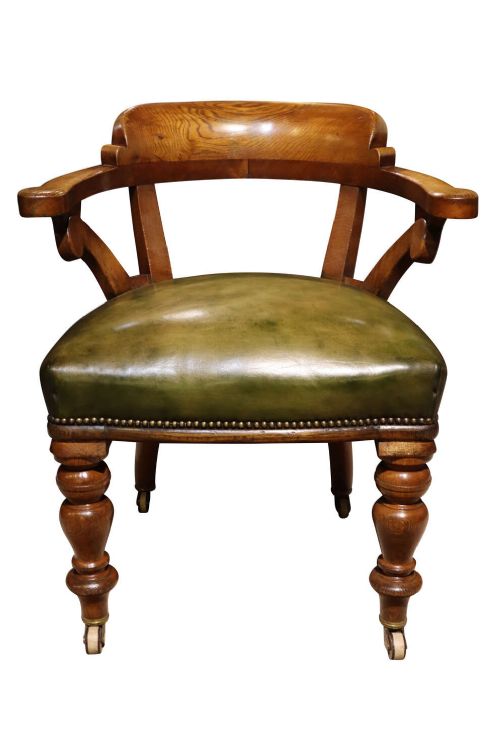
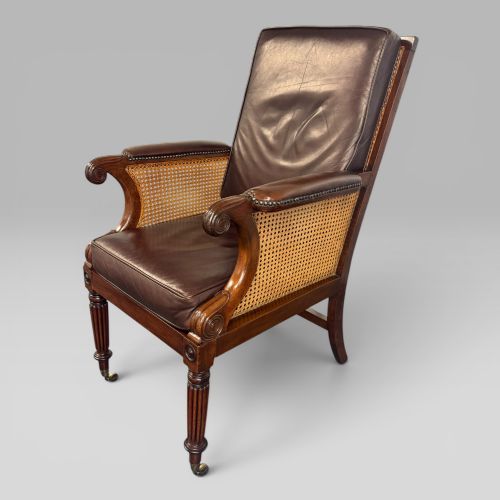


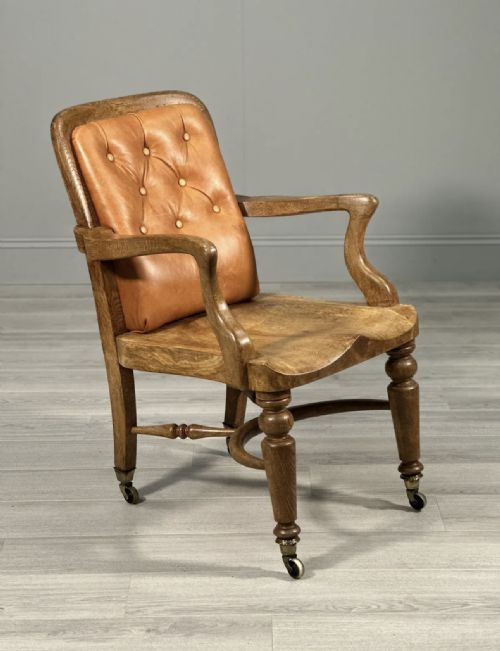


Leather Desk Chair Castors
Leather desk chair castors support heavy library and office seats across the nineteenth and early twentieth centuries, keeping workspaces mobile.
Leather Desk Chair Castors
When you search for leather desk chair castors, you find working components attached to heavy library chairs, revolving office seats, and mahogany armchairs. These pieces belong predominantly to the Victorian and Regency periods, alongside Edwardian swivel designs.
The forms span solid oak library armchairs, cane bergère seats, and walnut framing upholstered in red or green hide. Many examples hail from the nineteenth century, including specific pieces linked to workshops such as Gillows or W.Williamson & Sons.
You will encounter revolving office armchairs fitted alongside fixed dining and cockfighting chairs. Each piece relies on sturdy timber frames paired with durable leather surfaces designed for daily study or clerical work.
Judging quality and proportion
The standard of a leather desk chair rests on the density of the timber frame and the depth of the carved detailing. Fine examples exhibit crisp mouldings in mahogany or golden oak rather than plain, utilitarian joinery.
Hardware execution also defines the work, where substantial brass swivel actions and original metal fittings elevate an ordinary office seat into a notable library piece.
The listed inventory spans the nineteenth century through the Edwardian era, incorporating mahogany, oak, rosewood, brass, and leather.
W.Williamson & Sons·Gillows·Kendrick & Jefferson·Daws
The Leather Desk Chair Castors Glossary
- Castor
- A small wheel mounted on a swivel at the base of a chair leg to allow smooth movement across floors. They appear in brass, iron, and wood across nineteenth-century seating.
- Bergère
- An enclosed upholstered armchair with exposed wooden framing and cane-work sides. These frames frequently accommodate loose leather squab cushions.
- Swivel
- A rotating mechanism fitted beneath the seat frame allowing the user to turn without moving the base. This engineering is common in Edwardian and late Victorian office chairs.
- Cockfighting chair
- A low, heavily padded chair originally designed for spectators at sporting events, featuring a padded rest on the upper back. Examples often feature dark red leather upholstery.
Leather Desk Chair Castors: Frequently Asked Questions
Are these castors original to the chairs?
Most antique desk chairs retain metal or brass fittings from their period of manufacture, though replacement wheels occur frequently.
Inspect the fixing screws and timber seating blocks beneath to determine if the hardware has seen modern intervention.
How do I maintain the leather?
Apply traditional wax or leather balsam sparingly to nourish the hide and prevent drying or cracking over time.
Avoid modern chemical cleaning agents that strip the original dyed surface finish.
Can I use these chairs daily?
Victorian and Edwardian office seats were built for robust daily clerical and library work using dense hardwoods.
Ensure the revolving mechanism and wooden joints remain stable before placing the chair into heavy daily service.
How do I date a swivel chair?
Examine the complexity of the iron or brass undercarriage alongside the turning style of the central wooden pillar.
Early twentieth-century models typically feature more integrated mechanical adjustments than simpler nineteenth-century predecessors.