




Leather Case Clock
A leather case clock protects a fine portable movement inside a tailored hide exterior, offering reliable timekeeping for travel and the home.
Leather Case Clock
A leather case clock combines a precision timepiece, often a carriage clock or desk clock, with a fitted protective housing designed for safe transport. These items span the nineteenth century through the Art Deco era, encompassing Victorian and Edwardian examples alongside later twentieth-century travel pieces.
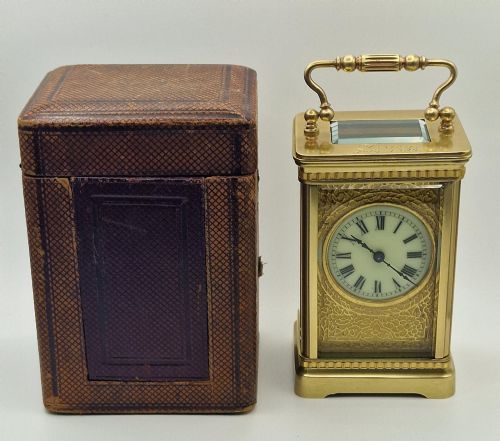
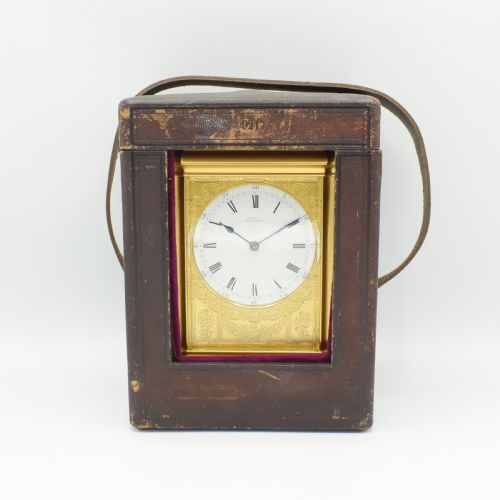
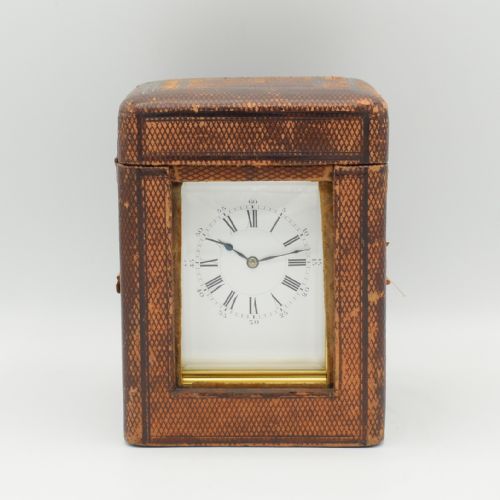
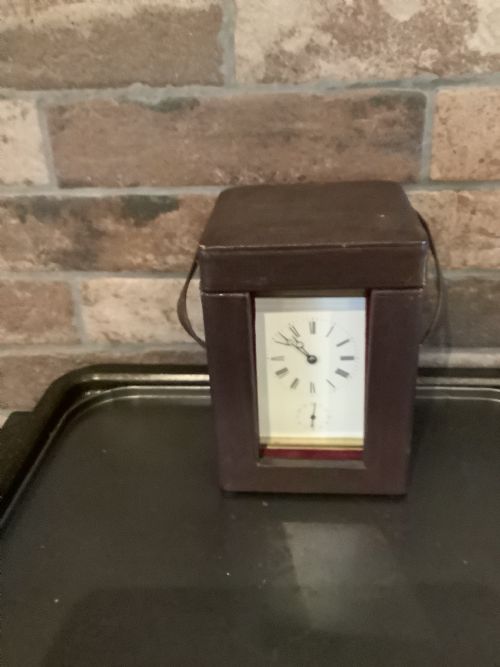
The most common form encountered here is the brass or gilt carriage clock accompanied by its original leather travel case. These compact mechanisms range from miniature boudoir models to larger striking and repeating examples built for journeys by rail or carriage.
How they were made
The movements rely on brass, gilt brass, and steel components assembled by hand, often featuring eight-day duration, platforms escapes, and strike or alarm complications. Cases combine glass panels with heavy cast frames, sometimes fully engraved with foliate or geometric motifs.
The outer protective cases utilise sturdy leather, occasionally embossed or coloured, lined with velvet or silk to cushion the clock within. Fastenings and handles of gilt brass or chrome-plated metal complete the construction, securing the instrument for transit.
The selection includes miniature boudoir timepieces alongside heavy striking carriage clocks by makers such as Henri Jacot and Dent.
What varies in quality
The distinction between standard production and the finest work lies in the execution of the movement and the crispness of the case engraving. Master makers produced complicated gear trains with grand sonnerie strikes, whereas simpler pieces relied on standard time-only platforms.
The survival and condition of the accompanying outer housing heavily influence the overall standard. An original leather case that retains its structural integrity, proper clasp, and original silk lining adds significantly to the completeness of the object.
Henri Jacot·Hunt And Roskell·Alfred Hollinge·LeCoultre·Smiths·Aspreys
The Leather Case Clock Glossary
- Carriage clock
- A portable spring-driven timepiece designed for travellers during the nineteenth century. These clocks usually feature a glass-panelled brass case and a swinging handle on top.
- Gorge case
- A specific style of carriage clock housing characterised by stepped mouldings at the top and bottom. This heavy brass frame is typical of better-quality nineteenth-century French production.
- Grand Sonnerie
- A complex striking mechanism that chimes the hours and the quarters automatically on every quarter hour. Such movements represent the upper tier of clockmaking skill.
- Platform escapement
- The tiny horizontal assembly containing the balance wheel and hairspring placed visibly on top of the movement. It allows a portable clock to keep accurate time in any position.
Leather Case Clock: Frequently Asked Questions
What is a leather case clock?
A leather case clock is a portable timepiece, frequently a carriage clock or folding travel alarm, housed in a fitted protective leather outer box.
These pieces were built for travel during the Victorian, Edwardian, and Art Deco periods, combining precision movements with durable exterior protection.
How do I wind my clock?
Most mechanical travel clocks use a small matching winding key inserted into arbors located on the backplate or underneath the movement.
Turn the key gently until resistance indicates the mainspring is fully tensioned, taking care not to overwind older mechanisms.
Are these clocks suitable for travel today?
While the original leather cases were designed for transit in carriages and trains, antique movements are delicate instruments.
Modern vibrations and impacts can easily disturb the sensitive platform escapement, so contemporary owners generally keep them stationary at home.
How can I tell the period?
Stylistic details in the brass case, the shape of the handle, and the typography of the enamel dial point to specific eras.
Victorian pieces often display heavy cast brass and floral engraving, while Art Deco models favour streamlined chrome-plated metal and geometric dials.