

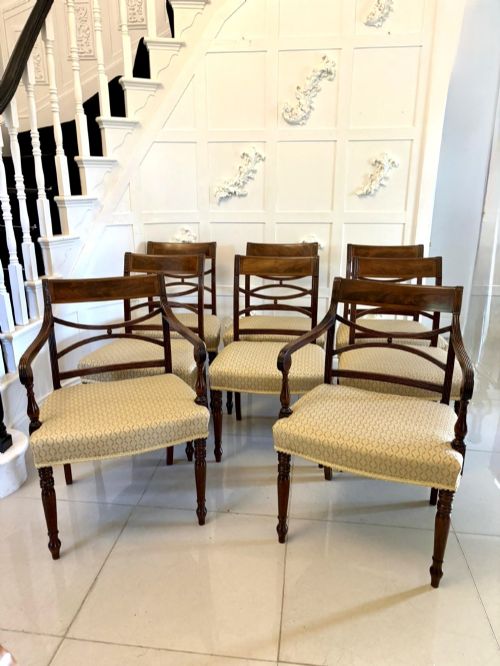
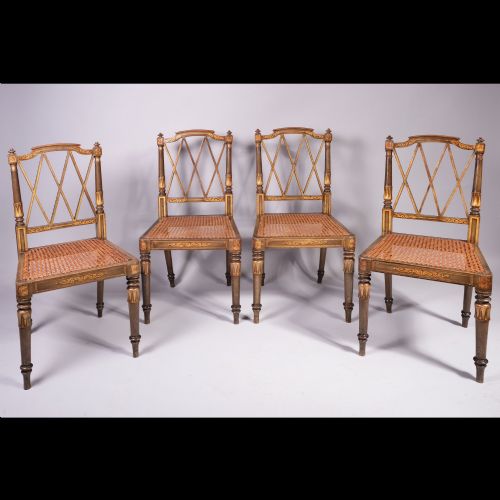


Lattice Back Side Chairs
Lattice back side chairs bring classic architectural framing and timeless openwork designs to any dining room.
Lattice Back Side Chairs
Dining chairs and hall chairs dominate the forms encountered here, often appearing in matched sets or pairs. The origins trace across the nineteenth and early twentieth centuries alongside earlier Georgian pieces.
The aesthetic vocabulary encompasses Sheraton style influences alongside Moorish Revival and Jacobean Revival expressions. Mahogany and painted timber provide the primary structural foundations for these designs.
How they were made
Timbers such as mahogany and walnut form the structural core, shaped through traditional joinery techniques to support intricate openwork splats. Ebonised finishes and paint are applied alongside gold leaf details to enhance specific decorative surfaces.
Upholstery elements integrate fabric, cane, and tapestry to pad the seats of dining chairs and armchairs. Inlaid decoration appears across select mahogany frames, reflecting period preferences for detailed surface ornamentation.
Lattice Back Side Chairs Retail Price Guide 2026
Typical asking prices for lattice back side chairs among the pieces listed under this phrase on Sellingantiques today, from the lower quarter to the upper quarter. They describe what is for sale here now, not the wider market.
Listings span the eighteenth, nineteenth, and twentieth centuries, featuring mahogany, walnut, oak, paint, and cane.
What varies in quality
The refinement of the pierced lattice woodwork dictates the visual success of the piece, separating standard production from exceptional craftsmanship. Crisp execution in the carved interlacing shows the maker's mastery over the material.
The integrity of the timber framing and the harmony of matched sets influence desirability among collectors. Original painted or ebonised surfaces carry more character than later alterations.
Liberty & Co·Collier and Plucknett·Thomas Chippendale·Brights of Nettlebed
The Lattice Back Side Chairs Glossary
- Side chair
- A chair without arms, designed primarily for dining tables or occasional placement against a wall. These form the majority of the openwork seating found in this category.
- Splat
- The vertical central strip of wood in the back of a chair, which in these pieces is pierced and interlaced to form a lattice pattern. The geometry of the splat often defines the stylistic period.
- Cane
- Woven plant material used to create resilient and decorative seat inserts. It appears frequently on seating from the late nineteenth and early twentieth centuries.
- Inlay
- A technique where contrasting materials are inserted into depressions in the wood surface to create decorative patterns. Sheraton style pieces frequently utilise this method on mahogany frames.
Lattice Back Side Chairs: Frequently Asked Questions
What defines a lattice back side chair?
These seats feature an openwork wooden backrest constructed with intersecting bars or interlaced splats that form a grid or geometric pattern. The design draws heavily on eighteenth-century pattern books and later revival movements.
They function primarily as dining seating or decorative hall chairs, combining structural rigidity with visual lightness.
How do I care for antique mahogany dining chairs?
Maintain the timber by keeping chairs away from direct heat sources and fluctuating humidity, which can cause wood to split or joints to loosen. Regular dusting with a dry, soft cloth preserves the finish without building up residue.
Avoid applying modern silicone polishes, opting instead for traditional beeswax when the timber requires nourishment.
Can I mix different periods of lattice chairs?
Mixing period revival pieces with eighteenth-century originals creates a layered, collected interior when the wood tones share similar warmth. Matching timber species helps unify groupings gathered over time.
Pay attention to seat height and overall scale to ensure comfort and visual balance around a dining table.
How do I distinguish Georgian from revival pieces?
Georgian pieces display the hand-cut tool marks and timber density typical of eighteenth-century workshop production. Revival pieces from the Victorian and Edwardian eras often show machine standardisation in their internal framing.
Secondary woods and fastener types provide further clues to dating the construction accurately.