


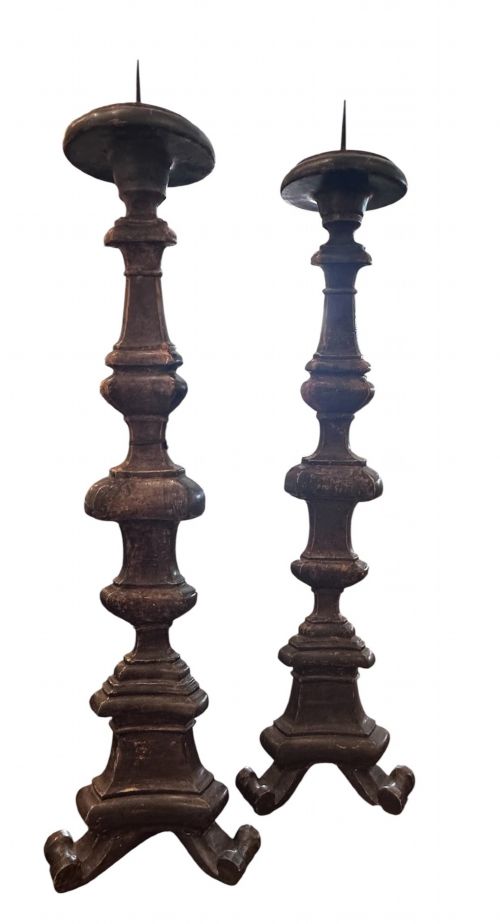


Large Wooden Prickets
Large wooden prickets are commanding altar-style candle holders and pricket sticks designed to elevate interior schemes with antique scale and presence.
Large Wooden Prickets
Large wooden prickets comprise towering altar-style candle sticks and monumental candle holders originating chiefly from the eighteenth and nineteenth centuries. Buyers searching for large wooden prickets encounter substantial pieces styled in Italian Baroque, French Chateau, and English Baroque traditions.
Most examples found on this page reflect continental European workshops, particularly Italian and French origins. Forms span simple carved wooden pricket sticks to giltwood and polychrome altar types of impressive proportions.
Makers utilised traditional turned and carved timber forms, often finishing surfaces with gesso, silver leaf, or paint. Functional adaptations also appear, including converted large English Baroque carved lamps and Art Deco iterations combining brass and wood.
How they were made
Artisans carved structural elements directly from solid wood before applying layers of gesso to prepare surfaces for decoration. Gilding with silver leaf or gold leaf created reflective finishes designed to catch candlelight within ecclesiastical and domestic interiors.
Surfaces frequently received polychrome paint or giltwood decoration, aligning with Baroque and Neoclassical aesthetic movements. Iron components occasionally reinforced heavy wooden constructions, while later twentieth-century examples integrated brass fittings alongside turned timber.
Large Wooden Prickets Retail Price Guide 2026
Typical asking prices for large wooden prickets among the pieces listed under this phrase on Sellingantiques today, from the lower quarter to the upper quarter. They describe what is for sale here now, not the wider market.
Listings span the eighteenth and nineteenth centuries, featuring wood, gesso, giltwood, silver leaf, brass, and iron materials.
What varies in quality
Depth and precision of hand-carved ornamentation separate standard turned posts from sculptural masterworks displaying intricate Baroque scrolling and proportion. The integrity of original surface treatments, such as aged silver leaf and gesso, dictates visual richness.
Imposing scale combined with balanced architectural proportions commands greater presence in large spaces. Preservation of the foundational wood structure beneath historical finishes defines structural merit.
The Large Wooden Prickets Glossary
- Pricket
- A sharp metal spike atop a candlestick designed to secure the base of a large candle. This traditional spike distinguishes prickets from socket-type candle holders.
- Giltwood
- Timber treated with a thin layer of gold leaf or metal leaf over gesso. This decorative finish provides a brilliant metallic sheen characteristic of Baroque furniture and church furnishings.
- Gesso
- A plaster mixture applied to wood surfaces as a base for painting or gilding. It creates a smooth, receptive ground for fine surface decoration.
- Polychrome
- Decorated in multiple colours. This painting technique adds vibrant pictorial depth to carved wooden surfaces.
Large Wooden Prickets: Frequently Asked Questions
Where were large wooden prickets used?
These tall candle holders originated primarily as altar furnishings in churches and chapels across Italy, France, and England. Their grand scale suited ecclesiastical settings before finding places in stately domestic interiors.
Today, buyers place them on large tables, sideboards, or architectural mantels to anchor a room with historical character.
How do I clean a giltwood pricket?
Dust surfaces gently using a soft, dry brush to protect delicate gesso and silver leaf layers. Avoid liquid cleaners and chemical solvents entirely.
Maintaining a stable indoor humidity prevents timber movement and preserves fragile historical finishes.
Can these hold real candles?
Traditional prickets use an upward-facing metal spike that pierces the base of a pillar candle to hold it steady. Care must be taken with open flames near dry antique timber.
Many collectors use fitted drip pans or modern LED candles to protect the original wood and metal spikes.
How do I identify a Baroque pricket?
Baroque examples feature bold, dynamic carving, exaggerated proportions, and rich surface ornamentation like giltwood or polychrome paint. Look for dramatic scrolls and substantial turned columns.
Eighteenth-century pieces typically display heavier timber construction compared to later nineteenth-century interpretations.