


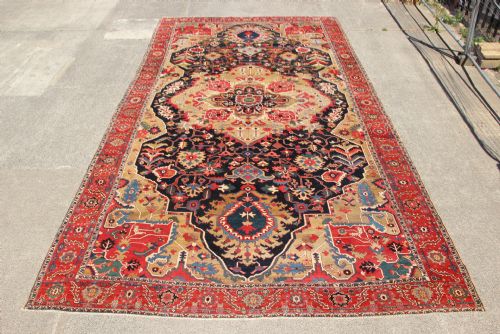


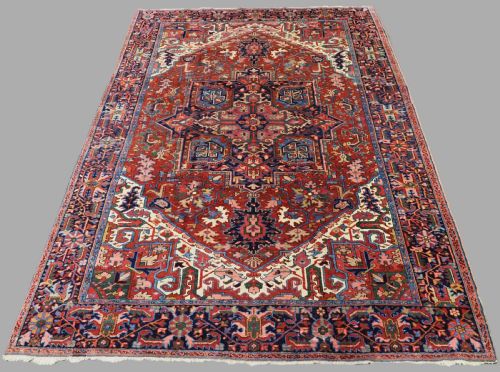


Large Serapi Area Rug
A large serapi area rug brings grand Northwest Persian weaving into a room, offering bold geometric medallions and robust floor coverage.
Large Serapi Area Rug
When buyers search for a large serapi area rug, they look at substantial hand-knotted floor coverings originating from Northwest Persia. These pieces represent a distinct subset of Heriz weaving, characterised by grand scale and geometric symmetry.
The versions most likely to appear on this page date from the latter half of the nineteenth century through the early decades of the twentieth century. These carpets display traditional room-size proportions suited to anchoring major living spaces.
What varies in quality
Quality in these carpets rests on the crispness of the geometric drawing and the balance of the central medallion design. Finer knot density allows for sharper definition within the traditional tribal motifs.
Depth and variation of the dyed wool also determine the visual standing of each piece. Piles retaining rich, saturated tones elevate the overall presence of the weaving.
Step closely and you might spot tiny weaver errors in the symmetry, proof of human hands at the loom centuries ago.
The Large Serapi Area Rug Glossary
- Serapi
- A sub-category of Heriz carpets known for bolder, more spacious geometric designs and a slightly earlier aesthetic. These pieces often feature simplified medallion layouts.
- Heriz
- A region in Northwest Persia renowned for producing durable, large-scale geometric carpets. The weaving centres here created robust floor coverings for export.
- Warp
- The vertical cotton threads stretched tightly on the loom that form the structural skeleton of the rug. Visible fringes typically consist of these extended warp threads.
- Weft
- The horizontal threads passed between the warp rows to bind the knots in place. These cotton strands give the heavy carpet its characteristic rigid structure.
Large Serapi Area Rug: Frequently Asked Questions
How do I style a large serapi area rug?
Place the rug in a central living area or dining room where its grand scale can anchor the furniture arrangement. Keep surrounding decor simple to let the bold geometric patterns dominate the floor space.
Allow enough bare floor around the edges of the room to frame the carpet properly. This highlights the traditional Northwest Persian border designs.
What is the difference between Heriz and Serapi rugs?
Serapi carpets typically display larger, more open geometric layouts with coarser knot counts than standard later Heriz pieces. They often date to the nineteenth century and feature distinct archaic charm.
Standard Heriz weaving tends towards slightly denser floral geometry and tighter overall composition. Both share the same robust Northwest Persian construction methods.
How do I care for an antique wool rug?
Vacuum the carpet gently using suction only, avoiding rotating brush bars that can pull at the wool fibres. Rotate the rug periodically to ensure even wear across high-traffic areas.
Professional cleaning should occur infrequently and be handled by specialists experienced in antique vegetable-dyed textiles. Keep the piece out of direct, harsh sunlight to protect the natural colours.
How are these rugs dated?
Experts date these textiles by analysing the structure, wool quality, palette, and specific stylistic traits of the geometric drawing. Subtle shifts in regional motifs help narrow the period of creation.
Comparison with documented pieces from Northwest Persia provides a reliable framework for estimating the decade of manufacture.