
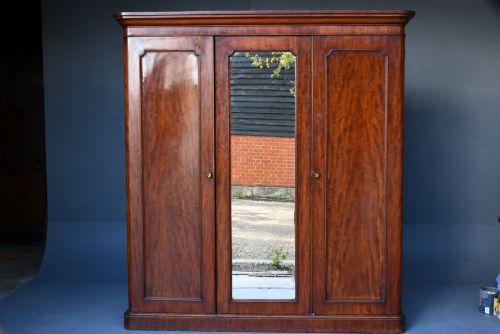
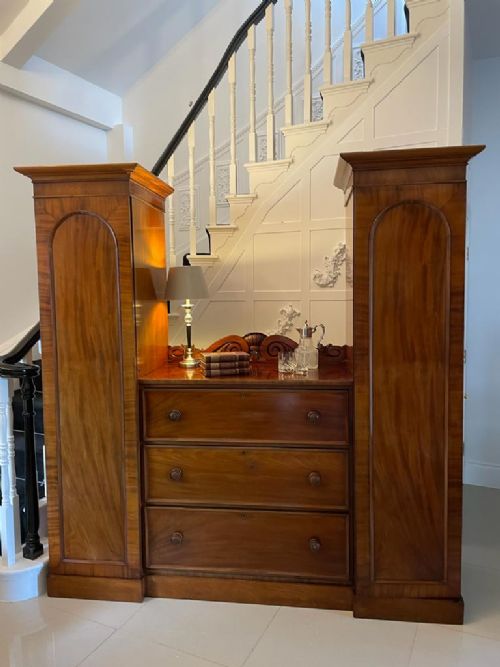
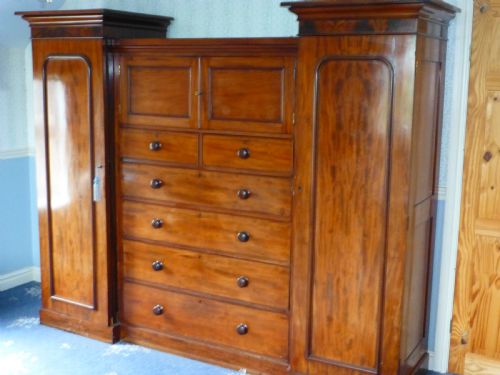
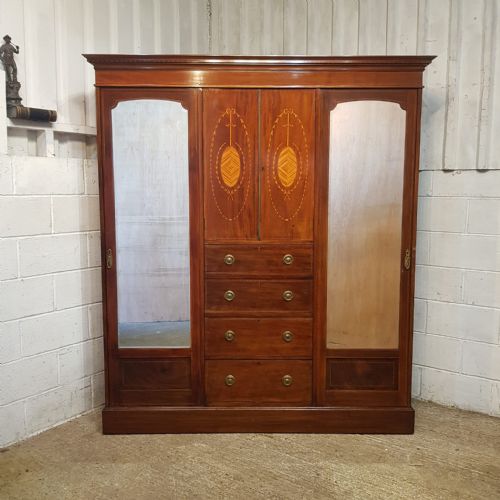
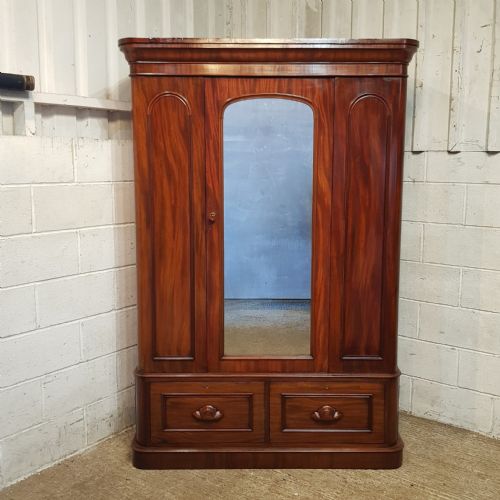
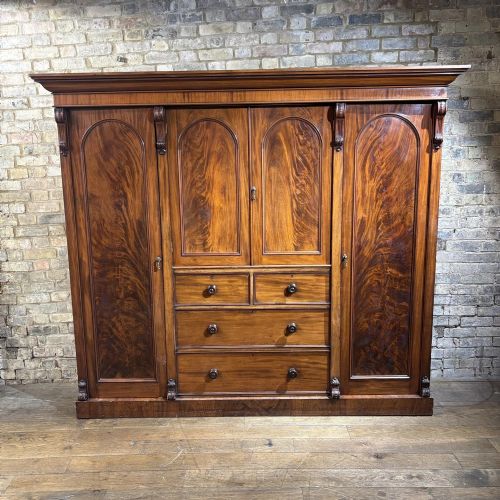
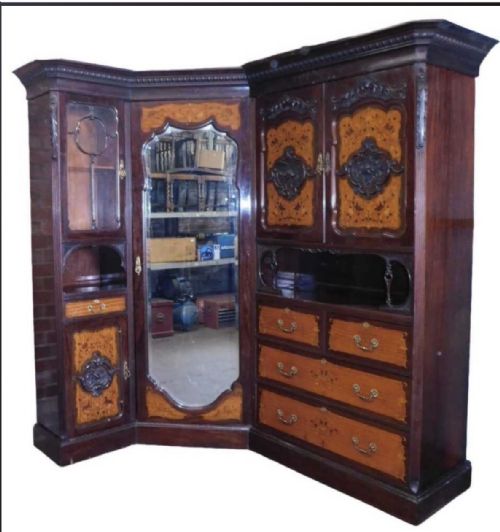


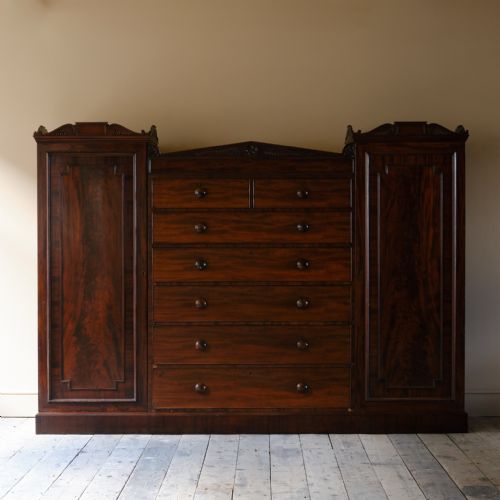


Large Mahogany Compactum
A large mahogany compactum is a substantial bedroom wardrobe designed to house multiple forms of attire in one fitted unit.
Large Mahogany Compactum
A large mahogany compactum offers combined storage, frequently uniting hanging space, linen drawers and shelving within a single multi-door carcass. These impressive pieces span the Georgian, William IV, Victorian and Edwardian periods, appearing in breakfront, inverted breakfront or straight configurations.
The version most commonly met on this page is the Victorian or Edwardian triple or four-door wardrobe, often featuring satinwood inlay, mirror doors or a central bank of linen drawers. Earlier Georgian and William IV examples rely on architectural proportions, solid timbers and fine figuration rather than added marquetry.
Materials and Construction
Cabinet makers built these large carcasses using solid mahogany and pine for internal linings, applying flame mahogany, curl mahogany or figured veneers to the principal exterior surfaces. The timber grain is carefully matched across the wide doors and drawer fronts to create symmetrical patterns.
Detailing involves contrasting satinwood inlay, boxwood stringing, brass hardware and occasionally carved mouldings. Larger breakfront examples were constructed in modular sections to facilitate delivery and assembly within period homes.
Common configurations include triple and four-door breakfront wardrobes, linen presses and inverted breakfront compactums.
Distinctions in Quality
Quality rests upon the selection of timber, the precision of the cabinet work and the ambition of the internal fittings. Superior examples utilise deeply figured flame or curl mahogany veneer with crisp satinwood marquetry, while simpler pieces rely on plain dark timber surfaces.
The internal arrangement also separates standard pieces from the finest work. Fully fitted linen presses with original sliding trays, modular hanging compartments and signed maker details represent the upper tier of production.
Gillows·Edwards & Roberts·Maples & Co
The Large Mahogany Compactum Glossary
- Compactum
- A large fitted wardrobe combining hanging space, drawers and shelving in a single unit. This multifunctional piece was designed to organise a complete gentleman's or lady's wardrobe.
- Breakfront
- A cabinet front where the central section projects forward from the flanking wings. This architectural arrangement creates depth and shadow across large wardrobe facades.
- Flame Mahogany
- A veneer cut from the fork of the mahogany tree where branches meet the trunk. This produces a distinctive flickering flame pattern highly prized by cabinet makers.
- Satinwood Inlay
- Contrasting pale exotic wood inserted into recesses cut into the mahogany surface. It forms geometric borders, ribbons or neo-classical motifs on Edwardian and Sheraton Revival pieces.
- Linen Press
- A tall cupboard featuring sliding trays or shelves in the upper section above a base of drawers. These pieces were originally utilised for storing household linen flat.
Large Mahogany Compactum: Frequently Asked Questions
How do I dismantle a large compactum?
These large wardrobes are typically constructed in modular sections, comprising a central carcass, two flanking wardrobes and a heavy cornice and plinth. Dismantling involves unscrewing internal fixings and lifting the components apart.
Professional removal is recommended due to the heavy solid mahogany timbers and large mirrored doors found on Victorian and Edwardian examples.
What is the difference between a wardrobe and a compactum?
A standard wardrobe provides primarily hanging space behind doors, occasionally with a single drawer beneath. A compactum is a more comprehensive storage unit that integrates hanging spaces, shelves and internal drawers.
These pieces were designed to hold a complete wardrobe of folded and hanging garments within one piece of bedroom furniture.
Will a compactum fit in a modern bedroom?
These pieces possess substantial proportions, often spanning several feet in width and height. Measuring ceiling clearance and access stairways is essential before acquisition.
Many breakfront examples arrive in modular sections, which assists with placement in rooms with standard ceiling heights.
How do I care for antique mahogany polish?
Mahogany surfaces benefit from application of traditional beeswax rather than modern silicone sprays. Regular dusting with a soft cloth preserves the deep patina developed over the centuries.
Keeping the timber away from direct heat sources and strong sunlight prevents the mahogany finish from drying or fading.