

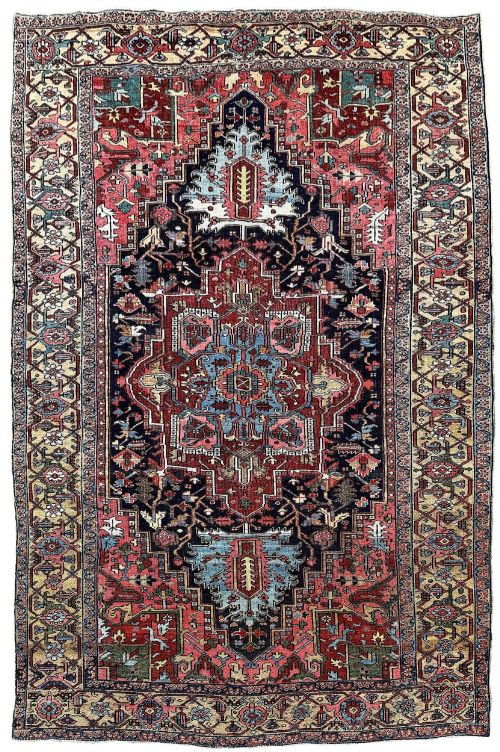
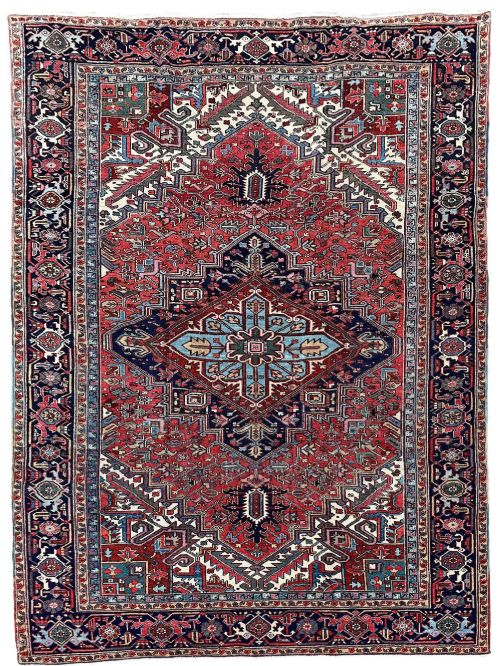

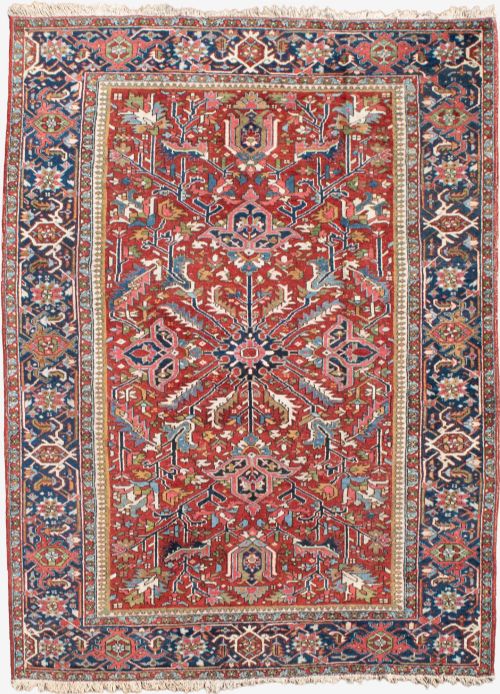
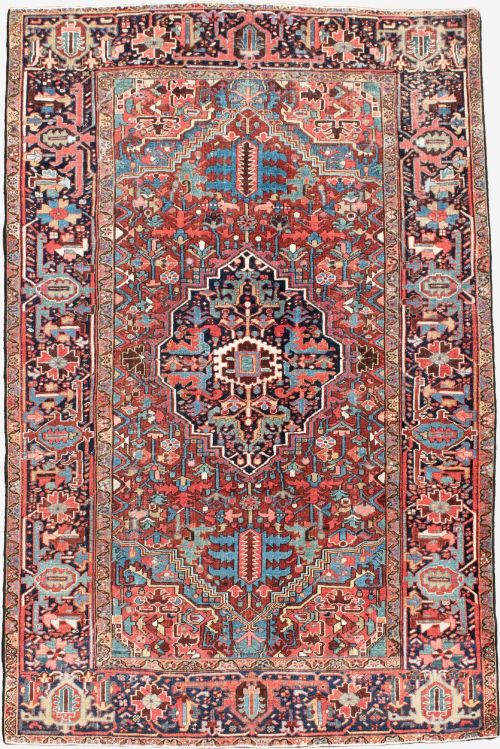
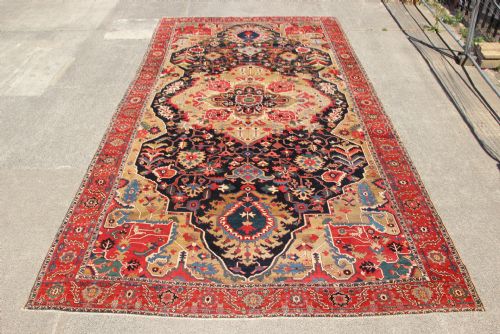

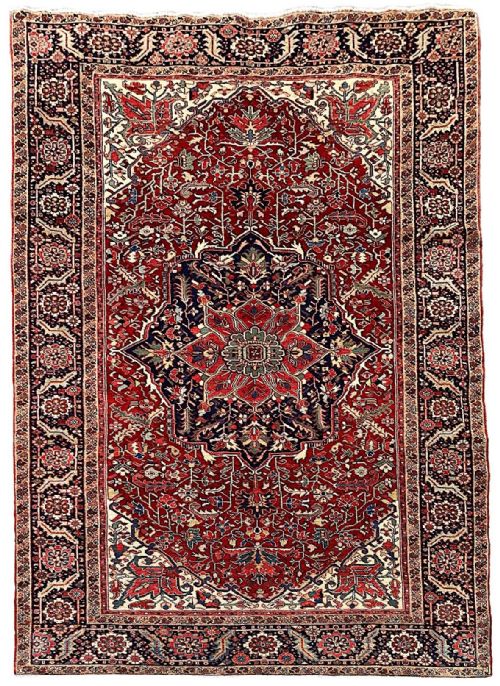


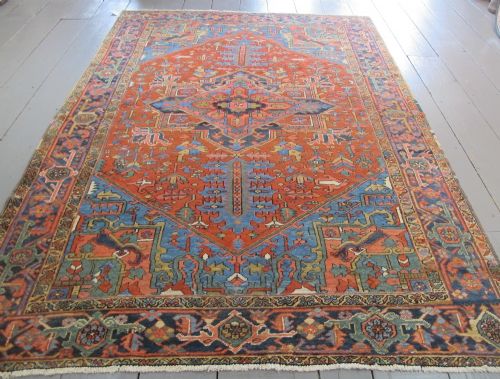
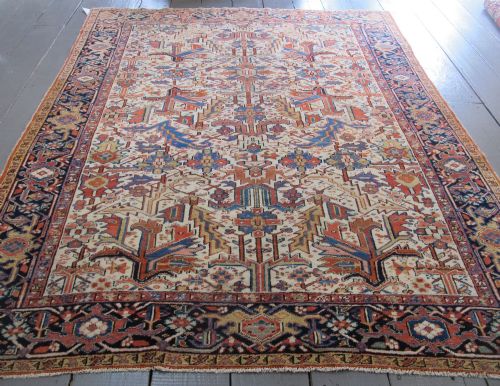

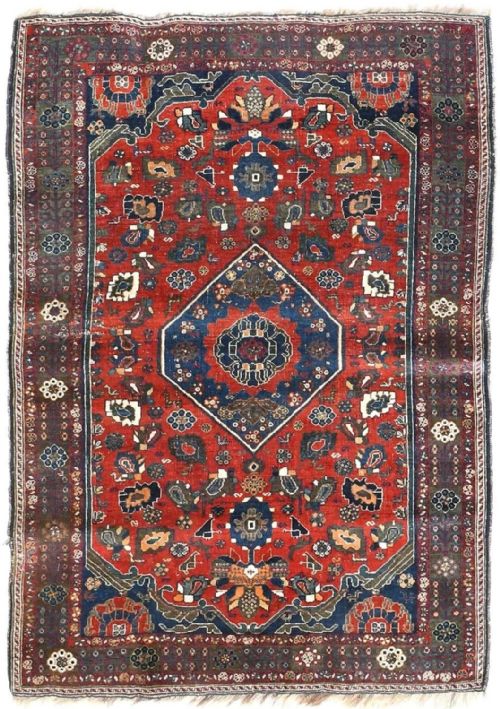


Large Heriz Medallion Carpet
A large heriz medallion carpet anchors a room with bold geometry and rich wool pile woven in North-West Persia.
Large Heriz Medallion Carpet
A large heriz medallion carpet is a heavy floor covering originating from North-West Persia, defined by a strong central motif and geometric field. These room-sized pieces range from late nineteenth-century examples to early twentieth-century weaves.
The versions most common on this page are traditional Persian carpets bearing distinctive geometric corner spandrels and large central medallions. They appear in room-scale formats alongside related regional pieces such as Serapi and Karaja carpets.
Woven for durability and visual impact, these carpets served as centrepieces in substantial reception rooms. Their sturdy construction allowed them to withstand heavy daily use while retaining their striking symmetrical designs.
How They Were Made
These carpets are constructed with hand-knotted wool pile foundation structures tied onto sturdy cotton warps and wefts. This combination creates a dense, resilient fabric capable of holding crisp geometric lines.
Weavers utilised natural wool dyes to produce deep terracotta, rich navy, and ivory tones that mellow gracefully over decades of light and wear. The knotting technique relies on the Turkish double knot, which locks the wool firmly into the grid.
The large scale of these floor coverings required substantial looms and cooperative labour within village workshops across the Heriz region. Artisans mapped out complex medallion layouts by eye and memory using traditional geometric cartons.
Large Heriz Medallion Carpet Retail Price Guide 2026
Typical asking prices for large heriz medallion carpet among the pieces listed under this phrase on Sellingantiques today, from the lower quarter to the upper quarter. They describe what is for sale here now, not the wider market.
Village weavers worked without graph paper, translating generations of geometric pattern memory directly onto upright looms.
What Varies in Quality
Quality rests in the precision of the geometric drawing and the clarity of the colour palette within the field. Superior examples display high knot density that sharpens the edges of the central medallion and floral motifs.
The balance of proportion between the central medallion, the main border, and the surrounding spandrels dictates visual harmony. Finer carpets maintain tight, consistent knotting across the entire cotton foundation without distortion in the format.
The Large Heriz Medallion Carpet Glossary
- Medallion
- The prominent central ornament of the carpet design. It anchors the symmetrical layout of the field.
- Spandrel
- The triangular corner motifs situated in the four angles of the main carpet border. They frame the central field and balance the medallion.
- Hand-Knotted
- A textile construction method where individual strands of wool are tied by hand onto a warp foundation. This process creates a durable pile texture.
- Warp
- The vertical threads stretched lengthwise on the loom that form the structural skeleton of the carpet. Cotton is typically used for this purpose.
- Serapi
- A sub-style of Heriz carpet from the nineteenth century known for more open designs and muted, luminous palettes. Collectors prize these older weaves for their relaxed geometric flow.
Large Heriz Medallion Carpet: Frequently Asked Questions
Where were these carpets made?
These carpets originate from the Heriz region and surrounding villages in North-West Persia. The area encompasses numerous small weaving communities sharing distinct geometric design traditions.
Production flourished in the nineteenth and early twentieth centuries, driven by skilled village weavers supplying both local and international markets.
How do I clean a wool carpet?
Gentle regular vacuuming without a beater bar removes surface grit from the wool pile. Professional specialist cleaning is necessary for deep washing.
Avoid chemical detergents and excessive moisture, which can damage the natural dyes and weaken the cotton foundation.
How do I distinguish Heriz from Serapi?
Serapi carpets represent an earlier, typically nineteenth-century style associated with the Heriz district. They generally feature more open compositions and softer, more nuanced colour proportions.
Standard Heriz carpets from the twentieth century often display denser geometric detailing and stronger, more saturated terracotta and navy tones.
Can these carpets handle heavy foot traffic?
The dense hand-knotted wool pile and sturdy cotton foundation make these carpets exceptionally durable for daily use. They were originally built to withstand generations of heavy household wear in busy reception rooms.
Placing a quality rug underlay beneath the carpet prevents slippage and reduces friction against hard flooring.