

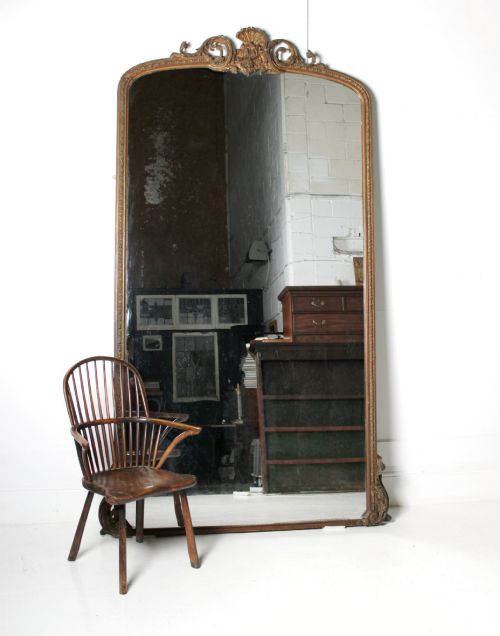
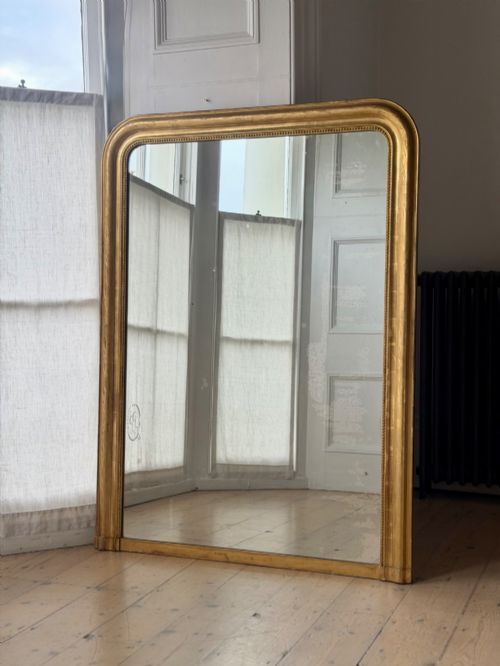
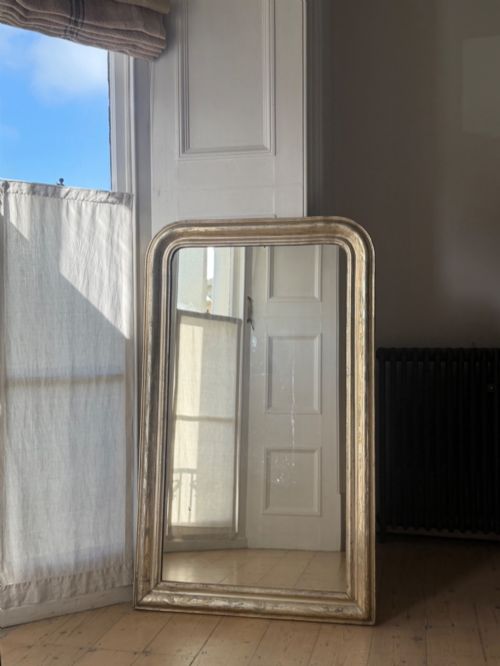


Large Gilded Leaning Mirror
A large gilded leaning mirror commands a room, bringing scale and golden light to any interior.
Large Gilded Leaning Mirror
When you search for a large gilded leaning mirror, you are looking at substantial wall and floor dressing mirrors designed to rest directly against a wall rather than hang securely from a single central hook. These impressive looking glasses appear across several distinct periods, most notably the nineteenth century, including French Louis Philippe, Victorian, and Edwardian examples.
The pieces on this page encompass various grand forms such as overmantle mirrors, tall narrow pier and console mirrors, and full-height floor dressing mirrors. Many originate from France and England, showcasing arched tops, rectangular proportions, and decorative frames that reflect light deep into a space.
How they were made
Makers built the foundational frames of these mirrors using sturdy timbers such as pine and wood, applying layers of gesso and plaster to build up intricate decorative motifs. Artisans then meticulously applied gold leaf or paint to the surface to achieve the characteristic rich golden finish.
Glazing often involved traditional mercury glass or period glass plates set securely within the carved frames. Carved wood details, Vitruvian scroll frames, and ornate neoclassical or rococo revival designs demonstrate the high level of craftsmanship involved in their creation.
Large Gilded Leaning Mirror Retail Price Guide 2026
Typical asking prices for large gilded leaning mirror among the pieces listed under this phrase on Sellingantiques today, from the lower quarter to the upper quarter. They describe what is for sale here now, not the wider market.
What varies in quality
The distinction between standard and superior examples lies in the depth and crispness of the carved wood and gesso ornamentation. Finer mirrors display sharply defined scrolls, smooth gilding, and substantial wooden construction that supports the heavy glass plate without sagging.
Original glass plates and untouched giltwood or silver and gilt surfaces retain more historical character than later replacements. The integrity of the original frame structure and the quality of the mercury glass significantly influence the overall desirability of each piece.
The Large Gilded Leaning Mirror Glossary
- Giltwood
- Wood that has been coated with gold leaf or a gold-coloured finish. This traditional surface treatment provides the bright metallic sheen characteristic of period frames.
- Gesso
- A plaster-like mixture applied to wood frames before gilding. Artisans carved and moulded this material to create intricate decorative details and relief patterns.
- Overmantle mirror
- A large mirror specifically designed to hang or lean on the wall directly above a fireplace mantel. These pieces often feature wide proportions to match the width of the fireplace below.
- Mercury glass
- An early type of silvered glass produced by pouring a mercury amalgam between double-walled blown glass or onto flat glass plates. It produces a distinctive mottled, atmospheric reflection.
- Vitruvian scroll
- A classical repeating scroll pattern resembling a wave, frequently carved into the frames of neoclassical and nineteenth-century mirrors.
Large Gilded Leaning Mirror: Frequently Asked Questions
How do I secure a leaning mirror?
Large leaning mirrors are heavy and require proper anchoring to prevent tipping forward. Most sit firmly on the floor while being secured near the top to the wall behind using discreet brackets.
Ensuring the weight rests securely on the floorboards rather than entirely on the fixings protects both the wall and the frame.
Where should I place a floor mirror?
These tall mirrors function best in living rooms, bedrooms, or hallways where they can reflect natural light from windows. Placing them opposite a light source maximises illumination and creates a sense of expanded space.
Their substantial height makes them particularly effective at the end of a long corridor or beside a fireplace.
What is the difference between Louis Philippe and Victorian styles?
Louis Philippe mirrors typically feature simpler, cleaner architectural lines with rounded upper corners and subtle neoclassical motifs. Victorian and French Rococo Revival examples tend to display heavier, more ornate carving, elaborate crests, and deep decorative mouldings.
Both styles utilise similar materials like gesso, wood, and gold leaf but achieve entirely distinct visual weights.