


Large Satsuma Vase
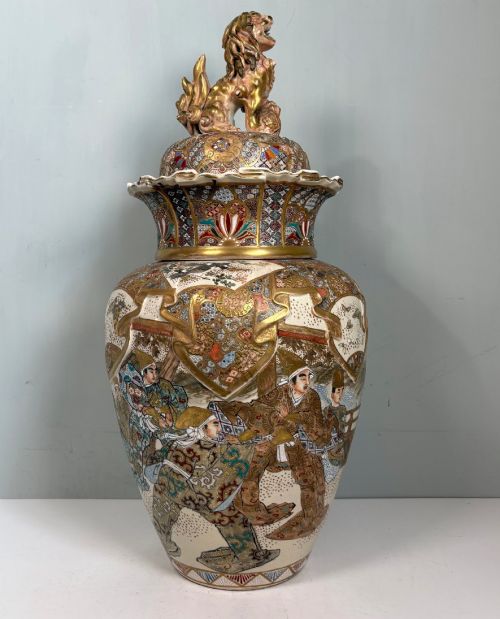
A large antique satsuma vase brings complex hand-painted earthenware into a room through rich enamel and gold leaf.
Large Satsuma Vase
A large antique satsuma vase is a substantial earthenware vessel decorated with intricate enamel work and gold gilt, originating primarily from Japan during the nineteenth and early twentieth centuries. These pieces appear as tall decorative urns, floor vases, table lamps, and lidded jars designed to command attention in a formal interior.
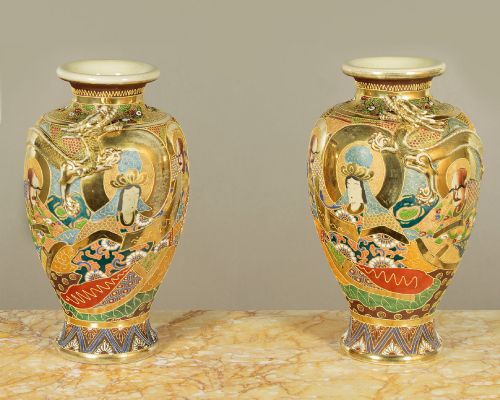
Most examples found in this selection date from the Meiji period through the early decades of the twentieth century, encompassing both export wares and monumental pieces. Buyers frequently encounter symmetrical pairs as well as singular monumental specimens, some reaching significant heights of over eighty centimetres.
The decorative schemes on a large antique satsuma vase often depict traditional narrative scenes, including samurai figures, arhats, and dragons set against elaborate geometric or floral borders. Forms range from standard baluster shapes to specialised silhouettes such as garlic head tops and hexagonal profiles.
The spectrum of quality
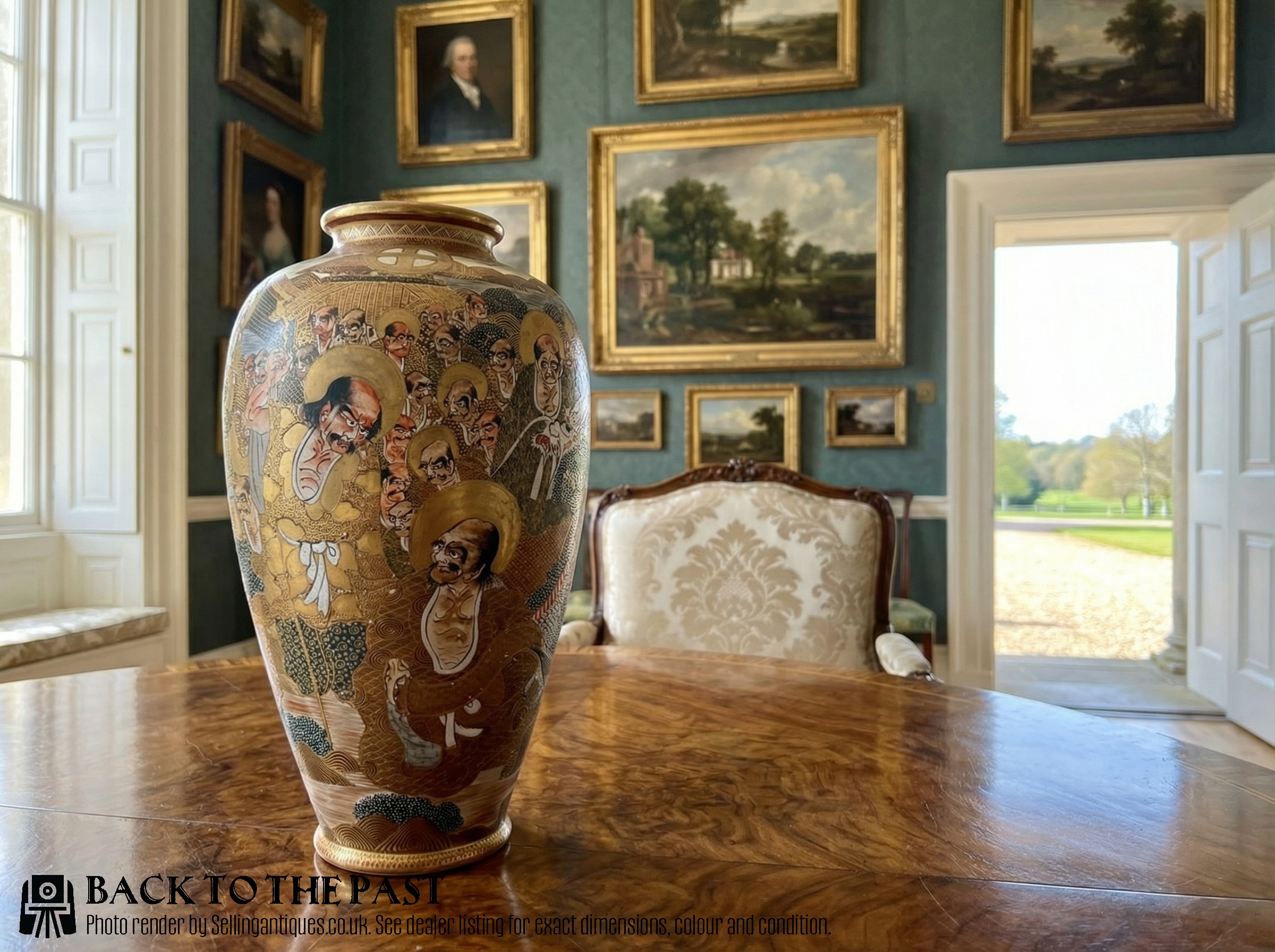
Quality in a large antique satsuma vase rests on the precision and density of the brushwork, particularly the fineness of the figural painting and the controlled application of gold leaf. Master workshops achieved remarkable depth and clarity in dense compositions involving hundreds of figures.
The baseline body formation and the evenness of the crackle glaze also dictate distinction, separating mass export production from ambitious studio pieces created by renowned artists and signed potteries.
Certain monumental vessels manage to crowd a thousand individual arhats and a dragon onto a single ceramic surface.
Hotoda·Seiko-en Chokei·Kinkozan·Hattori
The Large Satsuma Vase Glossary
- Satsuma
- Earthenware pottery originating from Satsuma Province in Japan, distinguished by a creamy, finely crackled glaze that accepts detailed enamel and gilt painting.
- Meiji Period
- The era of Japanese history lasting from 1868 to 1912, noted for the flourishing of intricate decorative arts destined for international export.
- Gilt
- A thin layer of gold or gold leaf applied to the surface of the ceramic to accent patterns, borders, and figural robes.
- Garlic Head
- A bulbous vase shape featuring a constriction below a rounded upper lip, resembling a bulb of garlic.
- Arhat
- Enlightened Buddhist sages frequently depicted in elaborate groupings on nineteenth-century Japanese ceramics.
Large Satsuma Vase: Frequently Asked Questions
How do I date a satsuma vase?
Dating relies on stylistic markers, studio signatures, and the characteristics of the crackle glaze across different manufacturing periods.
Nineteenth-century examples from the Meiji period often feature denser hand-painted narratives and heavier use of gold leaf compared to later twentieth-century iterations.
Are these vases waterproof?
Most antique satsuma vessels utilise porous earthenware with a crackle glaze that is intended for dry decoration rather than holding water.
Placing fresh water inside risks staining the clay body through the micro-fissures in the glaze over time.
How should I display a floor vase?
Large floor specimens require stable placement away from high-traffic household areas to prevent accidental impacts against their substantial ceramic bodies.
Positioning them on firm flooring allows the intricate enamel and gilt details to catch natural light effectively.
What do signature marks mean?
Signatures and seals on the base usually indicate the producing pottery, the artist, or the workshop responsible for the decoration.
Renowned names like Kinkozan or specialised studio signatures often denote higher standards of painting and craftsmanship.