



Lacquer Sewing Box
A lacquer sewing box brings Regency and Victorian elegance to any room, offering fitted compartments designed to hold needles, threads and small treasures.
Lacquer Sewing Box
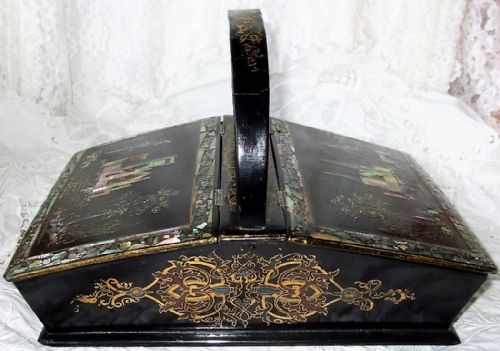
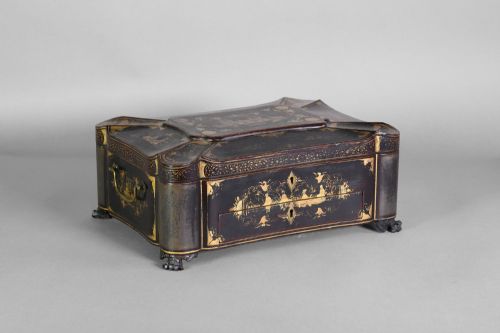
A lacquer sewing box is an intricate container made for needlework and correspondence, frequently appearing as a portable tabletop box or a standing sewing table. These pieces emerge from the nineteenth century, spanning the Regency and Victorian eras alongside Chinese Export productions.
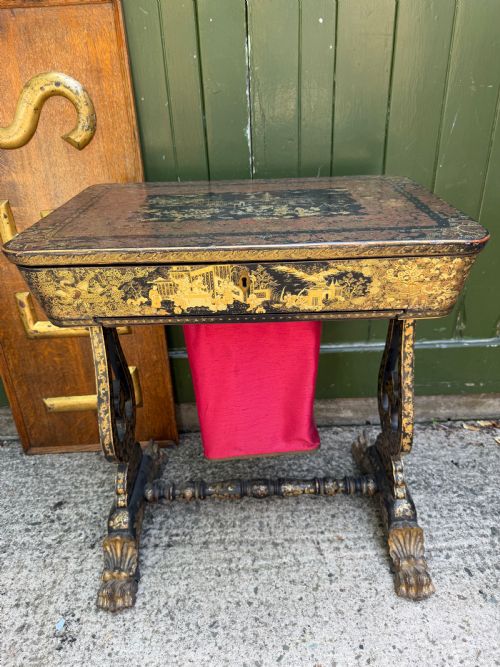
Buyers frequently encounter papier-mâché needlework caskets and lacquered wood workboxes finished with gilt decoration. The selection on this page also includes larger sewing tables featuring tiered storage and specialised compartments.
Origins stretch from English workshops to Chinese Export commissions, each displaying distinct regional artistry. The forms range from simple black lacquered jewellery boxes to elaborate Japanned workboxes.
Materials and construction
These pieces rely on lacquered wood, papier-mâché and tiger bamboo as structural foundations, finished with layered lacquer surfaces. Artisans applied smooth black or yellow japanned finishes to achieve a durable and glossy exterior.
Decoration involved delicate gilt painting and inlaid mother-of-pearl to create detailed Chinoiserie scenes and botanical motifs. Silk interiors and brass fittings completed the interior organisation, providing secure storage for sewing implements.
The listings here span the Regency and Victorian periods, utilising materials such as papier-mâché, mother-of-pearl, tiger bamboo and lacquered wood.
Judging quality in a lacquer sewing box
Quality rests upon the precision of the lacquer finish and the intricacy of the gilded decoration. Finer examples display crisp, hand-painted Chinoiserie details rather than simple stencilling, maintaining clear lines and deep lustre.
The sophistication of the internal compartment layout distinguishes finer workboxes from standard containers. Intact silk linings, well-fitted trays and robust brass hinges elevate a piece beyond basic utility.
The Lacquer Sewing Box Glossary
- Japanning
- A European imitation of East Asian lacquerwork, created by applying layers of varnish and heat-curing the surface. This technique produced glossy black or yellow finishes popular on nineteenth-century boxes.
- Papier-mache
- A composite material made from paper pulp mixed with glue and oil, pressed into moulds and dried. It provided a strong, smooth base for painting and inlay work on Victorian caskets.
- Chinoiserie
- A European artistic style reflecting Chinese aesthetic influences, featuring whimsical landscapes and figures. It appears widely in the gilt decoration of export workboxes.
- Workbox
- A portable container designed to hold sewing tools, threads and personal trinkets. These boxes often feature lift-out trays and compartmentalized interiors.
Lacquer Sewing Box: Frequently Asked Questions
What fits inside a lacquer sewing box?
These boxes contain fitted trays and compartments originally intended for spools, needles, thimbles and small sewing accessories. Many pieces also double as storage for letters and jewellery.
Today, they serve well on dressing tables or desks to keep small personal items organised out of sight.
How do I care for nineteenth-century lacquer?
Protect the surface by keeping the box away from direct sunlight and extreme humidity, which can damage the delicate finish. Dust gently with a dry, soft microfibre cloth without using chemical polishes.
Maintaining a stable indoor climate prevents the lacquer and wood from expanding or contracting.
Are these boxes English or Chinese Export?
The selection includes both English-made papier-mâché pieces and Chinese Export items commissioned for the Western market. Chinese Export pieces often feature intricate gilt landscapes and specific regional craftsmanship.
English makers adapted these styles during the Regency and Victorian periods using local woods and japanning techniques.
What is the difference between a workbox and a sewing table?
A workbox is a portable tabletop container designed to be carried by hand or moved easily between rooms. A sewing table stands on its own legs, sometimes featuring multiple tiers or attached fabric bags for larger projects.
Both forms share the same internal compartmentalization tailored for needlework.