



Kingwood Marble Top Tables
Kingwood marble top tables bring together rich timber veneers and cool stone surfaces, offering French style for practical rooms.
Kingwood Marble Top Tables
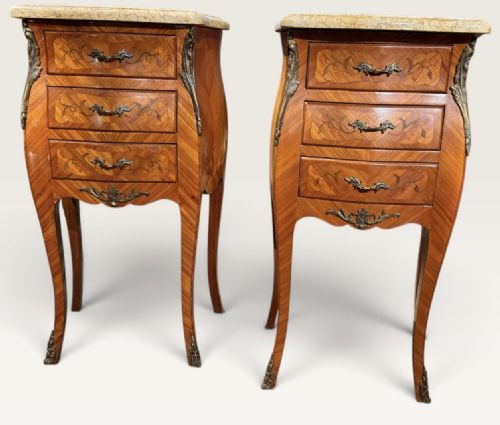
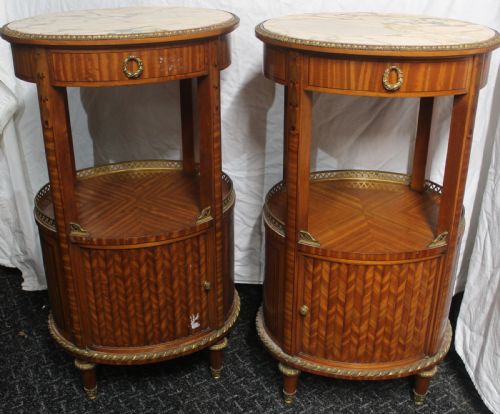
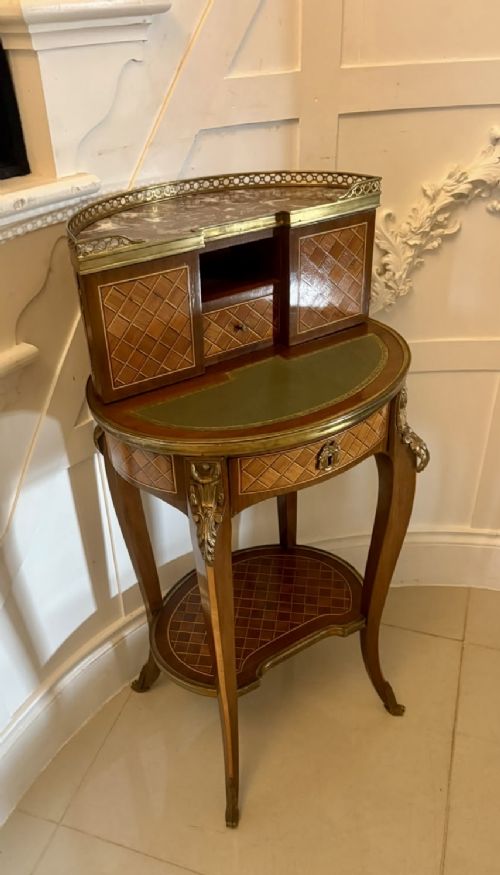
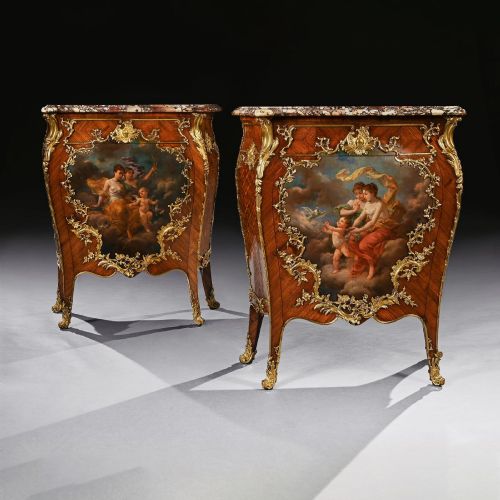
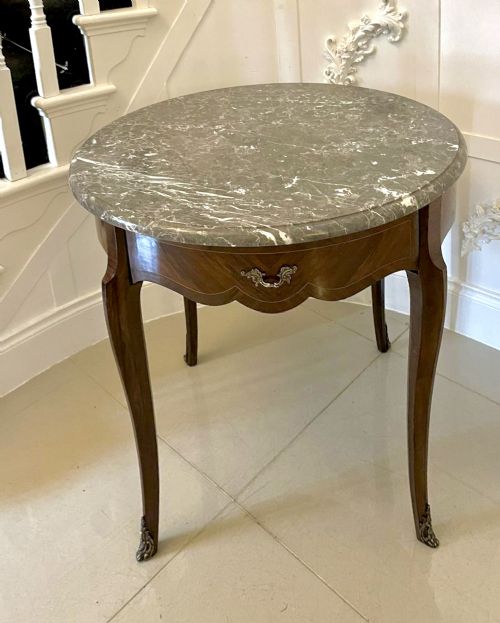
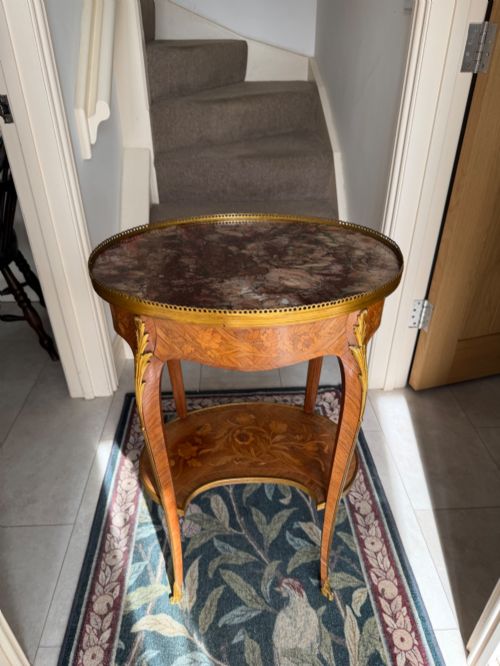
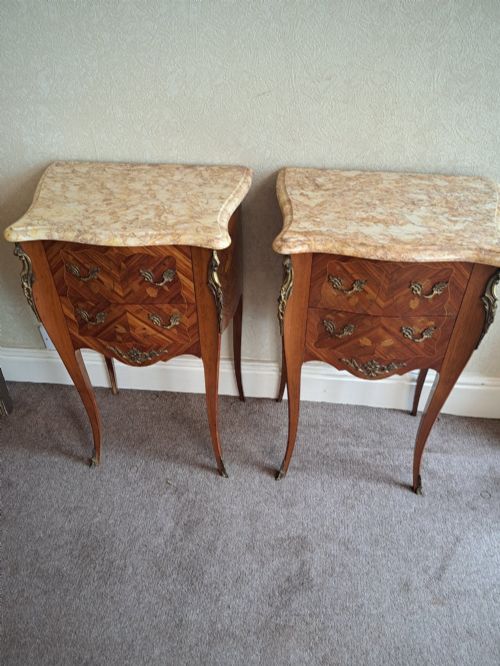
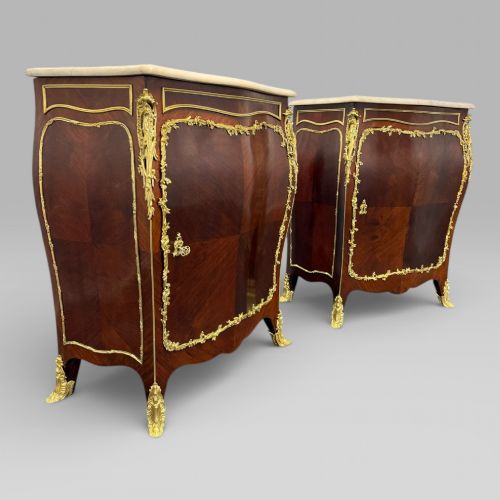
When looking for kingwood marble top tables, you encounter an array of French-inspired forms spanning the nineteenth and twentieth centuries. These pieces appear primarily as bedside cabinets, lamp tables, commodes, and writing desks reflecting Louis XV and Louis XVI styles.
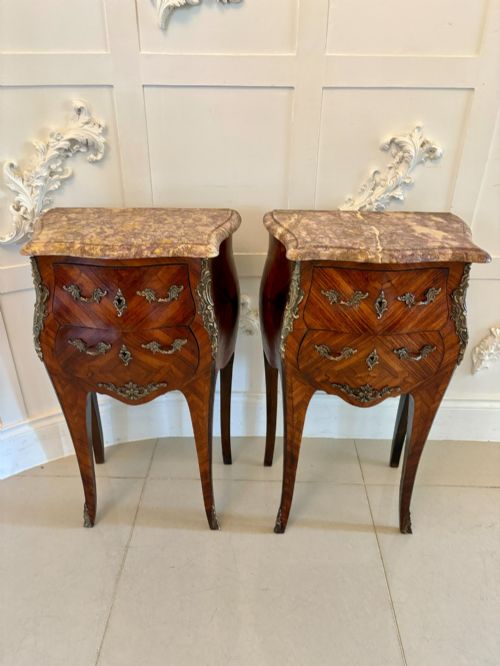
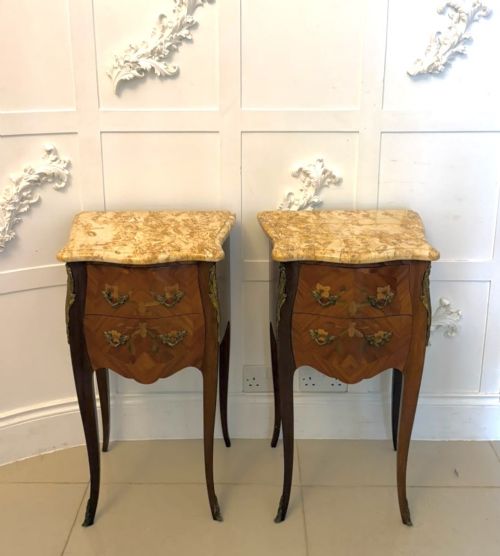
Bedside cabinets and side tables form the largest portion of the selection currently available. They range from serpentine bombe shapes to neat freestanding designs featuring inlaid parquetry and marquetry patterns.
The origins lean heavily towards French cabinet-making traditions, though pieces also demonstrate Italian craftsmanship and Victorian interpretations of continental designs. Alongside smaller lamp tables, larger centre tables and writing desks complete the range.
Materials and Construction
Makers constructed these pieces using dense kingwood veneer applied over secondary timbers, often incorporating marquetry and parquetry geometric patterns. Satinwood and walnut also feature alongside the principal timber to create contrasting details.
Mounts of gilt bronze and ormolu adorn corners, aprons, and legs, providing metallic highlights to the dark wood. Fitted marble slabs sit atop the carcases, supplying durable and veined stone surfaces for daily use.
Vernis Martin finishes and leather inserts appear on specialised items like writing desks. Joinery relies on traditional carcase construction designed to support heavy stone tops while maintaining slender proportions.
Kingwood Marble Top Tables Retail Price Guide 2026
Typical asking prices for kingwood marble top tables among the pieces listed under this phrase on Sellingantiques today, from the lower quarter to the upper quarter. They describe what is for sale here now, not the wider market.
The listings span the Victorian era through the 1930s, showing a strong preference for French Louis XV revival forms.
Judging Quality
The refinement of the ormolu mounts distinguishes finer examples from simpler production pieces. Crisp chasing and heavy gilding indicate superior workshop execution, whereas flat or hollow castings point to standard commercial output.
Precision in the veneer work dictates the visual appeal of the surface. Closely matched grain patterns and intricate parquetry alignment demonstrate the skill of the cabinet-maker.
The thickness and natural figure of the marble top influence the overall standard. Well-selected stone with active veining and precise edge profiling completes a high-grade piece.
E. Kahn·F. Linke
The Kingwood Marble Top Tables Glossary
- Kingwood
- A dense, durable Brazilian timber featuring dark violet-brown tones with lighter golden stripes. It became a favourite for luxury French furniture veneers during the eighteenth and nineteenth centuries.
- Ormolu
- Gilt bronze mounts applied to furniture edges and feet. The technique involves coating cast bronze with a mercury and gold amalgam before heating.
- Marquetry
- The art of applying small pieces of veneer to a structure to form decorative pictures or patterns. Craftsmen use various tinted woods to achieve naturalistic floral designs.
- Bombe
- A swollen or bulging contour characteristic of Louis XV case furniture. This curved profile requires expert veneer shaping over complex timber carcases.
- Gueridon
- A small French table supported by one or more columns or figures. These pieces often feature circular marble tops.
Kingwood Marble Top Tables: Frequently Asked Questions
How do I clean the marble top?
Use a damp cloth with mild soap for routine cleaning, avoiding acidic substances like lemon or vinegar that etch stone.
Dry the surface thoroughly with a soft cloth to prevent water spots and maintain the polish.
Are these tables sturdy enough for daily use?
These pieces were built for functional domestic settings such as bedrooms and drawing rooms.
The heavy marble tops add stability, though you should lift rather than drag the furniture when rearranging a room.
What is the difference between Louis XV and Louis XVI styles?
Louis XV furniture relies on asymmetrical curves, serpentine lines, and exuberant rococo mounts.
Louis XVI design introduces straight lines, neoclassical symmetry, and restrained geometric parquetry.
How can I tell if the kingwood veneer is old?
Examine the colour depth and the way the grain patinates under natural light over decades.
Older pieces show subtle shrinkage cracks in the ground timber beneath the thin decorative layers.