

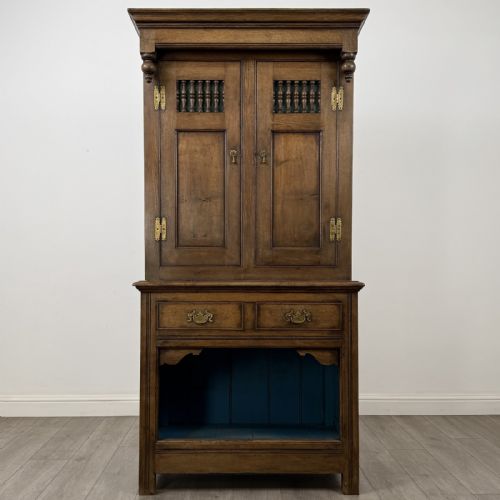


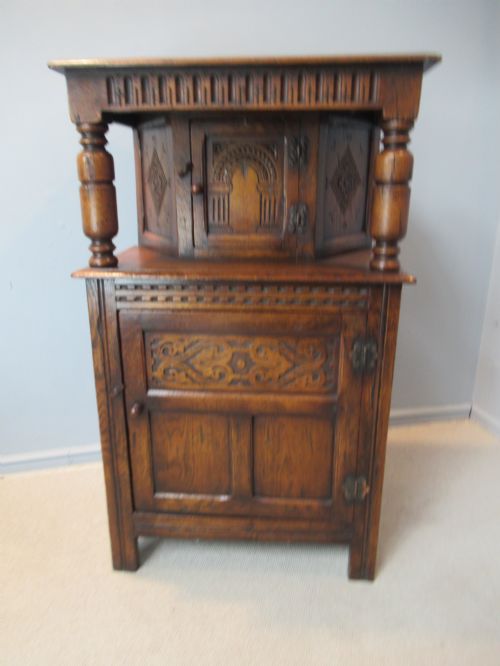


Jacobean Style Court Cupboard
A jacobean style court cupboard brings heavy timber architecture into a modern room, offering enclosed display space rooted in centuries of cabinet-making.
Jacobean Style Court Cupboard
A jacobean style court cupboard is a substantial storage piece primarily designed with enclosed upper and lower compartments. You will frequently encounter Edwardian and 1920s revivals alongside authentic 17th Century originals on this page.
The form appears under various overlapping descriptions in the listings, including sideboards, dressers, and livery cabinets. Most examples follow the traditional proportions of cupboards on stands or multi-tiered storage units.
Originating as status symbols for storing food and plate, these pieces serve today as focal points in dining rooms and halls. The prevailing examples rely heavily on oak construction and traditional panelled doors.
Materials and Construction
Makers built these pieces predominantly from solid oak, utilising its natural grain and durability to support heavy architectural carving. Iron and brass hardware such as hinges and handles secure the heavy doors and drawers.
Surface decoration relies on deep chiselling, featuring geometric patterns and carved motifs across the panels and friezes. Certain pieces incorporate details like mother-of-pearl inlay to accent the timber surfaces.
Jacobean Style Court Cupboard Retail Price Guide 2026
Typical asking prices for jacobean style court cupboard among the pieces listed under this phrase on Sellingantiques today, from the lower quarter to the upper quarter. They describe what is for sale here now, not the wider market.
One piece comes with the charmingly specific alternative description of cottage livery cupboard.
Assessing Craftsmanship and Age
The distinction between a standard revival piece and a period antique lies in the depth of the timber work and the integrity of the joinery. Earlier pieces display hand-cut joints and uneven patination accumulated over centuries.
Proportion and scale also separate ordinary sideboards from finer court cupboards, particularly where carvers applied balanced geometric ornament rather than repetitive machine cutting.
The Jacobean Style Court Cupboard Glossary
- Court cupboard
- A traditional English storage cabinet featuring an upper recessed section supported by pillars above a wider base. These units were historically used for displaying plate and storing provisions.
- Linenfold
- A style of wood carving that imitates folded parchment or fabric panels. This technique appears frequently on Tudor and Jacobean revival doors.
- Livery cupboard
- A small ventilated cabinet used for storing food rations or candles before nightfall. The term often overlaps with court cupboard in older listings.
- Jacobean Revival
- A 19th and 20th century design movement that emulates the heavy, dark oak furniture of the early 17th century. Makers utilised this style to supply demand for historicist domestic interiors.
Jacobean Style Court Cupboard: Frequently Asked Questions
What is a court cupboard?
A court cupboard is a multi-tiered wooden cabinet with a recessed upper section supported by columns. They were traditionally used to store and display household valuables.
Today, they function as substantial sideboards or display cabinets in dining rooms and living spaces.
How old are these cupboards?
The listings include pieces spanning from pre-16th century origins through to 1930s revival interpretations. The majority originate from the Edwardian era and the early 20th century.
True 17th century pieces sit alongside Victorian and Edwardian reproductions built in the same architectural style.
Are these pieces made of solid wood?
The listings specify oak as the primary material used for both the structural frames and the decorative panels. Iron and brass provide the functional hardware.
This heavy timber construction accounts for the enduring weight and stability of these cabinets.
How do I style a court cupboard?
These cabinets work well as primary storage items in dining rooms or entrance halls where their carved details can be appreciated. Their dark timber tones pair effectively with neutral walls.
Keep surrounding furniture simple to let the architectural carvings remain the focal point of the room.