


Jacobean Revival Plant Table
A jacobean revival plant table brings substantial carved timber and sturdy presence to a corner without demanding floor space.
Jacobean Revival Plant Table
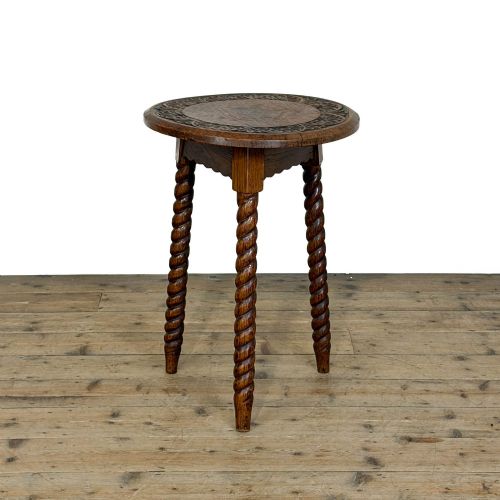
When you search for a jacobean revival plant table, you encounter compact occasional furniture designed to elevate greenery or display decorative objects within a room. The selections available span from the late nineteenth century through the interwar decades, showing the enduring appeal of seventeenth-century motifs adapted for domestic interiors. These sturdy items typically manifest as small side tables, plant stands, or occasional tables positioned beside seating or in hallways.
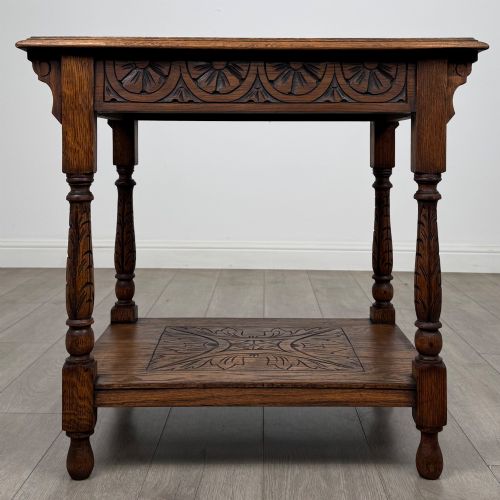
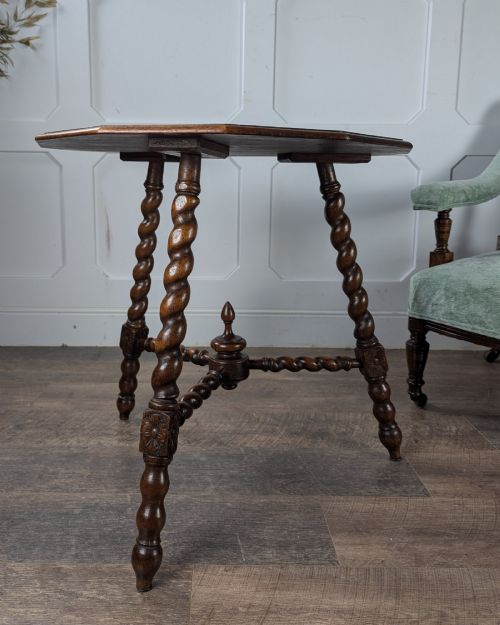
The prevailing examples on this page date predominantly from the Edwardian period, the 1910s, and the 1920s, alongside late Victorian and 1930s variations. You find forms ranging from round tripod cricket tables and oval tops to octagonal surfaces and two-tier hall tables. Oak is the defining medium across these pieces, styled with the dark tones and heavy detailing associated with English country house aesthetics.
How they were made
The construction relies entirely on solid oak and hardwood, selected for its density and capacity to hold deep sculptural carving. Makers utilised traditional joinery methods to build frames that could bear the weight of heavy ceramic planters and lamps without losing stability.
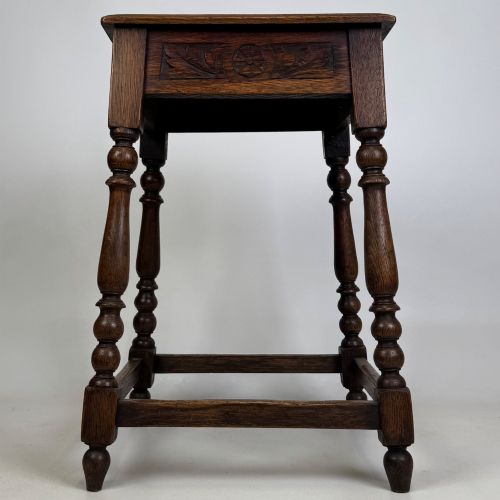
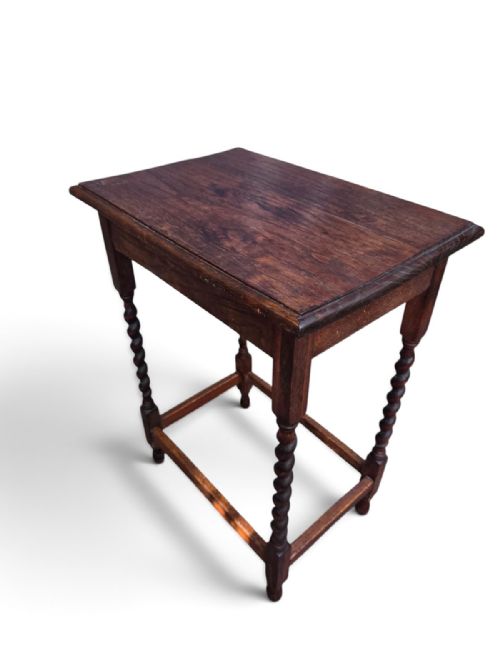
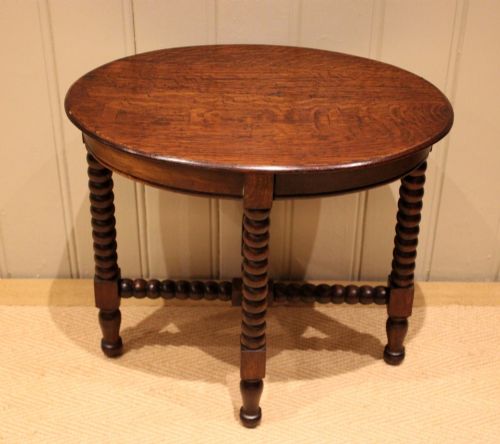
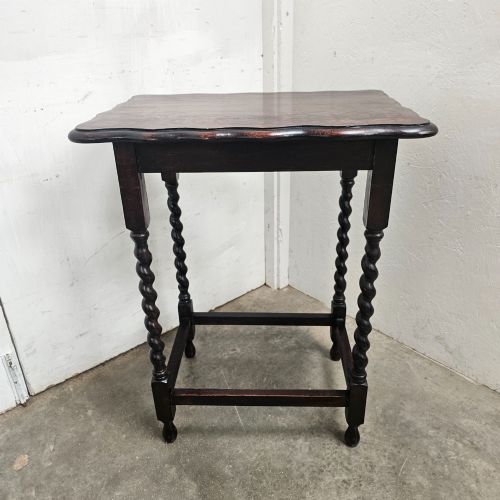
Turned woodwork defines the structural supports of these pieces, showcasing characteristic barley twist and bobbin turned legs. Surfaces frequently feature decorative carving, scalloped pie crust edges, and distinct tripod or four-legged bases designed for compact footprints.
Many a sturdy oak table has spent a century quietly supporting heavy ferns without ever managing to learn how to sit straight on an uneven Victorian floorboards.
What varies in quality
The distinction between standard domestic items and finer examples lies in the crispness and depth of the carved detailing across the timber. Superior pieces exhibit well-proportioned turned legs, such as tight barley twist or bobbin work, executed with precise symmetry and balance.
Material selection and finish integrity also separate the grades, with better pieces showing carefully selected oak grain and rich patination developed over decades of use. The solidity of the joints and the crisp execution of edges like pie crust tops indicate the original maker's skill.
The Jacobean Revival Plant Table Glossary
- Barley Twist
- A type of turning that resembles a helix or coiled rope, commonly found on the legs of tables and stands from this era. This technique required precise lathe work to achieve an even, continuous spiral.
- Bobbin Turned
- Furniture legs formed by a series of rounded, spherical wooden shapes stacked vertically, resembling a string of beads. It creates a distinctive, tactile profile popular in revivalist furniture.
- Pie Crust Table
- A small table featuring a raised, carved, and scalloped edge along the perimeter of the circular top. This ornamental rim prevents items from sliding off the surface.
- Cricket Table
- A small, lightweight three-legged table traditionally used in domestic settings. The tripod base ensures stability on uneven floors.
- Jacobean Revival
- An architectural and furniture style popular in the nineteenth and early twentieth centuries that imitates the heavy, carved oak furniture of the early seventeenth century. It emphasises dark finishes, strapwork, and geometric mouldings.
Jacobean Revival Plant Table: Frequently Asked Questions
What is a jacobean revival plant table used for?
These tables provide a sturdy raised surface specifically intended for displaying potted plants, ceramic jardinieres, or decorative lamps in domestic rooms. Their compact proportions allow them to fit into corners or narrow hallways where larger furniture cannot go.
Beyond holding plants, they serve practical functions as small side tables next to armchairs or as occasional surfaces for holding small items in an entrance hall.
How do I date a jacobean revival table?
Dating relies on observing the combination of materials, construction methods, and stylistic cues present in the turnings and carvings. Pieces from the Victorian era often feature heavier, deeper carving and darker finishes, whereas 1920s and 1930s examples can show simpler lines alongside standard barley twist legs.
Examining the underside of the top and the joints helps confirm the period, as machine-sawn timber and modern fixings indicate later twentieth-century production.
Are these tables made of solid oak?
The pieces recorded in these listings are constructed from solid oak and hardwood. This heavy timber provides the structural integrity necessary for supporting weighted tops and turned legs without warping.
The use of solid wood also allows for the deep chiselling and sculptural detailing characteristic of the revival style.
How do I style a plant table in a modern interior?
A dark oak stand works effectively as a contrasting textural element in a neutral or contemporary room. Pairing the dark timber with trailing green foliage or simple ceramics softens the heavy historical appearance.
Positioning the table in an unused corner or beside a window maximises both its display function and its architectural presence.