



Italian Marble Mosaic
These Italian marble mosaic pieces bring nineteenth-century workshops directly into a room, offering finely fitted stone pictures and tables crafted for travellers.
Italian Marble Mosaic
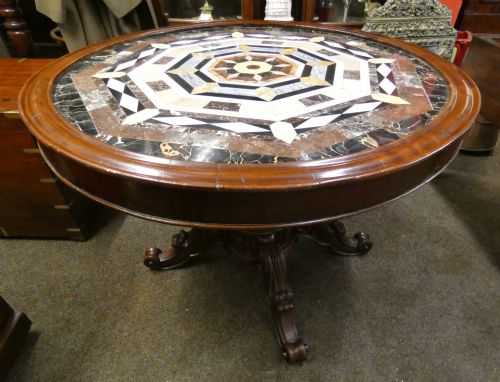
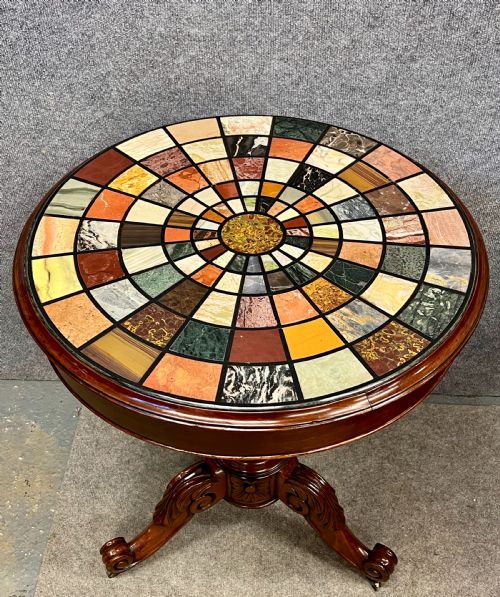
When someone searches for italian marble mosaic, they encounter nineteenth-century objects created across Italy, often as souvenirs for Grand Tour travellers. These pieces take forms such as occasional tables, centre tables, wall art, paperweights, boxes, caskets, and pendants.
The objects most frequently met on this page date from the Victorian era, spanning the decades between eighteen fifty and eighteen ninety. They combine architectural stone forms with intricate inlaid pictures and decorative panels.
How they were made
Maker workshops utilised marble, black marble, and slate as foundations for intricate pictorial work, securing tiny glass tesserae or shaped hardstones directly into the stone base. Specimen marbles and semi-precious stones were meticulously cut to form floral, geometric, or figurative compositions.
Support elements such as giltwood, brass, and ebonised wood frame or mount the stone panels, combining structural rigidity with decorative contrast. The technique relies on precise hand-fitting of disparate stone fragments to achieve seamless pictorial surfaces.
Italian Marble Mosaic Retail Price Guide 2026
Typical asking prices for italian marble mosaic among the pieces listed under this phrase on Sellingantiques today, from the lower quarter to the upper quarter. They describe what is for sale here now, not the wider market.
The listings show works from the Victorian period, specifically spanning the decades between eighteen fifty and eighteen ninety.
What varies in quality
The precision of the stone-to-stone joints dictates the visual success of the piece, separating tight, imperceptible joins from those with visible gaps. Workshops that employed master lapidaries achieved pictorial depth and naturalism that lesser hands missed.
The selection of raw materials also alters the character of the work, with high-grade semi-precious stones and finely graded specimen marbles offering richer colouration than standard varieties. The quality of the secondary support, whether ebonised wood or gilt bronze, matches the ambition of the stone top.
The Italian Marble Mosaic Glossary
- Pietra dura
- An Italian term for hardstone inlay using cut and fitted polished coloured stones to create pictures. This technique defines many of the tables and plaques seen here.
- Micro-mosaic
- A method using tiny pieces of coloured glass tesserae assembled into detailed pictorial scenes. These panels typically feature in smaller items like paperweights and pendants.
- Grand Tour
- A cultural journey undertaken by nineteenth-century Europeans visiting Italy, resulting in the acquisition of local souvenirs. These objects formed the backbone of the trade in specimen marble works.
- Specimen marble
- Marbles gathered from various classical and geological quarries and displayed together in geometric table tops or panels. Each sample demonstrates a distinct colour and geological origin.
Italian Marble Mosaic: Frequently Asked Questions
What is an Italian marble mosaic?
These items are nineteenth-century decorative works featuring inlaid hardstones or glass tesserae set into marble bases. They range from small tabletop paperweights to large centre tables.
Craftsmen in Italian workshops produced them during the Victorian period, frequently catering to travellers on the Grand Tour.
How were these tables used?
Occasional and centre tables served as prominent display surfaces in nineteenth-century drawing rooms. Their detailed stone tops were meant to be inspected closely by guests.
Smaller items like boxes, caskets, and paperweights functioned as desk accessories or cabinet pieces.
How do I date these pieces?
Dating relies on stylistic clues, mounting materials, and recorded production periods from the mid to late nineteenth century. Pieces often correspond to specific revival movements or Grand Tour itineraries.
Materials such as ebonised wood frames and specific brass mounts offer further chronological indicators.
How do I care for stone mosaic?
Keep these items away from direct sunlight and dramatic temperature changes to protect the underlying adhesives and wooden supports. Dust them gently with a dry, soft cloth.
Avoid using liquid cleaners or polishing compounds on the delicate stone and glass surfaces.