



Islamic Seating
Islamic antique seating brings intricate geometric inlay and rich textiles into a room, offering functional chairs and benches rooted in centuries of Near Eastern and North African design.
Islamic Seating
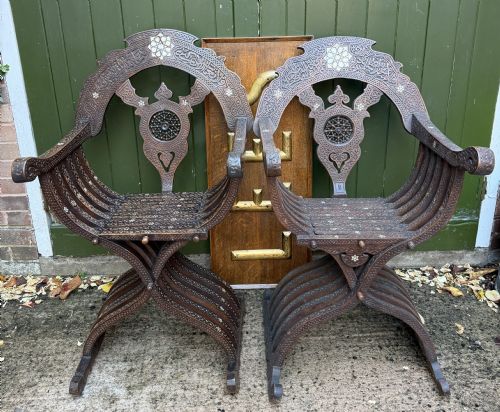
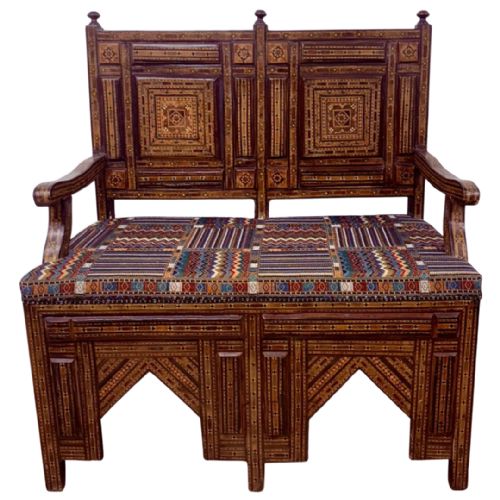
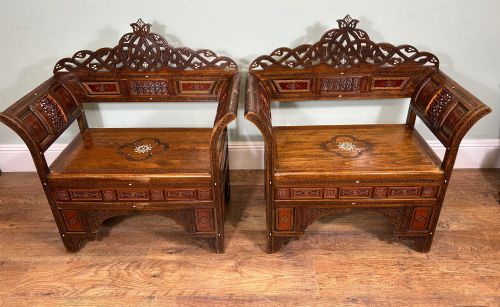
When you search for islamic antique seating, you encounter a distinct array of armchairs, benches, and settees spanning the nineteenth and early twentieth centuries alongside revival styles. These pieces range from Syrian hardwood benches to Moroccan painted armchairs and Moorish Damascus seating suites.
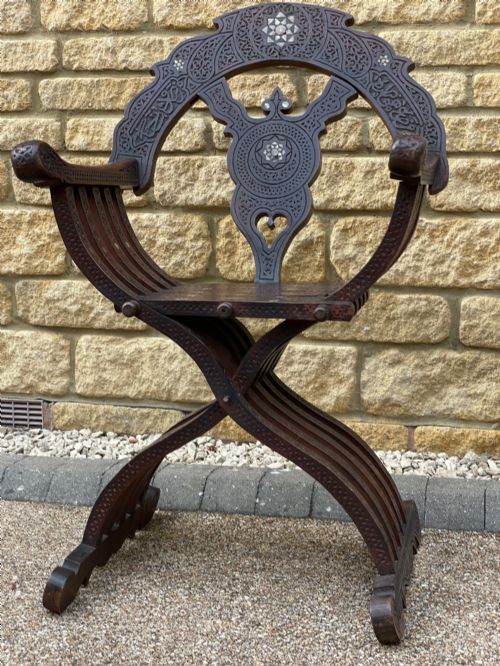
The selections on this page heavily feature Moorish Revival and Syrian Ottoman influences, often incorporating folding chair forms or conversation seats. Alongside furniture, occasional ceramic pieces such as slip-painted pottery bowls depicting seated figures provide historical context for historical representations of seating.
Most items date from the nineteenth century and the Edwardian era, reflecting a Victorian and early twentieth-century British appetite for exotic revival interiors. You will find walnut and various hardwoods forming the structural framework of these elaborate seating forms.
Materials and construction methods
The makers constructed these seats primarily using walnut and dense hardwoods, providing a sturdy foundation for intricate decorative work. Artisans then applied elaborate bone inlay, wood inlay, and mother-of-pearl to create shimmering geometric patterns across the wooden surfaces.
Upholstery and painted finishes complete many of the pieces, utilising traditional textiles and hand-applied pigments to enhance the visual depth of Moroccan and Syrian designs. Boulle inlay also appears on specific settee variants, combining metal and tortoiseshell-effect elements into the wooden frame.
Islamic Seating Retail Price Guide 2026
Typical asking prices for islamic seating among the pieces listed under this phrase on Sellingantiques today, from the lower quarter to the upper quarter. They describe what is for sale here now, not the wider market.
Listings feature walnut and hardwood frames enhanced with bone inlay, mother-of-pearl, and textile upholstery across nineteenth-century and Edwardian periods.
Assessing craftsmanship and execution
The distinction between standard examples and finer works lies in the precision of the inlay and the complexity of the carved wood. Tightly fitted mother-of-pearl and bone tesserae demonstrate superior artisan skill compared to simpler, more uniform surface applications.
Structural integrity also separates the output, with solid hardwood frames holding intricate joinery together far better than softer woods subjected to centuries of atmospheric changes. The intricacy of the painted motifs on Moroccan pieces further indicates the level of artisan investment in the individual item.
The Islamic Seating Glossary
- Moorish Revival
- An architectural and decorative style popular in the nineteenth century that reinterpreted traditional North African and Spanish Islamic design motifs for European and British homes. It frequently incorporates horseshoe arches, intricate lattice work, and extensive surface inlay.
- Mother-of-Pearl Inlay
- The technique of embedding thin, iridescent slices of mollusc shell into carved recesses within a wooden surface. This method creates shimmering, contrasting patterns that catch the light.
- Savonarola Chair
- A type of X-shaped folding chair originating in the Italian Renaissance but adopted widely in various revival styles, including Syrian interpretations. It consists of multiple curved wooden slats that intersect to form a barrel-like seat.
- Boulle Inlay
- A decorative process involving the application of tortoiseshell and brass or other metals cut in intricate marquetry patterns. It appears on select hybrid European-Islamic seating forms from the early twentieth century.
- Slip-Painted Pottery
- A ceramic technique where liquefied clay mixed with pigments is applied to a pottery body before firing to create surface illustrations. In this context, bowls featuring this technique depict historical figures seated on traditional furniture.
Islamic Seating: Frequently Asked Questions
Where should I place these seats?
These decorative chairs and benches serve well as focal points in a hallway, drawing room, or study where their intricate inlay can be fully appreciated.
Because many feature delicate mother-of-pearl and fabric upholstery, placing them out of direct sunlight preserves both the wood and the decorative elements.
How do I clean mother-of-pearl inlay?
Dust the surface regularly with a soft, dry cloth to prevent particles from settling into the recesses around the shell pieces.
Avoid using liquid cleaners or harsh polishes, as moisture can damage the adhesive securing the bone and pearl inlay to the hardwood base.
Are these chairs comfortable for daily use?
Many of these pieces, such as the conversation seats and armchairs, were built for formal reception rooms rather than modern lounging.
While structurally sound, their ornate wooden backs and rigid frames mean they function best as occasional seating or statement pieces.
How do I identify a Moorish Revival piece?
Look for dense geometric surface decoration, extensive use of bone or mother-of-pearl, and architectural silhouettes reminiscent of North African design.
Most items meeting this description date from the nineteenth or early twentieth century, reflecting the period fascination with Eastern aesthetics.