
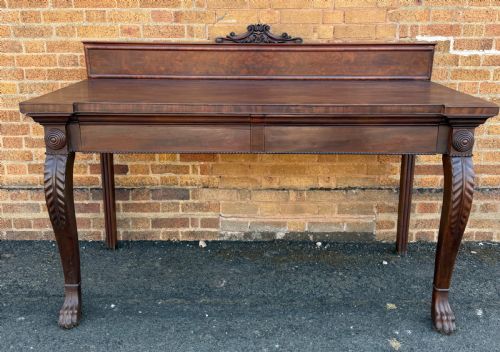


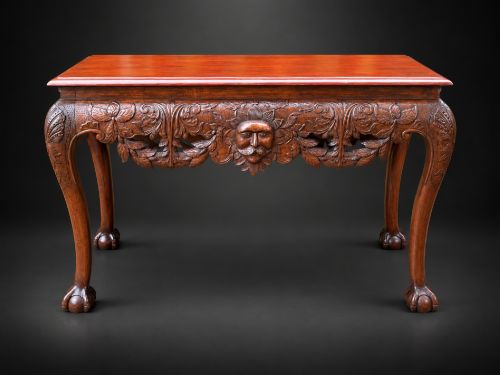


Irish Mahogany Serving Table
An irish mahogany serving table brings architectural timber and deep grain into a dining room with the presence that only vernacular Georgian and Regency joinery achieves.
Irish Mahogany Serving Table
When you search for an irish mahogany serving table, you find grand dining furniture shaped by cabinetmakers across the eighteenth and nineteenth centuries. These heavy timber pieces served dining rooms as sideboards and console tables before fitted dining furniture became standard.
The versions you meet most frequently on this page date from the Georgian and Regency periods, alongside later revival pieces from around nineteen hundred. Their forms range from straight-legged side tables to breakfront servers and occasional dumbwaiters.
How they were made
Joiners built these tables using dense, dark mahogany timber, selected for its rich grain and weight. Workshops relied on traditional frame construction to support large top boards without warping over decades of heavy service.
Makers incorporated carved details directly into the solid mahogany framing, sometimes pairing the timber with brass mounts or inlay. Surfaces received hand-rubbed finishes that deepened the natural reddish-brown tone of the wood.
Several tables were built with such imposing scale that modern delivery teams occasionally require architectural drawings just to navigate the hallway corners.
What varies in quality
The distinction between ordinary and exceptional examples rests in the ambition of the carving and the scale of the timber. Boldly carved legs and substantial breakfront tops separate imposing boardroom pieces from domestic side tables.
Design confidence also dictates worth, visible in how cleanly the proportions balance across heavy pedestals and friezes. Pieces attributed to documented cabinetmakers show a sharper execution in every moulded detail.
Robert Strahan & Co·Mack Williams And Gibton
The Irish Mahogany Serving Table Glossary
- Breakfront
- A cabinet or table front where the central section projects forward from the flanking sides. This architectural arrangement creates deeper shadow lines and visual weight.
- Dumbwaiter
- A tiered serving stand fitted with rotating or fixed circular shelves mounted on a central pillar. These pieces stood beside dining tables to hold dishes without requiring extra servants.
- Console table
- A wall-mounted or freestanding table designed to stand flat against a room divider. They often feature elaborate front legs while relying on brackets for wall support.
- Serpentine
- A curved shape featuring a convex centre flanked by concave ends, resembling a winding snake. This subtle geometry demands high skill from the woodworker.
Irish Mahogany Serving Table: Frequently Asked Questions
Where did these tables stand in a house?
These large pieces stood against dining room walls to hold heavy platters, silver, and decanters during large meals.
Servants used them as staging surfaces before modern sideboards took over the dining room layout.
How do I spot a Regency piece?
Regency examples often display bolder architectural lines, heavy carved scrolls, and classical motifs derived from ancient Greek and Roman design.
They rely less on delicate fretwork and more on imposing scale and dark mahogany surfaces.
Are these tables suitable for modern dining rooms?
Their deep timber tops and narrow depths make them practical as sideboards or console tables in contemporary living spaces.
They provide display space without blocking floor area in rooms with high ceilings.