
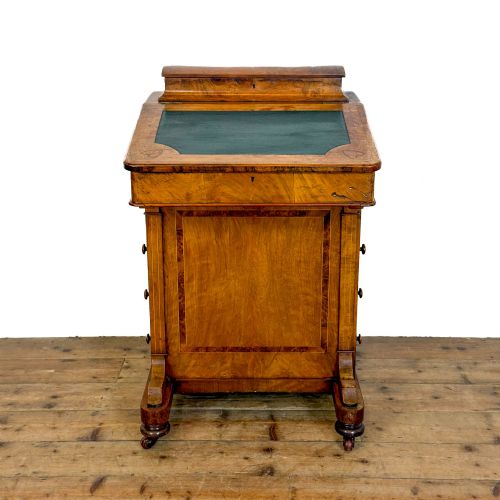


Inlay Walnut Davenport
An inlay walnut davenport is a compact nineteenth-century writing desk that combines practical storage with striking decorative timbers.
Inlay Walnut Davenport
An inlay walnut davenport is a small writing desk originating from the Victorian period, appearing frequently in options from the eighteen-fifties through the eighteen-eighties. These pieces typically combine a sloping writing surface lined with leather above a pedestal of drawers, alongside stationery compartments positioned on top.
The versions met most often on this page are constructed from burr walnut and feature contrasting boxwood inlay or floral marquetry. Variants include piano top davenports, pop up mechanisms, and tall bureau cabinets, though the standard four-drawer pedestal desk remains the most common form.
Materials and Construction Techniques
Makers utilised figured burr walnut for its rich, swirling grain patterns, applying it as veneer over secondary timbers to cover the main body of the desk. Boxwood and various other woods were carefully cut and fitted by hand to create intricate marquetry panels and linear stringing across the surfaces.
Structural durability relied on solid walnut framing for the pedestals and writing slopes, supplemented by brass hardware for hinges, handles, and casters. The sloped writing surfaces were traditionally inset with panels of tooled leather to provide a suitable medium for penwork.
The listings on this site span the Victorian era, specifically concentrating on the decades between eighteen-fifty and eighteen-ninety.
Assessing Craftsmanship and Detail
The quality of an inlay walnut davenport rests primarily on the choice of timber and the precision of the cabinetwork. Pieces featuring deeply figured burr walnut and crisp, securely fitted marquetry sit at the upper end of the scale compared to simpler plain walnut examples.
Interior fittings and mechanical complexity also distinguish standard models from finer productions. Desks incorporating specialised stationery cabinets, pop-up compartments, or freestanding finished backs demonstrate superior joinery and more ambitious design.
The Inlay Walnut Davenport Glossary
- Burr walnut
- A specialised timber cut from the abnormal growths of walnut trees, prized by cabinetmakers for its dense, swirling grain patterns. It creates a highly decorative surface when polished.
- Marquetry
- The art of applying pieces of veneer to a structure to form decorative patterns and pictorial designs. Different coloured woods are meticulously cut and fitted together flush.
- Stationery cabinet
- An upright compartment positioned on the upper rear of the desk, often fitted with pigeonholes and small drawers for letters and paper. It is sometimes enclosed by a tambour or lid.
- Pedestal
- The supporting base of the davenport containing a bank of drawers, usually arranged down one side while dummy drawers balance the reverse on freestanding models.
Inlay Walnut Davenport: Frequently Asked Questions
What is a davenport desk used for?
A davenport is a compact writing desk designed for correspondence and household administration in the Victorian era.
The sloping top provides a surface for writing letters, while the upper compartments and pedestal drawers store stationery, ink, and papers.
How do you open a piano top davenport?
Piano top davenports feature a sliding or rolling cylinder lid that retracts to reveal the internal writing slide and fittings.
Operating the mechanism often involves releasing internal catches connected to the side drawers or lifting the writing surface directly.
Are all davenports freestanding?
Not all davenports are finished on all four sides, as many Victorian examples were designed to stand directly against a wall.
Freestanding versions feature matched burr walnut veneer and dummy drawers on the reverse side so they can sit in the middle of a room.
How do I care for a walnut writing slope?
Walnut furniture requires protection from direct sunlight and excessive changes in temperature to prevent the timber and veneer from splitting.
Applying appropriate wax polishes helps maintain the finish of the wood and the condition of the boxwood inlay over time.