

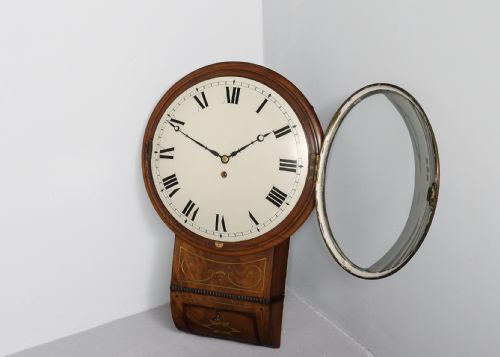

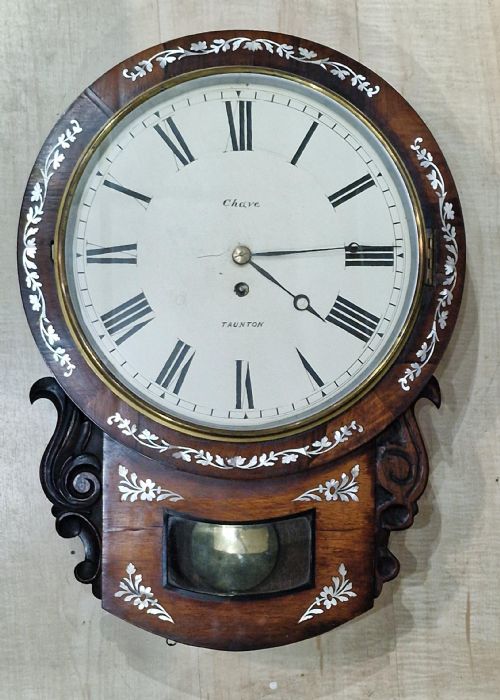


Inlaid Wooden Wall Clock
An inlaid wooden wall clock brings precision timekeeping and rich cabinetwork together on the wall, offering a focal point that anchors a room.
Inlaid Wooden Wall Clock
When you search for an inlaid wooden wall clock, you encounter timepieces housed in timber cases that span the Georgian, Regency, Victorian, and mid twentieth century periods. These instruments range from small octagonal shapes to large fusee and drop dial wall clocks designed for domestic or public spaces.
The version most commonly met on this page is the 19th century mahogany or rosewood wall clock, often featuring brass inlay and a circular or octagonal dial. Examples vary from simple trunk dials to elaborate French Napoleon III and English fusee models.
How they were made
Cabinetmakers constructed these clock cases using dense hardwoods such as mahogany and rosewood, sometimes applying ebonised finishes to create striking visual contrast. These timbers provided a stable foundation for intricate decorative work.
Craftsmen enriched the wooden surfaces through the insertion of contrasting materials, embedding boxwood, brass, and mother of pearl into the grain. Mechanical components such as fusee movements were then integrated alongside glass viewing covers and brass bezels.
Inlaid Wooden Wall Clock Retail Price Guide 2026
Typical asking prices for inlaid wooden wall clock among the pieces listed under this phrase on Sellingantiques today, from the lower quarter to the upper quarter. They describe what is for sale here now, not the wider market.
One London clock bears the personal inscription 'J Fisher Esq', forever linking its tick to a specific Victorian gentleman.
What varies in quality
The standard of an inlaid wooden wall clock rests upon the precision of the cabinetwork and the integration of the decorative elements. Sharpness in the brass or mother of pearl inlay and the crispness of the wood carving distinguish superior examples.
Movement sophistication also dictates value, particularly in the presence of reliable fusee mechanisms rather than standard gear trains. The harmony between the dial proportions, timber grain selection, and case execution marks the difference across the range.
Samuel Chave Taunton·Cording of London·Kleyser of London·Sansom
The Inlaid Wooden Wall Clock Glossary
- Fusee
- A conical pulley used in clock movements to maintain even tension on the chain as the mainspring unwinds. This mechanism ensures more accurate timekeeping throughout the power reserve.
- Drop dial
- A clock case featuring a circular dial at the top and an extended trunk below, which often houses a pendulum. This form became popular in public and domestic settings during the nineteenth century.
- Bracket clock
- A portable timekeeper originally designed to sit on a bracket or shelf. These pieces frequently incorporate fine timber cases and sophisticated striking mechanisms.
- Octagonal wall clock
- A timepiece featuring an eight sided wooden surround framing the dial. This geometric case shape is characteristic of specific nineteenth century regional and London workshops.
- Trunk dial
- A wall clock design incorporating a prominent lower case extension below the main dial housing. The configuration accommodates longer pendulums and weight driven movements.
Inlaid Wooden Wall Clock: Frequently Asked Questions
What is a fusee wall clock?
A fusee wall clock is a timepiece driven by a chain and a conical pulley mechanism that equalises the power of the mainspring. This design provides steady energy to the movement, resulting in more reliable timekeeping.
Such movements are typically housed in robust mahogany or rosewood cases designed to hang securely on a wall. They represent a higher standard of mechanical execution compared to simpler spring driven alternatives.
How do I hang a wall clock safely?
Hanging an antique wall clock securely requires identifying a solid fixing point in the wall, such as a stud or using appropriate masonry anchors. The weight of dense timbers like mahogany and rosewood demands fixings rated well beyond the load of the clock.
Once mounted, the case must hang plumb against the wall so the pendulum swings freely without catching. Levelling the clock ensures the beat remains even and the movement continues to run accurately.
How do I tell Victorian clocks apart from Georgian ones?
Georgian clocks generally display restrained proportions and refined cabinetwork typical of the eighteenth and early nineteenth centuries. Their timber selection often favours rich mahogany with understated brass details.
Victorian pieces tend to embrace more varied influences, including French styles and heavier ebonised or rosewood cases with mother of pearl inlay. The presence of bolder decorative flourishes often points towards the later nineteenth century.
Where were these clocks originally used?
These timepieces served practical and decorative functions in domestic hallways, parlours, offices, and commercial establishments. Their presence ensured that households and businesses maintained accurate schedules throughout the day.
Larger fusee and trunk dial models were frequently chosen for spaces where legibility and reliable timekeeping were paramount. Smaller octagonal and bracket variations suited more intimate domestic rooms.