

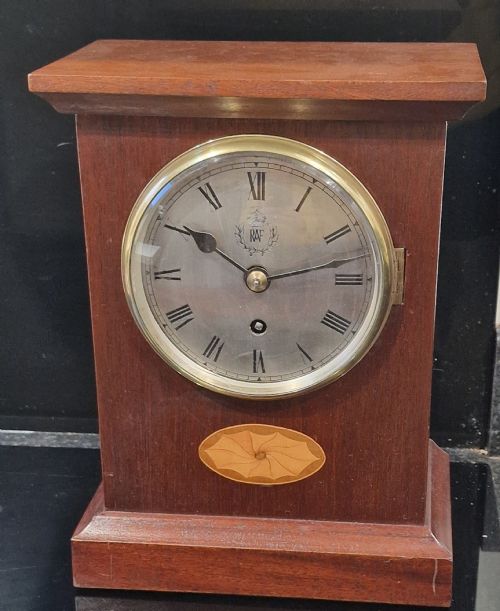
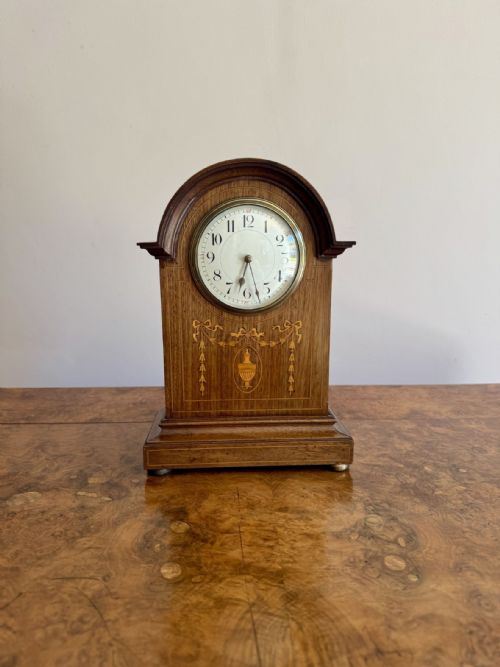


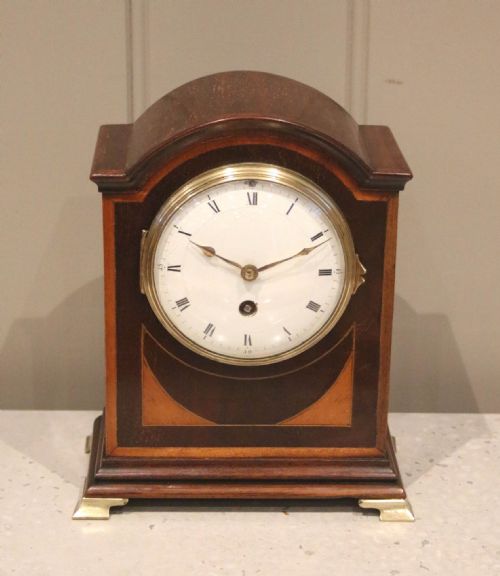


Inlaid Wood Desk Clock
These inlaid wood desk clock pieces bring fine cabinetwork and reliable timekeeping together on a writing surface, offering both utility and decorative presence.
Inlaid Wood Desk Clock
An inlaid wood desk clock sits upon a surface to combine precision movement with decorative cabinetry, often taking the form of a portable table timepiece, a bracket clock, or a compact mantel piece adapted for a writing desk. Buyers examine these objects for their functional timekeeping alongside their cabinetry.
The selection on this page draws from several periods, featuring Edwardian and Victorian examples alongside Regency, Georgian, and 1920s traditional pieces. Makers house these mechanisms within compact wooden housings designed for domestic and study spaces.
Mahogany, rosewood, and coromandel provide the structural carcases, while boxwood and satinwood supply contrasting stringing and floral motifs. These timbers create the visual depth that characterises the category.
Cabinetmaking and Materials
Cabinetmakers construct the housings from dense hardwoods such as mahogany and rosewood, applying contrasting veneers and fine stringing in boxwood and satinwood to form delicate inlay patterns. The timber is selected for grain regularity and stability before being shaped into bracket, dome top, or architectural cases.
The decorative surfaces incorporate marquetry and wood inlay techniques, contrasting dark tropical woods with pale linear insertions. Glass bezels and brass dials or bezels protect the enamel faces and mechanical movements housed within.
Inlaid Wood Desk Clock Retail Price Guide 2026
Typical asking prices for inlaid wood desk clock among the pieces listed under this phrase on Sellingantiques today, from the lower quarter to the upper quarter. They describe what is for sale here now, not the wider market.
The inventory spans the nineteenth and twentieth centuries, encompassing Edwardian, Victorian, and Regency examples.
Evaluating Craftsmanship
Quality rests upon the crispness of the cabinetmaker's inlay work and the structural integrity of the timber case. Finer examples display precise alignment in the contrasting satinwood or boxwood stringing and retain their original patination without excessive restoration.
The sophistication of the internal movement, whether a standard platform escapement or a fusee mechanism, dictates the technical merit of the piece. Well-executed dials with clear enamel work and original brass hardware elevate an individual clock above standard production.
Henry Marc·Joseph Jump·Paul Garnier·Walker and Hall·Plumbly and Tupman
The Inlaid Wood Desk Clock Glossary
- Fusee
- A conical pulley used in mechanical clocks to maintain even tension on the gear train as the mainspring unwinds. This mechanism is typical of better quality English table and bracket clocks.
- Marquetry
- The art of applying pieces of veneer to a structure to form decorative patterns and pictorial designs. Craftsmen utilise different coloured woods to achieve tonal contrast.
- Bracket clock
- A portable timekeeper originally designed to stand upon a wall bracket or a table surface. These pieces frequently feature heavy wooden cases and brass carrying handles.
- Satinwood
- A durable, lustrous yellowish timber native to India and Ceylon, frequently utilised for contrasting inlay work and banding on mahogany furniture.
- Bezel
- The metal ring that holds the glass protecting the dial of a clock. It often opens on a hinge to allow access for hand-setting or winding.
Inlaid Wood Desk Clock: Frequently Asked Questions
How do I wind a mechanical desk clock?
Most mechanical desk clocks utilise a key inserted into winding holes on the dial or back plate to tension the mainspring. Care must be taken not to over-wind the movement.
Older fusee and spring-driven movements require a steady, measured turn until resistance increases, ensuring the internal components remain undamaged.
Where should I place an inlaid wood desk clock?
These clocks belong on a stable flat surface away from direct sunlight and sudden temperature fluctuations. A writing desk, library table, or mantelpiece provides an appropriate environment.
Stable placement prevents vibrations that might affect the balance wheel or pendulum regulation of the movement.
How do I distinguish Edwardian from Victorian clocks?
Victorian clocks often feature heavier proportions, darker rosewood or mahogany carcases, and more ornate architectural detailing. They reflect mid to late nineteenth-century tastes for substantial decoration.
Edwardian examples tend to display lighter mahogany or satinwood inlaid cases with refined, cleaner outlines influenced by the transition into the twentieth century.
What maintenance do these wooden cases require?
Wooden cases benefit from occasional applications of microcrystalline wax to nourish the timber and protect the French polish. Harsh chemical cleaners must be avoided.
Keeping the environment dry preserves both the veneer work and the brass components of the internal clockwork.