
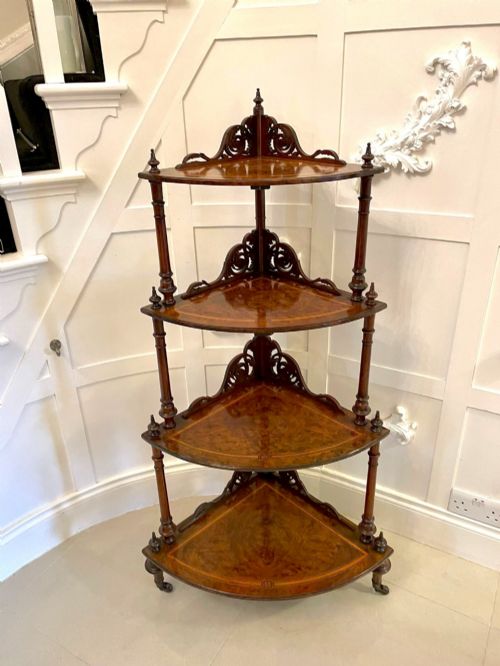


Inlaid Walnut Corner Unit
An inlaid walnut corner unit turns awkward architectural junctions into display space with rich timber grain and fine decorative banding.
Inlaid Walnut Corner Unit
An inlaid walnut corner unit provides compact storage or display by fitting neatly into room intersections, drawing the eye with patterned woodwork. These pieces appear across several eras, including the 18th Century, Georgian, Queen Anne, Victorian, Edwardian, and Dutch Baroque periods.
Buyers encounter standing corner whatnot stands and shelving units alongside enclosed cupboards. Each piece makes use of overlooked angles in a room while showing off distinctive timber surfaces.
How they were made
Cabinet makers built these pieces using walnut and burr walnut veneers, often enhanced with boxwood inlay, marquetry, and additional inlay wood details. Brass hardware frequently appears on cabinet doors and hinges.
Standing whatnots utilise tiered shelving supported by turned or shaped uprights, whilst hanging cupboards feature panelled doors securing with working locks. Marquetry and stringing patterns are carefully set into the primary walnut surfaces.
Several whatnots feature four separate tiers, providing ample vertical real estate for displaying small treasures in tight spaces.
What varies in quality
Quality rests upon the choice of timber and the precision of the marquetry work. Burr walnut figures prominently in superior examples, offering deep, swirling grain patterns that contrast sharply with plainer timbers.
The crispness of the boxwood inlay and the structural integrity of multi-tiered corner whatnot stands dictate the grade of the piece. Finer items display meticulous alignment in their veneer panels and balanced proportions across all tiers.
The Inlaid Walnut Corner Unit Glossary
- Whatnot
- A piece of furniture consisting of open shelves for displaying small objects. These tiered stands frequently occupy corners in Victorian and Edwardian interiors.
- Marquetry
- The art and craft of applying pieces of veneer to a structure to form decorative designs. Craftsmen utilise different coloured woods to create pictorial or geometric motifs on cabinet doors.
- Burr Walnut
- A prized timber harvested from walnut tree growths, yielding highly figured and gnarled grain patterns. Cabinet makers select this material for its exceptional visual depth on primary surfaces.
- Stringing
- A narrow strip of contrasting wood inlaid into a channel on a furniture surface. This technique creates delicate framing lines around panels and drawer fronts.
Inlaid Walnut Corner Unit: Frequently Asked Questions
Where should I place a corner whatnot?
These pieces fit naturally into empty room angles where standard rectangular furniture cannot go. They use vertical height effectively without taking up central floor space.
Position them away from direct heat sources to protect the walnut veneer and inlay work from drying out.
How do I care for inlaid walnut furniture?
Dust the surfaces regularly with a soft, dry cloth and apply a quality beeswax periodically to nourish the timber. Avoid modern liquid polishes containing silicone, which can damage historic finishes.
Keep the room humidity stable to prevent the wood and delicate boxwood stringing from shrinking or lifting.
How can I tell a Victorian whatnot from an Edwardian one?
Victorian examples often present darker walnut tones with heavier turned supports and dense marquetry or inlay. Edwardian pieces generally appear lighter in build, reflecting the transitional tastes of the later period.
Examining the construction methods and secondary timbers inside the piece helps confirm the era of manufacture.