
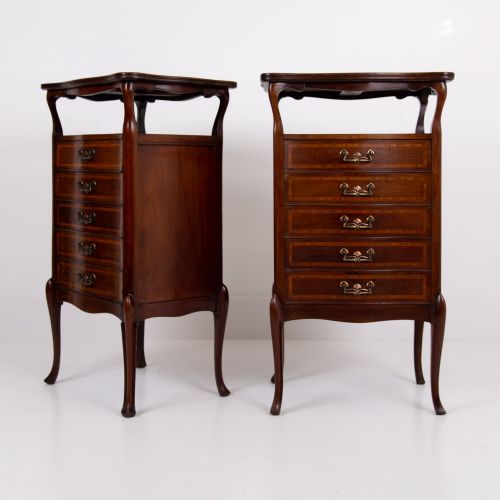
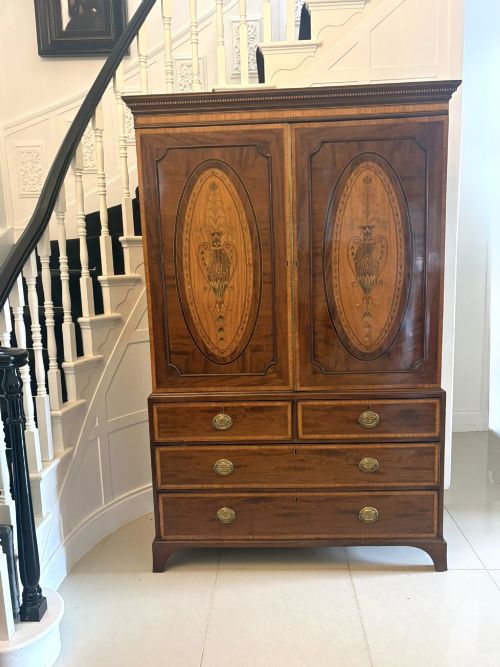
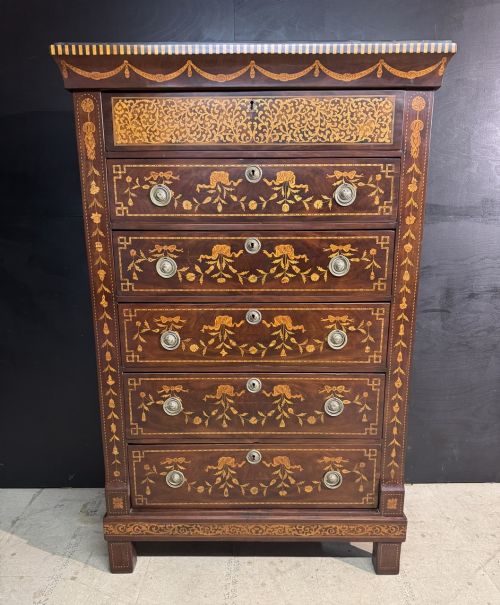
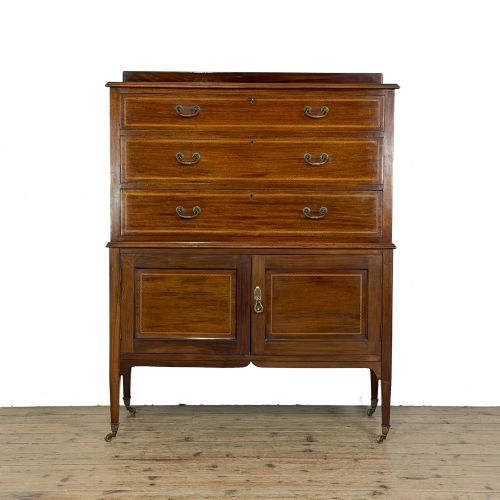




Inlaid Tall Chest
When you handle an inlaid tall chest, you encounter a commanding vertical form that brings refined timberwork and clever storage into domestic rooms.
Inlaid Tall Chest
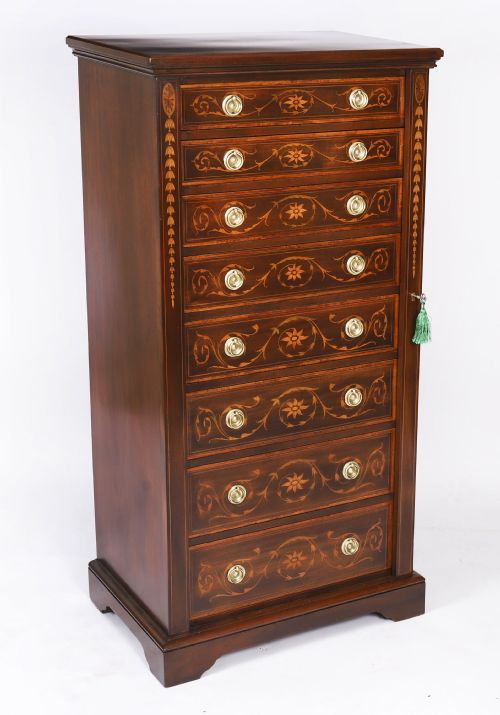
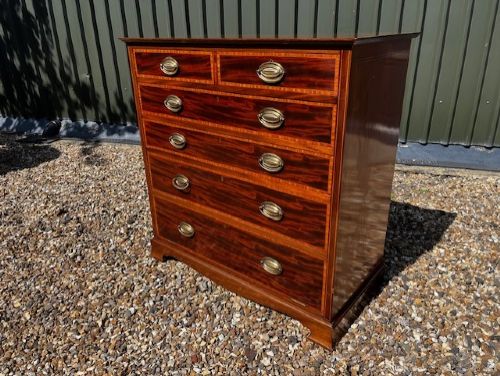
An inlaid tall chest provides deep vertical storage across multiple drawers while occupying a minimal floor footprint in a bedroom or dressing space. Buyers seeking this form will find examples spanning the eighteenth, nineteenth, and early twentieth centuries, with Edwardian and Victorian pieces appearing frequently.
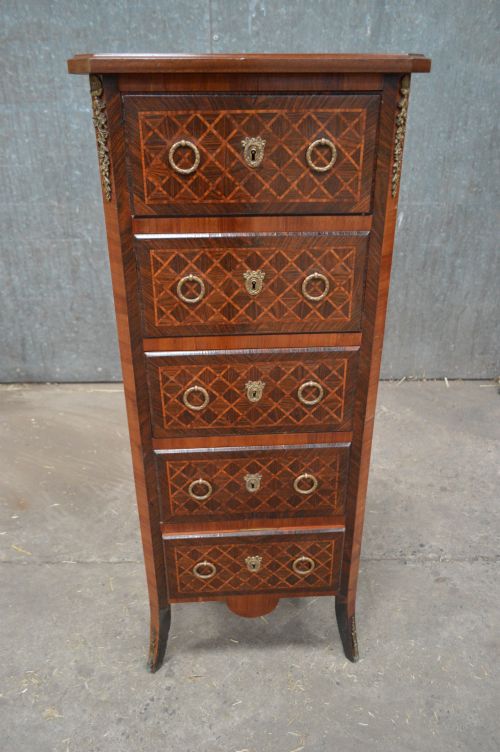
The category encompasses several regional and stylistic variations, including Georgian tallboys, French semainiers, and compact Wellington chests. Mahogany serves as the primary timber, often enhanced by satinwood, walnut, or rosewood, creating distinct vertical proportions tailored for domestic utility.
Pieces originating from English workshops sit alongside continental examples featuring intricate marquetry and parquetry patterns. Whether selecting a Sheraton Revival model or an 18th century Dutch marquetry chest, the emphasis remains on tall, narrow elevation combined with decorative surface detailing.
Materials and construction
Cabinet makers utilised dense primary timbers such as mahogany, walnut, and satinwood to construct the structural carcasses and drawer frames. Fine veneers and contrasting stringing were then applied to create complex geometric or floral inlay patterns across the drawer fronts and top surfaces.
Specialist techniques included parquetry and marquetry, where small pieces of exotic woods, mother of pearl, or brass were meticulously fitted together to form ornamental motifs. Drawer dividers and internal linings often employed secondary softwoods, while brass handles and escutcheons completed the hardware.
Listings feature mahogany, satinwood, walnut, and kingwood across periods spanning the eighteenth century to the twentieth century.
Factors of quality
Quality rests in the precision of the timber selection, the crispness of the inlay work, and the structural integrity of the vertical carcass. Pieces constructed with figured flame mahogany and sharply executed satinwood stringing demonstrate superior craftsmanship compared to plain or heavily restored surfaces.
The handling of internal drawer construction, dovetail joints, and original brass hardware further distinguishes standard production items from workshop pieces attributed to known makers such as Holland & Sons or J Shoolbred. Grain alignment and the preservation of tactile patination mark the highest tier of execution.
J Shoolbred·Maison Krieger·Holland & Sons·Maple & Co
The Inlaid Tall Chest Glossary
- Tallboy
- A tall chest of drawers, often built in two sections with a smaller chest sitting atop a larger base. This form maximises vertical storage capacity while maintaining a manageable floor footprint.
- Semainier
- A slender seven drawer chest originating in France, traditionally designed to hold a week of linen or daily garments. The tall, narrow proportions suit constrained bedside layouts.
- Wellington chest
- A secure vertical chest featuring a hinged side locking bar that secures all drawers simultaneously. The design typically incorporates a modest number of shallow drawers.
- Marquetry
- The art of applying decorative veneer pieces to a structural surface to form pictorial or geometric designs. Craftsmen use contrasting timbers and materials like mother of pearl to create these patterns.
- Stringing
- A narrow strip of contrasting wood inlaid into the surface of a furniture piece to form borders and linear accents. This technique frames drawer fronts and panels on Georgian and Edwardian furniture.
Inlaid Tall Chest: Frequently Asked Questions
What is an inlaid tall chest?
An inlaid tall chest is a vertical storage unit featuring multiple drawers decorated with contrasting wood veneers and decorative stringing. These pieces range from Georgian tallboys to Edwardian slim chests.
They combine practical vertical capacity with ornamental surface work designed to suit formal dressing rooms and bedrooms.
How do tallboys and semainiers differ?
A tallboy typically consists of a two-part chest on chest structure, offering deep storage across a wider frame. A semainier is a tall, narrow single section chest usually containing seven drawers.
Semainiers often feature French styling with delicate parquetry or marquetry, whereas tallboys frequently showcase English mahogany or walnut construction.
How do I identify a Wellington chest?
A Wellington chest is identified by its narrow proportions and a distinctive hinged locking stile down one side. This locking bar fastens over the drawer edges and is secured with a small key.
Originating in the nineteenth century, this design allowed secure storage for documents or personal items within a compact footprint.
Where were these chests placed?
These chests were placed in bedrooms, dressing rooms, and private chambers where floor space was at a premium. Their vertical orientation provided substantial drawer capacity without blocking walkways.
Period interiors utilised them for linens, garments, and documents, keeping daily necessities close at hand.