
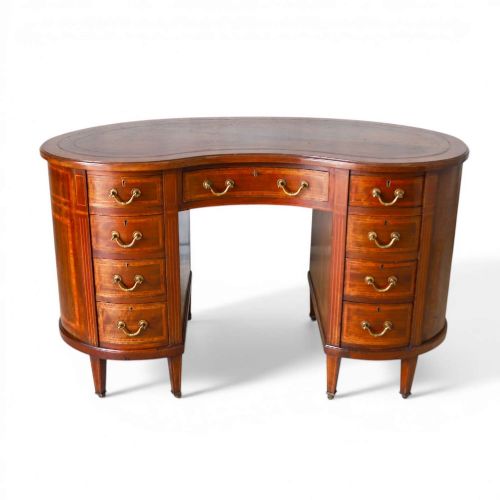


Inlaid Partner Desk
An inlaid partner desk is a substantial double-sided workspace designed for two people, combining decorative surface craft with functional drawers.
Inlaid Partner Desk
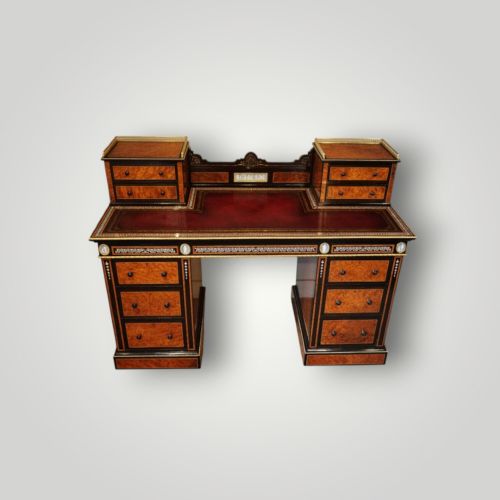
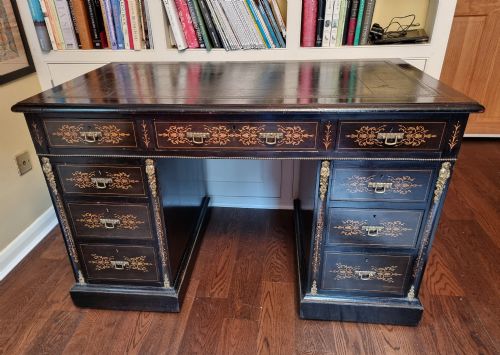
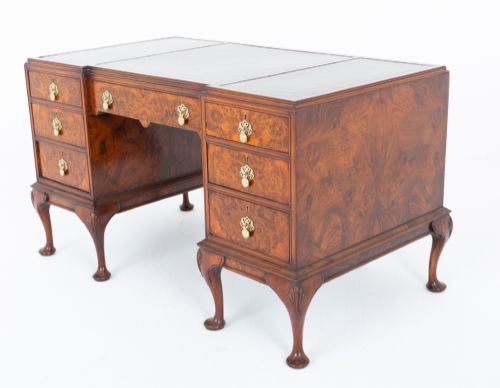
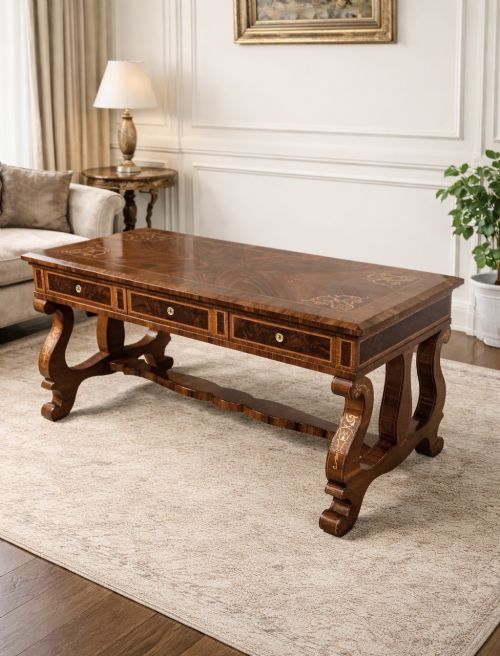
An inlaid partner desk provides dual-sided workspaces with drawers or cupboards arranged on both flanks so two individuals sit opposite each other. The pieces span periods from the nineteenth century into the twentieth century, encompassing Victorian, Edwardian, and Regency styles alongside revival designs.
The form appears in varied proportions, from pedestal desks with twin banks of drawers to larger library writing tables and kidney-shaped variants. Mahogany, walnut, and rosewood form the primary carcasses, decorated with contrasting timbers and metal mounts.
Victorian and Edwardian iterations dominate the selection, often featuring satinwood, ebony, or marquetry details integrated into the writing surfaces and friezes.
Materials and construction methods
Cabinet makers constructed the foundational frames using dense timbers such as mahogany, walnut, and rosewood, frequently incorporating flame veneers and crossbanding to enhance the visual depth of the grain. Inlay work utilises contrasting woods like satinwood and ebony, alongside delicate brass stringing and ormolu mounts.
Writing surfaces commonly insert panels of tooled leather into the timber top, bordered by detailed marquetry or banding. Brass hardware, including handles and key escutcheons, secures the functional drawer units on both sides of the pedestal structure.
The selection spans nineteenth-century Victorian and Edwardian periods alongside twentieth-century continental interpretations.
Distinctions in quality and execution
Quality rests upon the precision of the timber selection and the execution of the inlay work. Finer examples display continuous, balanced grain patterns across the double-sided pedestals and crisply cut marquetry without gaps or filler.
The integration of mountings, such as chased ormolu and fitted leather writing surfaces, separates standard utility furniture from pieces produced by prominent cabinet makers. Construction integrity is evident in the flush fitting of the drawers and the weight of the underlying secondary timbers.
Jackson and Graham·Edwards and Roberts·S and H Jewell·Viardot
The Inlaid Partner Desk Glossary
- Partner desk
- A double-sided piece of furniture with drawers and cupboards accessible from both the front and the back, intended for two users. This form allows simultaneous use by facing individuals.
- Marquetry
- The art of applying decorative veneer pieces in pictorial or geometric patterns onto a structural surface. It often employs varied woods to create tonal contrast.
- Ormolu
- Gilded bronze used for decorative mounts and feet on high-status furniture. The technique was particularly favoured in French and grand English revival pieces.
- Crossbanding
- A strip of veneer applied to the border of a furniture top or drawer front with the grain running perpendicular to the central panel. This technique frames the primary wood.
- Pedestal desk
- A form comprising two freestanding pedestals or columns of drawers supporting a single broad writing slab. The central kneehole provides seating space.
Inlaid Partner Desk: Frequently Asked Questions
How do I use a partner desk?
A partner desk provides working surfaces and drawer space on opposite sides, allowing two people to sit face-to-face.
Position the piece away from walls so both users can access the drawers and kneeholes freely.
What woods were used for these desks?
Cabinet makers built the primary carcass using dense hardwoods including mahogany, walnut, and rosewood.
Decorative elements incorporate satinwood, ebony, and thuya, alongside brass and ormolu mounts.
How do I distinguish Victorian from Edwardian desks?
Victorian desks generally exhibit heavier proportions, darker timbers, and robust marquetry or brass inlay.
Edwardian pieces often feature lighter mahogany frames, satinwood banding, and more restrained decorative schemes.
Are these desks finished on all sides?
Partner desks are finished on all four sides because they are designed to stand in the centre of a room.
Drawers and cupboards appear on both the front and the back flanks.