

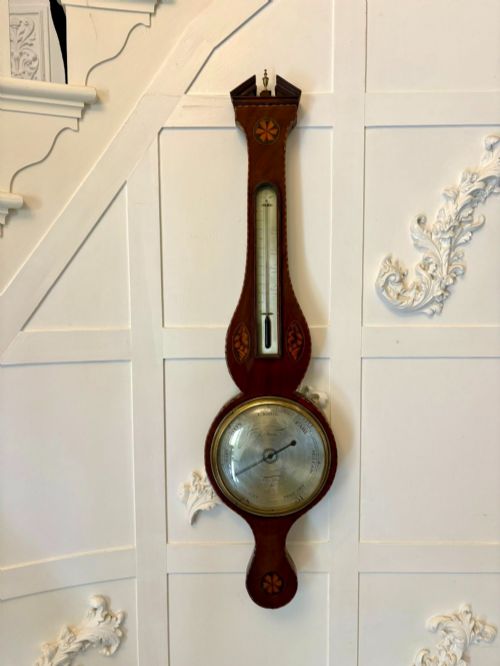
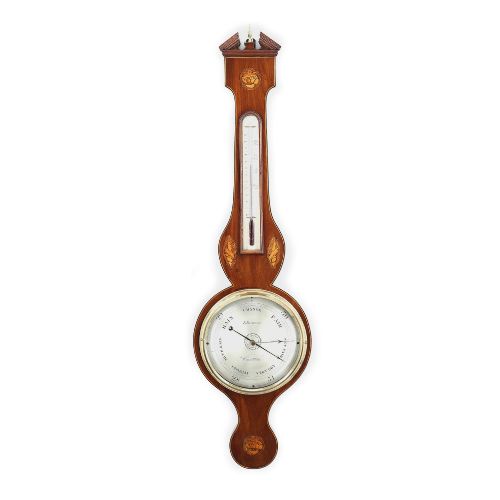
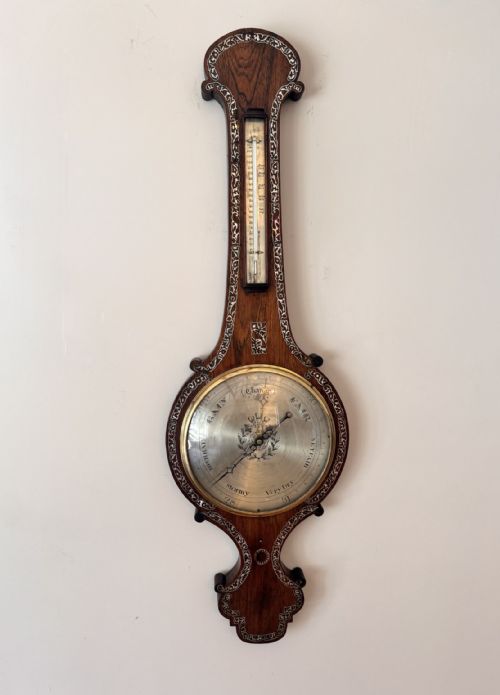


Inlaid Mahogany Wheel Barometer
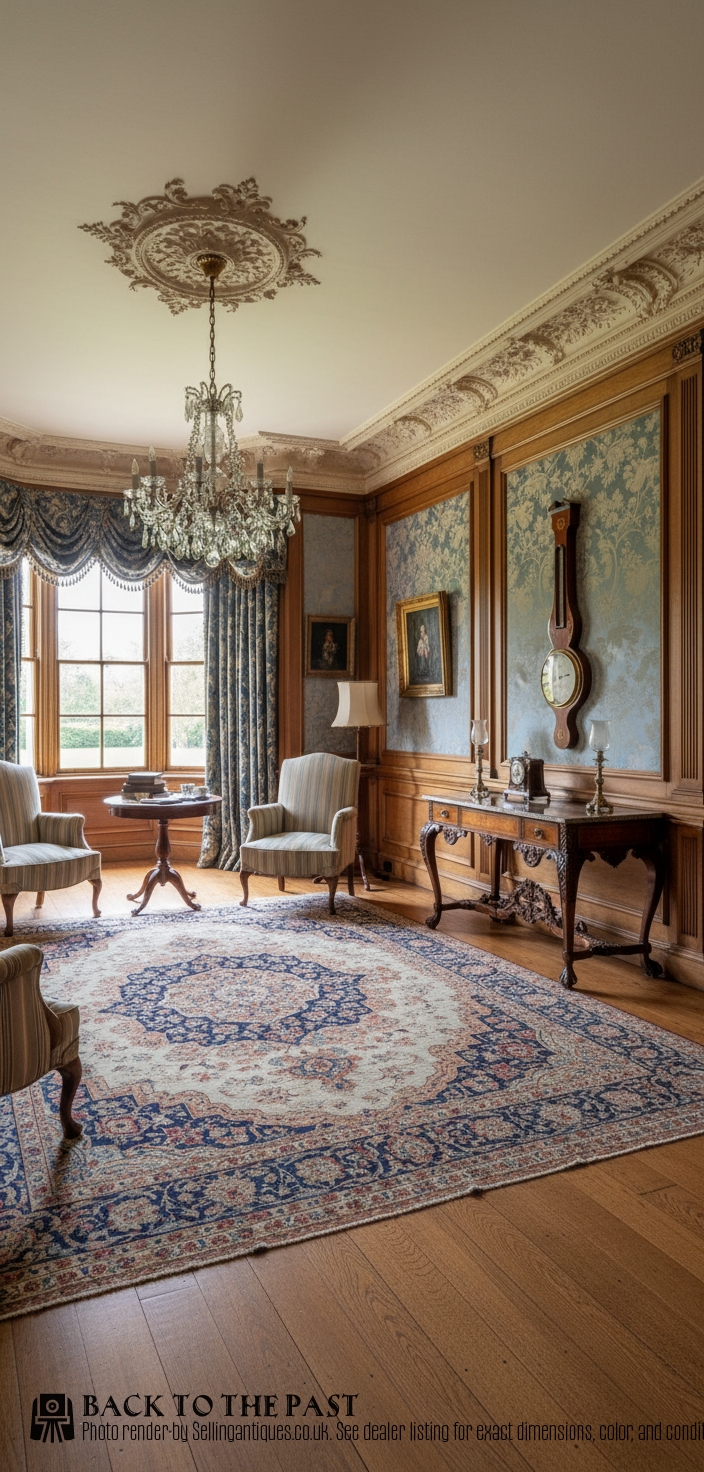
An inlaid mahogany wheel barometer brings tactile Georgian and Victorian craftsmanship into a hallway, offering both functional weather-reading and striking wall furniture.
Inlaid Mahogany Wheel Barometer
An inlaid mahogany wheel barometer is a wall-hanging domestic weather glass housed within a distinctive banjo-shaped wooden case. The form combines a hygrometer, thermometer, circular dial and spirit level into a single vertical instrument designed to ornament principal rooms.
Examples on this page span the Georgian, Regency, and Victorian periods, stretching from the late eighteenth century through the nineteenth century. These pieces originate from provincial makers across England as well as London workshops, displaying diverse regional interpretations of classical design.
The layout typically positions a hygrometer at the top beneath a damp-air dial, followed by a thermometer, a principal curved silvered metal dial for barometric pressure, and a spirit level set into the base. Mahogany frames are repeatedly enriched with contrasting boxwood and satinwood stringing or shell motifs.
Materials and construction methods
Cabinetmakers constructed the distinctive cases from solid and veneered mahogany, selecting timber for deep grain and rich colour. They applied delicate boxwood and satinwood stringing alongside shell or floral marquetry to accentuate the curved outlines of the banjo shape.
Interior mechanical assemblies rely on brass fittings, glass covers protecting delicate dials, and silvered metal plates engraved with weather descriptors and maker signatures. Mother-of-pearl inlay frequently appears on nineteenth-century dials and cases as an alternative decorative accent.
Makers integrated mercury-filled glass tubes linked to mechanical pulleys and wheel indicators to translate atmospheric pressure changes into needle movement on the main dial. Spirit levels set into the lower bulb ensured the heavy wooden case hung plumb against the wall.
Inlaid Mahogany Wheel Barometer Retail Price Guide 2026
Typical asking prices for inlaid mahogany wheel barometer among the pieces listed under this phrase on Sellingantiques today, from the lower quarter to the upper quarter. They describe what is for sale here now, not the wider market.
Listings demonstrate materials including mahogany, rosewood, boxwood inlay, satinwood, mother-of-pearl, and silvered metal across Georgian and Victorian periods.
Distinctions in quality and execution
Quality rests upon the crispness of the cabinetwork, particularly the precision of the boxwood stringing and the natural depth of the mahogany grain. Finer examples display meticulous hand-engraved silvered dials signed by established makers rather than mass-produced generic faces.
The complexity of the case layout dictates execution standards, with superior instruments incorporating multiple subsidiary dials, hygrometers, and thermometers under bevelled glass. Intricate shell marquetry and mother-of-pearl embellishments executed with geometric exactness elevate the status of the piece.
B. Besozzi of Weymouth·Ganthony of London·Prada of High Wycombe·Molton of Norwich·Luisetti of London·Giana·L Casatelli of Liverpool·Vecchio & Co of Shaftsbury·A. Rivolta·J Groce, York·F Salteri & Co, Nottingham·Dominic Gatty·Schiavi of Chesham·Gugeri & Belotti, London
The Inlaid Mahogany Wheel Barometer Glossary
- Wheel barometer
- A weather-measuring instrument housed in an expanded case where atmospheric pressure changes rotate a pointer around a circular dial via a pulley system. This layout replaced earlier stick barometers for domestic display.
- Banjo barometer
- A colloquial term for a wall barometer whose wooden case resembles the shape of a banjo, featuring a narrow neck and a bulbous lower section containing the spirit level. Most wheel barometers adopt this characteristic silhouette.
- Silvered metal
- A brass or copper dial plate treated with a silver solution to create a matte, reflective surface that is subsequently engraved with numerals and weather notes. These dials tarnish naturally over time.
- Stringing
- Thin inlaid lines of contrasting light wood, such as boxwood or satinwood, set flush into channels cut into the darker mahogany case. This technique defines the edges and geometric borders of the instrument.
- Hygrometer
- A subsidiary dial mounted near the top of the case designed to measure humidity levels in the surrounding air. It often complements the main barometric dial with a matching brass pointer.
Inlaid Mahogany Wheel Barometer: Frequently Asked Questions
How do I hang a wheel barometer?
These instruments require a secure wall fixing capable of supporting the full weight of the solid mahogany case and internal glass tubes. Hang the barometer from a sturdy screw or bracket utilising the hanging ring or eyelet fitted to the rear upper spine.
Ensure the wall surface is flat so the case rests evenly without twisting the wood. The spirit level fixed in the lower bulb provides an immediate reference to check whether the instrument hangs perfectly vertical.
Do antique barometers still work?
Many surviving examples remain fully operational and continue to respond accurately to local atmospheric pressure changes. The internal mechanical linkages and mercury tubes require careful handling and stable indoor environments to maintain function.
Periodic professional inspection helps preserve the delicate silk threads, pulleys, and pivot points within the mechanism. Even when mechanical adjustments are needed, the instrument retains its primary value as decorative wall furniture.
How do I read the dial?
The main circular dial displays barometric pressure measurements, traditionally marked with weather descriptors ranging from stormy and rain to change, fair, and very dry. The brass pointer indicates the current air pressure reading.
Many examples feature a manually adjustable second hand set into the glass bezel via a small knob. Turning this secondary pointer directly over the main needle allows you to track whether pressure is rising or falling since your last observation.
How do I date an inlaid barometer?
Dating relies on stylistic shifts in the mahogany case design, the shape of the pediment at the top, and the character of the engraved maker signature. Late eighteenth-century Georgian examples often feature broken arch pediments and restrained boxwood stringing.
Nineteenth-century Regency and Victorian iterations frequently adopt onion-top pediments, richer marquetry, and mother-of-pearl accents. Maker signatures combined with trade directories provide the most precise chronological markers.