

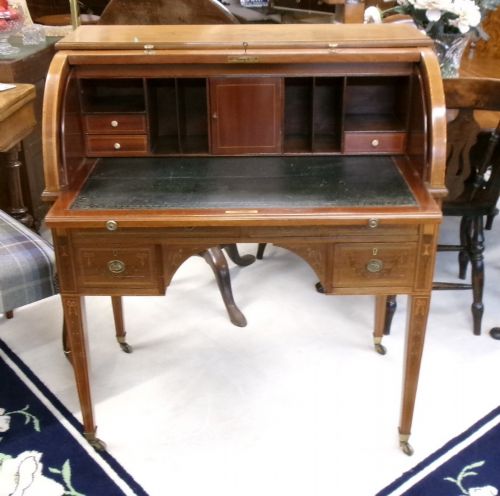
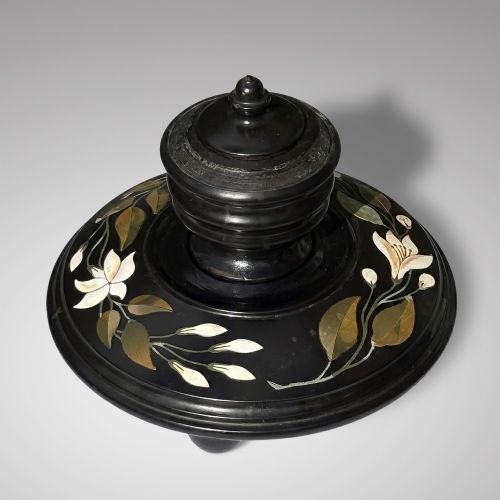


Inlaid Desk Stand
An inlaid desk stand brings together practical writing accessories and detailed cabinetwork from the nineteenth and early twentieth centuries.
Inlaid Desk Stand
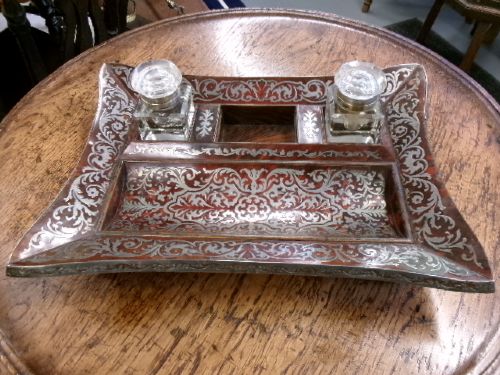
An inlaid desk stand serves as a portable or tabletop writing accessory designed to hold inkwells, pens, and paper supplies within a fitted wooden frame. These pieces range from compact mid-century trays to substantial Victorian and Edwardian examples featuring fitted glass bottles and brass mounts.
The objects derive from periods spanning the Regency, Victorian, and Edwardian eras, with many specimens exhibiting French Napoleon III or Boulle work influences. Cabinetmakers utilised exotic timbers and contrasting veneers to create decorative surfaces that complemented formal studies and drawing rooms.
Buyers searching this phrase encounter desk tidies, inkstands, and writing sets equipped with lidded compartments and pen rests. The fundamental form prioritises both utility and surface ornamentation, making these pieces suitable for active desktop use.
Materials and construction methods
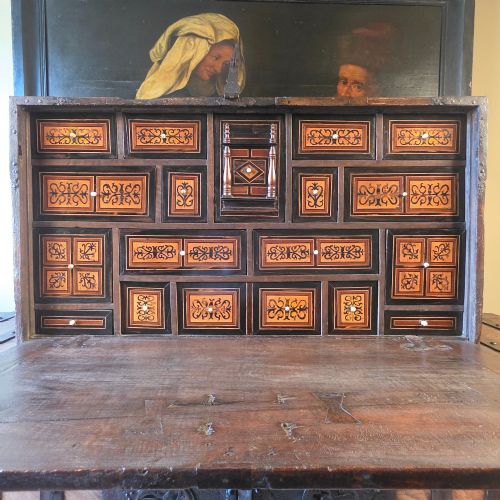
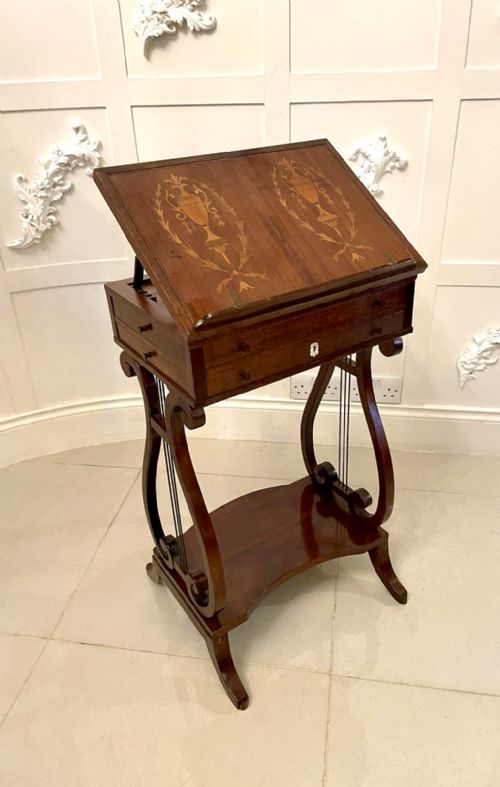
Construction relies upon a foundation of dense hardwoods such as mahogany, rosewood, walnut, and coromandel, selected for their stability and rich grain. Artisans applied contrasting veneers of satinwood and fruitwood, alongside bone and mother of pearl, to form intricate geometric or floral patterns across the surface.
Metal elements including brass inlay, ormolu mounts, and silver fittings were integrated into the woodwork to define borders and secure compartments. Glass inkwells, frequently fitted with hinged metal collars, complete the fitted interior arrangements of these writing pieces.
Several stands include secret compartments originally designed for private correspondence and hidden postage stamps.
Distinctions in execution and design
Superior examples display precise, flush-fitting marquetry where different wood species meet without perceptible gaps or filler. The crispness of the brass engraving and the weight of the cast bronze or silver mounts indicate the level of workshop resource dedicated to the piece.
Internal arrangements demonstrate workmanship through neatly dovetailed small drawers, accurately cut pen grooves, and original glass inkwells with matching tops. Pieces bearing identifiable maker stamps or firm attribution often reflect higher standards of secondary timber selection and internal finish.
Edwards & Roberts·Maple & Co·Rupert Favell·Adriano Brambilla
The Inlaid Desk Stand Glossary
- Marquetry
- The art of forming decorative patterns by fitting together veneers of different woods, metals, or shells. This technique creates complex pictorial or geometric designs across desk surfaces.
- Boulle work
- A style of ornate marquetry using tortoiseshell and brass inlaid in contrasting negative patterns. It originated in seventeenth-century France and saw revivals during the Victorian period.
- Inkstand
- A portable tray or stand holding one or more inkwells, sanders, and pen holders. These accessories formed an essential part of nineteenth-century desk equipment.
- Coromandel
- A dense, heavy timber from Southeast Asia with dark brown colour and striking black streaks. It was frequently used for luxury Victorian desk accessories.
- Ormolu
- Gilt bronze mounts applied to furniture and desktop items for decorative effect. The technique involves coating cast bronze with a mercury and gold amalgam.
Inlaid Desk Stand: Frequently Asked Questions
What is an inlaid desk stand used for?
These stands organise writing implements by providing secure recesses for glass inkwells, pen trays, and sometimes sanders or sealing wax compartments. They sat upon desks or writing tables to keep daily correspondence tools tidy and accessible.
In period settings, such accessories were portable enough to move between rooms or libraries depending on where letters required answering.
How do I identify a Victorian desk stand?
Victorian examples frequently utilise dense timbers like walnut, rosewood, or coromandel combined with brass stringing, mother of pearl, or pewter inlay. They often house cut-glass inkwells with heavy brass or plated collars.
The overall aesthetic draws upon contemporary revivals of French Napoleon III styles or geometric English cabinetmaking traditions.
Are the inkwells usually original?
Many surviving desk stands retain their matching fitted glass inkwells, though some replacement bottles occur due to breakage over decades of use. Matching collars and lids that sit flush within the wooden apertures indicate original components.
Examining the base of the glass and the interior of the wooden wells reveals whether the compartments have been altered.
How should I care for inlaid wood?
Maintain the timber and veneer by keeping the piece away from direct sunlight and steady heat sources that cause wood to shrink or crack. Gentle dusting with a dry cloth preserves the polished surface without moisture damage.
Avoid applying modern silicone polishes, as they penetrate old finishes and degrade delicate brass or shell inlay over time.