


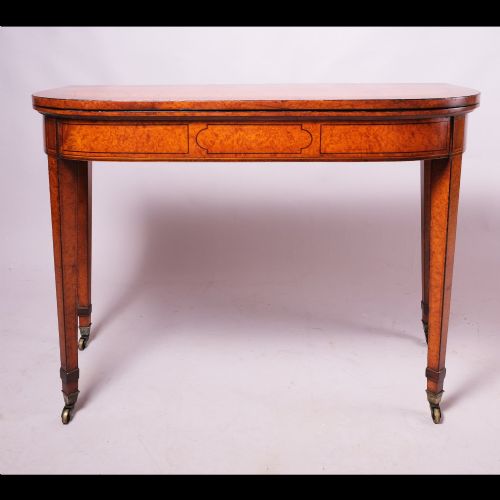
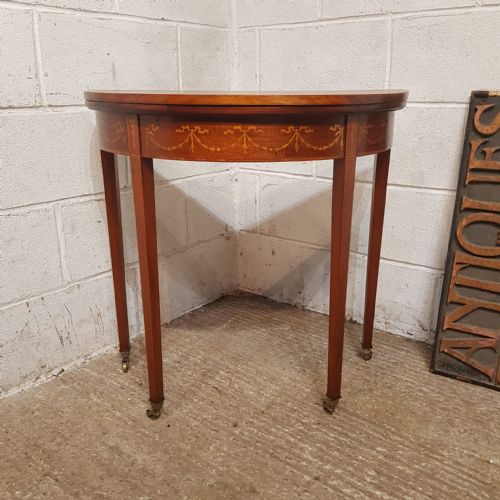
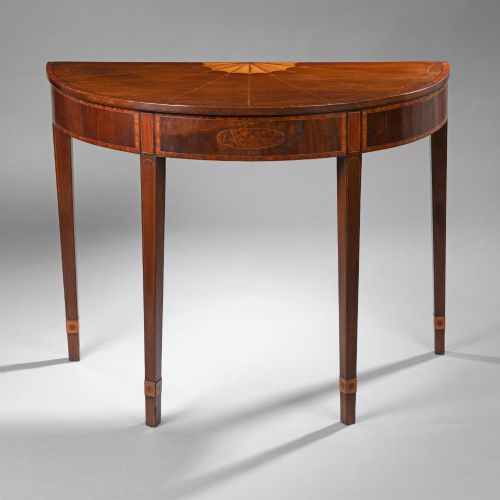

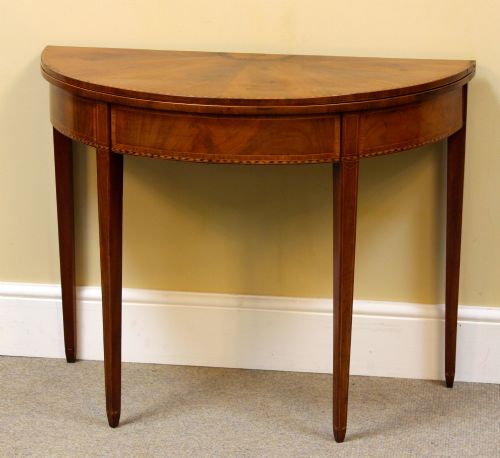
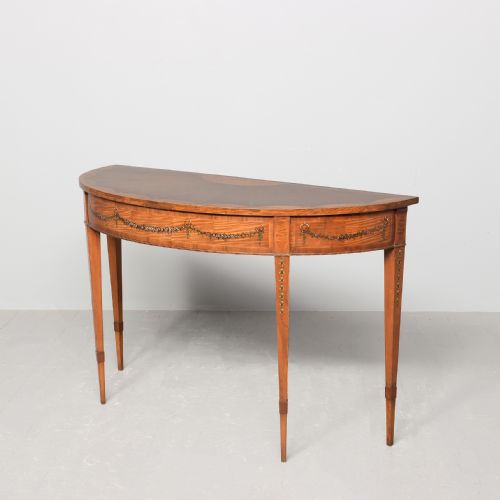


Inlaid Demi Lune Console
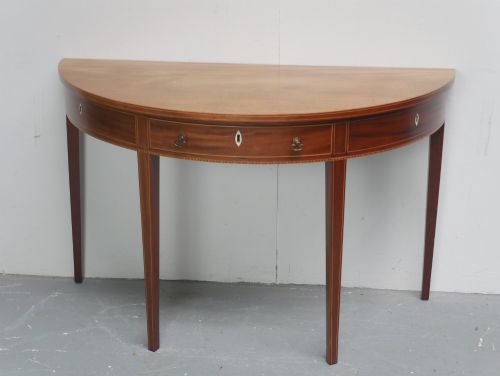
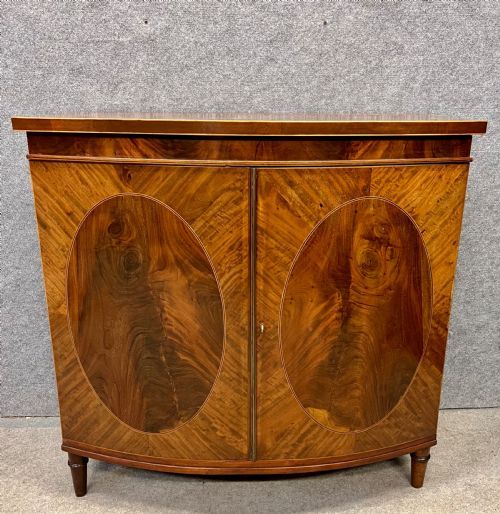
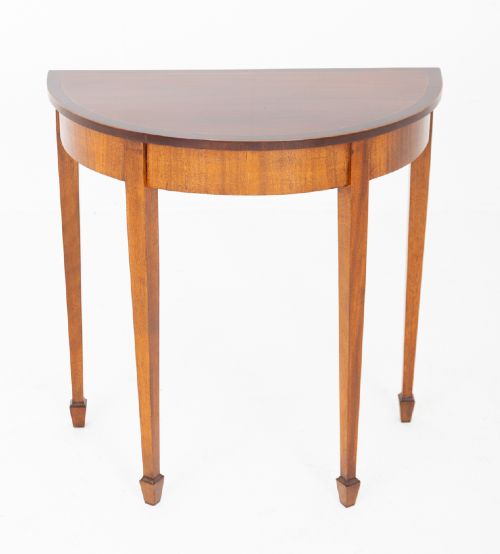
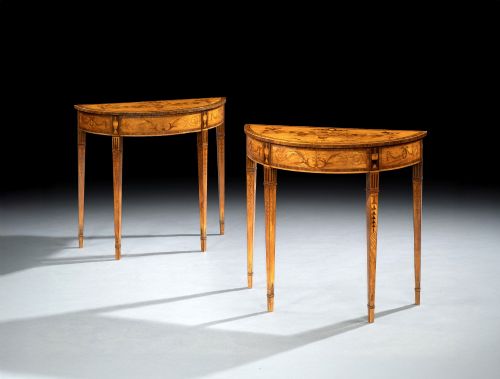
These inlaid demi lune console tables offer curved profiles and fine marquetry, designed to stand flush against a wall while bringing warmth to a hallway or drawing room.
Inlaid Demi Lune Console
An inlaid demi lune console is a semicircular table designed to sit flat against a wall, frequently appearing as a card, tea, or games table with a fold-over top. The form gained widespread popularity during the eighteenth century under Georgian and Sheraton influence, continuing through Regency and Edwardian revivals.
Beyond standard side tables, the category extends to substantial side cabinets and serving tables shaped with the characteristic half-moon curve. Mahogany and satinwood form the primary structural timbers, frequently augmented by intricate contrasting stringing and banding.
Makers produced these semicircular items to maximise floor space in narrow hallways or grand reception rooms while providing a decorative surface. Surviving examples demonstrate both simple domestic utility and high-status Neoclassical design.
Materials and Construction Techniques
Cabinet makers utilised solid mahogany and satinwood for the primary carcases and framing, often selecting figured veneers to cover the sweeping semicircular tops. Secondary timbers such as oak or pine appear in the framing and drawer linings.
The decorative surfaces rely on precise boxwood inlay, marquetry, and crossbanding to create contrasting borders and central fan motifs. Craftsmen cut thin strips of light wood to follow the tight curves of the demi-lune edge, securing them with animal glue.
Many an eighteenth-century card table secretly hides a shallow well beneath its folding top for storing tallow candles.
Distinctions in Quality
The integrity of the timber selection and the precision of the marquetry define the tier of a piece, distinguishing workshop production from ambitious exhibition furniture. Finely figured mahogany and meticulously fitted satinwood veneers indicate higher standards of cabinet making.
Structural harmony in the folding mechanisms and the alignment of the hinged top reveal the original maker's skill. Superior examples maintain crisp inlay lines that follow the curved apron without lifting or noticeable timber shrinkage.
Edwards and Roberts·Pietro Ferrario
The Inlaid Demi Lune Console Glossary
- Demi-lune
- A half-moon shape used for table tops and cabinet fronts. This profile allows the furniture to sit flat against a wall.
- Marquetry
- Decorative patterns formed by inserting thin pieces of wood, shell, or ivory into a veneered surface. This technique creates pictorial or geometric designs across tabletops.
- Crossbanding
- A border of veneer laid with the grain running perpendicular to the main surface. It frames the central panel of a table top.
- Stringing
- Thin lines of contrasting wood inlaid into channels cut into the timber. It outlines the edges of drawers and table legs.
- Fold-over top
- A hinged table surface that opens to double its size for card games or tea. The pivoting leaf is often supported by a swing leg.
Inlaid Demi Lune Console: Frequently Asked Questions
How were demi lune tables used originally?
These tables served primarily as decorative side pieces in halls and drawing rooms, holding lamps, porcelain, or decorative ornaments. Many doubled as functional card or tea tables when the hinged top was unfolded for evening entertainment.
In tighter entrance spaces, their curved front minimised obstructions while offering a surface for correspondence or visiting cards. Wealthy households often paired them symmetrically flanking a fireplace or doorway.
Where should I place an inlaid demi lune console?
The flat back allows the table to anchor securely against any interior wall without projecting too far into the floor space. Hallways, landings, and dining rooms remain traditional positions for displaying the curved wooden top.
Pairing a mirror or painting above the console balances the semicircular footprint visually. Folding game versions benefit from placement where the top can open fully without crowding surrounding furniture.
How do I distinguish George III from Edwardian pieces?
George III pieces, dating from the late eighteenth century, display hand-cut timber veneers, older secondary woods like oak, and natural patination developed over centuries. The construction relies on traditional joinery methods appropriate to the period.
Edwardian reproductions and revivals, built around nineteen hundred, often utilise machine-sawn veneers, different secondary woods, and standardised hardware. They reflect later revivals of Sheraton and Hepplewhite styles rather than original eighteenth-century output.