

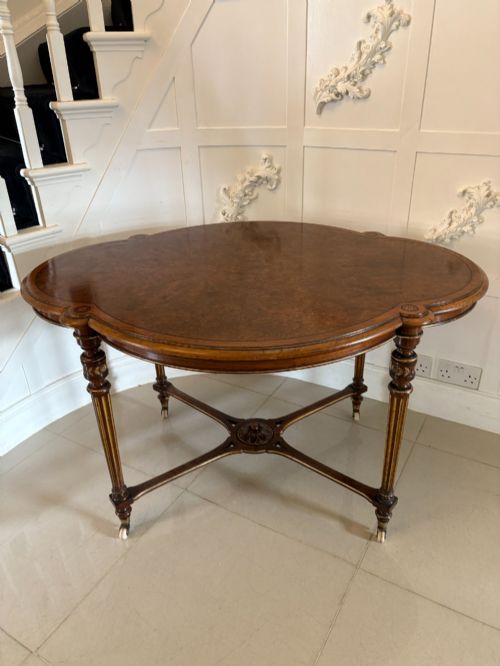
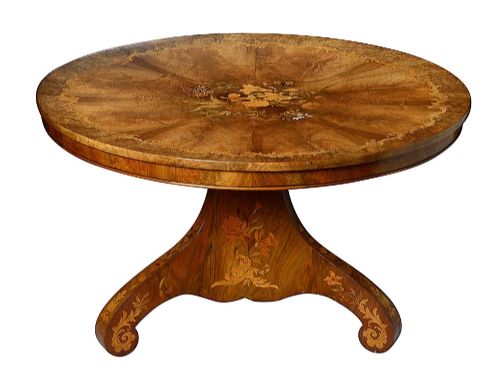
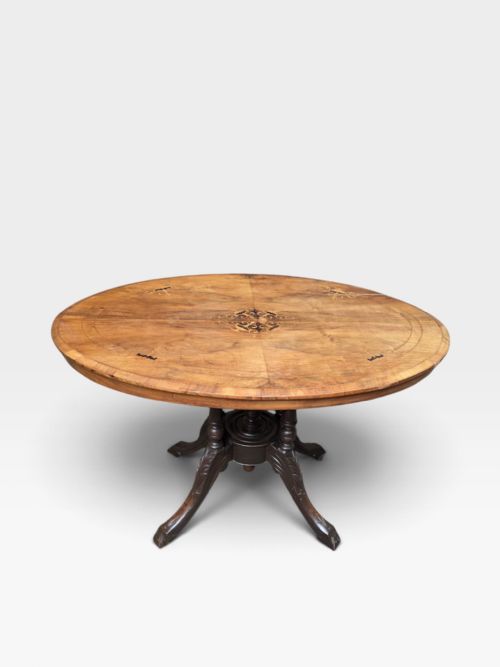
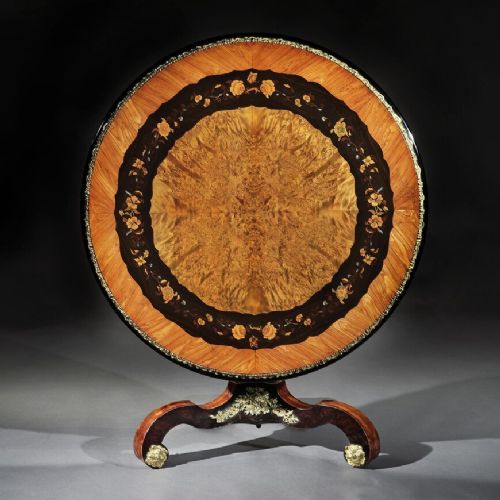

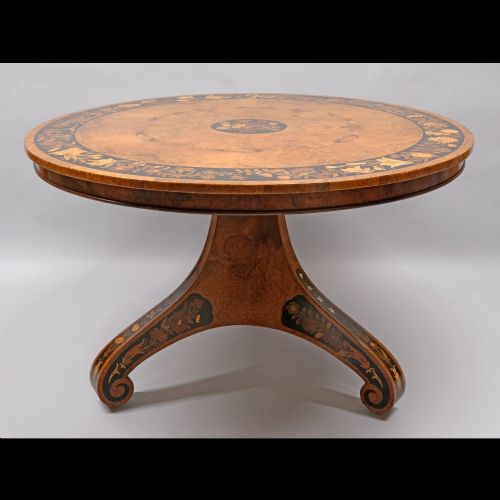


Inlaid Burr Walnut Loo Table
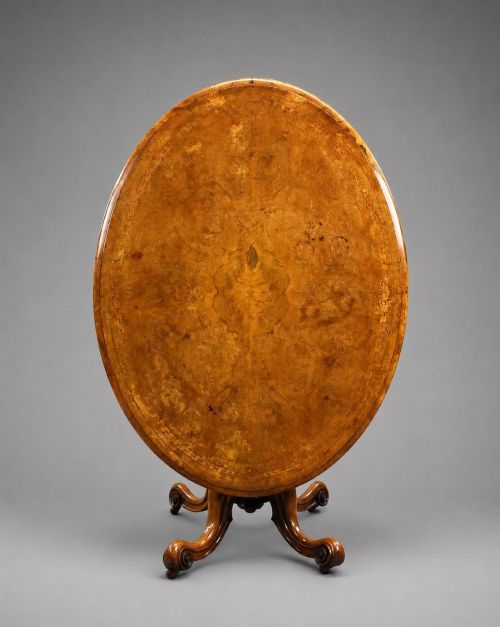
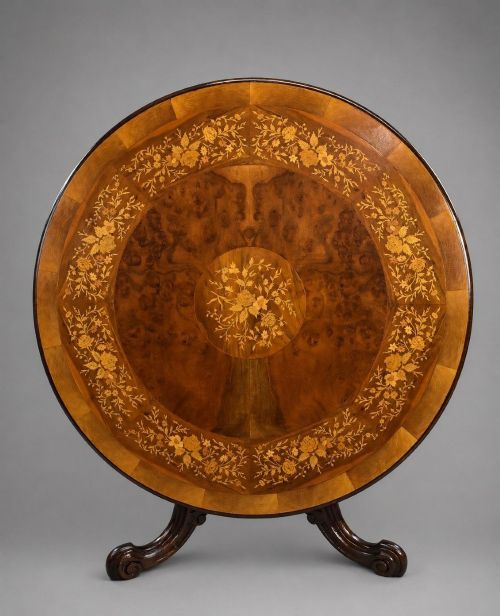
Burr walnut loo tables are substantial Victorian centre tables defined by figured timber and marquetry inlay.
Inlaid Burr Walnut Loo Table
An inlaid burr walnut loo table sits firmly in the Victorian period, originating mostly between the eighteen-fifties and eighteen-eighties. These pieces take the form of large round or oval centre tables designed for gathering, frequently featuring tilt tops or snap mechanisms for storage.
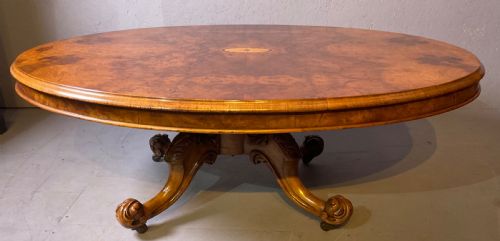
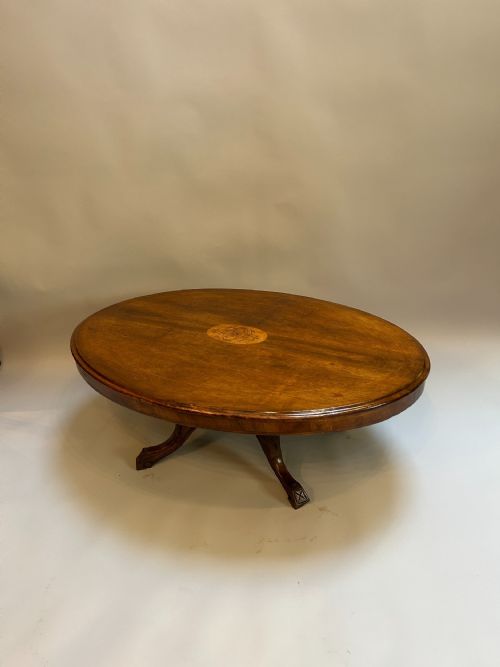
The version most commonly met on this page is an oval or round table supported on a carved pillar base, often with multiple legs or a freestanding basket base. Makers constructed these items primarily as centre tables or breakfast tables for the principal rooms of nineteenth-century homes.
Makers also produced smaller variants including occasional tables, lamp tables, and occasional coffee tables adapted from the same stylistic vocabulary. The designation covers both standard pedestal formats and stretcher tables incorporating elaborate wood inlay.
Distinctions in standard and execution
The richness and complexity of the marquetry inlay set individual pieces apart, ranging from simple stringing lines to elaborate multi-wood floral panels across the top. Superior examples display crisp, deep carving on the central pillar and legs, contrasting sharply with simpler turned columns.
The choice of burr walnut veneer dictates visual impact, with tightly curled grain patterns fetching greater regard than plain timber surfaces. Furthermore, the precision of the tilt mechanism and the stability of the pedestal base reveal the original joiner's skill.
Inlaid Burr Walnut Loo Table Retail Price Guide 2026
Typical asking prices for inlaid burr walnut loo table among the pieces listed under this phrase on Sellingantiques today, from the lower quarter to the upper quarter. They describe what is for sale here now, not the wider market.
Listings show Victorian pieces dated between eighteen-fifty and eighteen-eighty, utilising burr walnut, boxwood inlay, and marquetry.
Edward Holmes Baldock·Gillows·Holland and Sons
The Inlaid Burr Walnut Loo Table Glossary
- Burr walnut
- A specialised timber cut from walnut tree growths, yielding highly swirled and mottled grain patterns. Cabinet makers prized this veneer for tabletops.
- Loo table
- A large Victorian round or oval table designed for card games and social gatherings. Many versions feature a tilt top mechanism.
- Marquetry
- A decorative technique arranging thin pieces of wood veneer into pictorial or geometric patterns. Artisans used contrasting fruitwoods and boxwood for this work.
- Tilt top
- A hinged tabletop mechanism allowing the surface to fold vertical for storage against a wall. This format appeared frequently on nineteenth-century centre tables.
- Centre table
- A freestanding table finished on all sides to sit in the middle of a room. Victorian interiors utilised these pieces as focal points.
Inlaid Burr Walnut Loo Table: Frequently Asked Questions
How do I date a burr walnut table?
Most examples date from the Victorian era between eighteen-fifty and eighteen-eighty. Look at the construction of the pedestal base, the style of the carving, and the complexity of the marquetry.
Mid-Victorian pieces typically display richer burr walnut veneers and more exuberant Revival styling than later decades.
Can I use a loo table as a coffee table?
Many people adapt these tables for modern living spaces as coffee tables, though their original height is taller than standard low coffee tables. The expansive inlaid top provides a dramatic surface for display.
Ensure the tilt mechanism remains stable if you choose to place heavy items on the surface.
What is the difference between a centre table and a breakfast table?
Centre tables were built as decorative freestanding pieces for the middle of a room, while breakfast tables served a functional dining purpose in morning rooms. Both share similar pedestal and tilt-top construction.
In practice, Victorian cabinet makers often used the terms interchangeably for round inlaid walnut tables.