



Impressionist Woodland Landscape
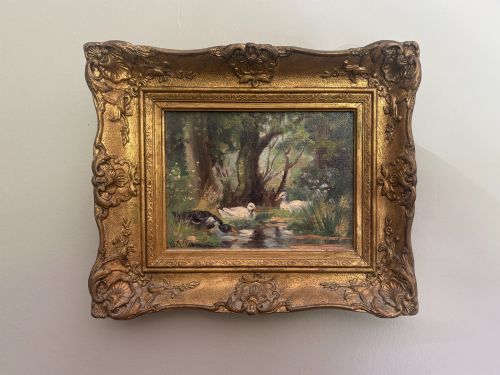
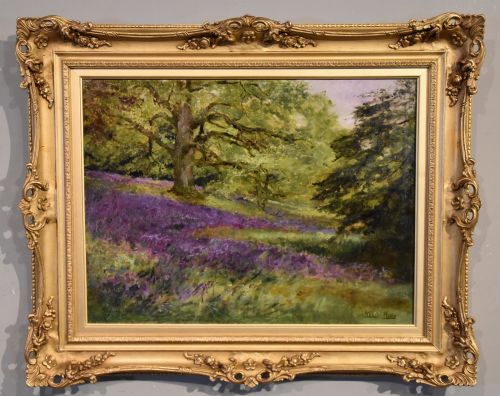
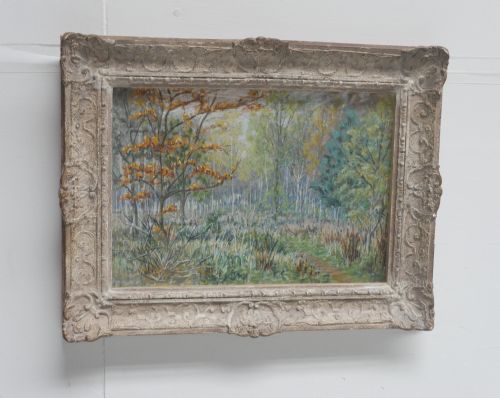
An impressionist woodland landscape captures dappled light and foliage through loose brushwork, bringing the quiet atmosphere of trees indoors.
Impressionist Woodland Landscape
An impressionist woodland landscape presents trees, forest paths and clearings rendered through visible brushstrokes and a focus on natural light. You will encounter works spanning from the nineteenth century through the mid-twentieth century, reflecting diverse regional interpretations.
Common subjects include bluebell woods, riverside trees and secluded country lanes. Artists such as Paul Désiré Trouillebert and Henri Joseph Harpignies connect these works to the Barbizon School and French Naturalism.
How they were made
Artists built these compositions primarily using oil paint applied to stretched canvas or wooden panels, utilising loaded brushes to create textured surfaces. Watercolour on paper and pastel appear in select examples, offering lighter tonal washes and softer transitions of light.
Gesso serves as the foundational ground on many wooden panels and canvases, preparing the surface to receive oil media. Selected frames incorporate gold leaf, adding a reflective border that complements the luminous pigments within the artwork.
Several canvases record quiet woodland spots where painters traded studio comfort for damp grass and curious local wildlife.
What varies in quality
Quality rests in the handling of light and the confidence of the brushwork. A superior canvas uses broken colour and varied pigment thickness to suggest foliage and atmosphere rather than relying on strict botanical detail.
The strength of the composition dictates the visual balance between shadowed groves and sunlit clearings. Masterful works maintain depth and spatial cohesion across the entire surface, whereas lesser examples lose structure in the background.
Paul Désiré Trouillebert·Thomas Bromley Blacklock·Owen Bowen·Henri Joseph Harpignies·James Proudfoot·Ernest Higgins Rigg·Edward H. Holder·George F. Wetherbee·Herbert Royle·John Falconar Slater·Hans Kappel Øvre·Walter Emsley·Charles Edmond Rene His·Kershaw Schofield·George Neil
The Impressionist Woodland Landscape Glossary
- Barbizon School
- A nineteenth-century French art movement dedicated to naturalistic landscape painting. Artists painted outdoors to capture authentic rural scenery.
- Gesso
- A plaster mixture applied as a ground on canvas or wood panels before painting. It creates a smooth and stable surface for oil media.
- Oil on Canvas
- Pigment mixed with drying oils applied to woven fabric stretched over a wooden frame. This combination allows for rich colour blending and texture.
- Watercolour
- A painting method where coloured pigments are suspended in a water-based solution. It produces translucent washes on paper.
- Impressionism
- A style of painting that emphasises fugitive effects of light and rapid brushwork. Artists prioritize overall atmospheric impression over meticulous finish.
Impressionist Woodland Landscape: Frequently Asked Questions
How do I identify a woodland impressionist painting?
Look for visible, broken brushstrokes and an emphasis on how light filters through tree branches. Artists use varied colour patches rather than blended lines to represent leaves and shadows.
Context also helps determine the period. Works from the nineteenth and early twentieth centuries often show academic grounding beneath the loose impressionist surface.
Where should I hang a landscape painting?
Choose a wall with stable ambient light away from direct, harsh sunlight to protect oil pigments and watercolours over time. Wall placement at eye level allows the viewer to engage with the brushwork and depth of the forest scene.
Pairing the piece with traditional wooden furniture or neutral walls helps anchor the natural tones of the woodland subject.
What is the difference between oil and watercolour landscapes?
Oil paintings utilise heavy pigments suspended in oil on canvas or panel, offering rich textures and deep colour layering. Watercolours use transparent pigments on paper, resulting in lighter, more luminous compositions.
Oils generally tolerate environmental changes better than paper works, though both benefit from protective framing behind glass for watercolours.
How do I care for antique canvas paintings?
Keep paintings away from damp environments and extreme temperature fluctuations to prevent canvas slackening and wood warping. Dust the surface very gently with a soft, dry brush without applying pressure.
Avoid using any liquid cleaners or chemical agents on the painted surface. Professional conservators should handle any structural repairs or varnish cleaning.