




Impressionist Venice Painting
Impressionist venice painting captures the shifting light and water of the lagoon through loose brushwork and atmospheric colour.
Impressionist Venice Painting
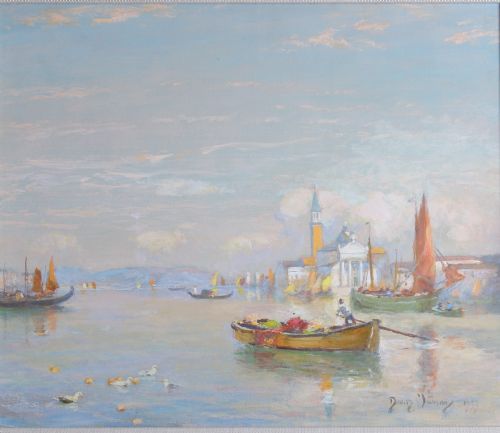
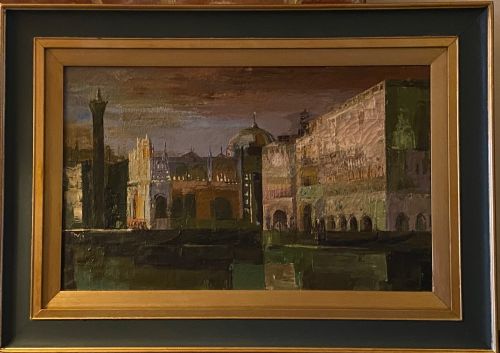
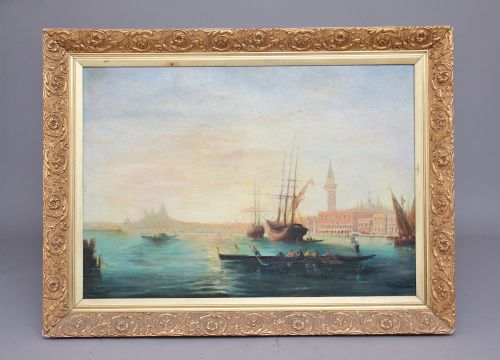
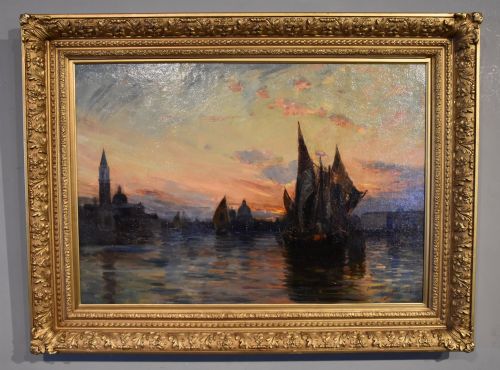
An impressionist venice painting brings the light, canals, and architecture of the lagoon into a room through rapid brushwork and luminous pigments. These works capture specific atmospheric moments, from bright midday glare on the Grand Canal to the deep shadows near the Bridge of Sighs.
The pieces appearing on this page span from the late nineteenth century into the mid-twentieth century, encompassing British Impressionism, French Impressionism, and Italian Impressionism. Buyers will find both intimate watercolours on paper and large oil paintings on canvas.
Common subjects include gondoliers navigating narrow canals, distant views of Santa Maria della Salute, and old Venetian mansions flanking the water. The selection ranges from compact works suited for small spaces to grand canvases designed to anchor a wall.
How they were made
Artists built these scenes using oil paint or watercolour applied to canvas, paper, or wood panels. Oil on canvas allowed painters to build rich surface textures with thick impasto, while watercolour enabled swift, transparent washes that captured the fluidity of the lagoon.
Gesso frequently served as a preparatory ground for canvas supports, creating a bright foundation that enhanced the luminosity of overlying pigments. Painters worked rapidly to record shifting daylight, relying on broken colour and optical mixing rather than rigid lines.
Impressionist Venice Painting Retail Price Guide 2026
Typical asking prices for impressionist venice painting among the pieces listed under this phrase on Sellingantiques today, from the lower quarter to the upper quarter. They describe what is for sale here now, not the wider market.
Several gondoliers captured in these paintings have been silently poling beneath the Bridge of Sighs for over a century.
What varies in quality
The distinction between standard works and masterworks rests on the artist's handling of light and atmospheric depth. Superior pieces demonstrate a confident command over tone, where loose brushstrokes resolve into convincing reflections on water and solid architectural mass.
Compositional balance separates routine topographical records from compelling artistic interpretations. Stronger examples utilise perspective and colour harmony to draw the viewer into the scene, avoiding static or overcrowded arrangements.
Sir David Murray RA·Sushila Singh·Claude Jousset·Antoine Bouvard Senior·Clara Montalba·Vittore Zanetti Zilla·Hercules Brabazon Brabazon·Frank Wasley·Henry Wimbush·Helen Donald-Smith
The Impressionist Venice Painting Glossary
- Impressionism
- A nineteenth-century painting style focused on capturing the visual impression of a moment, particularly shifting light and atmosphere. Artists prioritized loose brushwork and unblended colours over smooth academic finishes.
- Lagoon
- The shallow body of salt water in which Venice sits, bounded by sandbars and the Adriatic Sea. It provides the characteristic misty light and reflective surfaces seen in these works.
- Gesso
- A white paint mixture consisting of a binder mixed with chalk, gypsum, or pigment. Used historically to prepare wood panels, canvas, or paper for painting.
- Impasto
- Paint applied thickly to a canvas, standing out from the surface so that the marks of the brush or palette knife remain visible. This technique adds tactile depth and catches ambient light.
- Gondolier
- A traditional Venetian oarsman who propels and steers the long flat-bottomed boat known as a gondola. Figures of gondoliers frequently provide scale and human narrative in lagoon scenes.
Impressionist Venice Painting: Frequently Asked Questions
What subjects appear in these paintings?
The works primarily depict the canals, lagoons, and historic architecture of Venice. Common motifs include the Grand Canal, gondoliers beneath bridges, and landmark buildings like Santa Maria della Salute.
Scenes range from wide panoramic views of the water to quiet residential canals flanked by old mansions.
How do oil and watercolour versions differ?
Oil paintings on canvas offer heavy pigment texture, rich impasto, and deep colour saturation. They often present larger compositions suited for prominent display.
Watercolours on paper provide a lighter, more transparent quality that emphasises the luminous haze and fluid atmosphere of the lagoon.
How should I frame an impressionist painting?
Traditional gilt frames or simple wooden mouldings complement the period aesthetics of these works. The choice of frame should enhance the depth of the canvas without overpowering the loose brushwork.
Watercolours require conservation framing behind glass to protect the paper from moisture and ultraviolet light.
How do I distinguish British from French impressionist styles here?
British works often lean towards tonal subtlety and atmospheric restraint, reflecting the local landscape tradition. French and Italian examples tend to use brighter palettes and more direct experiments with light.
Both approaches share the core impressionist focus on capturing fleeting optical effects rather than rigid botanical or architectural detail.