

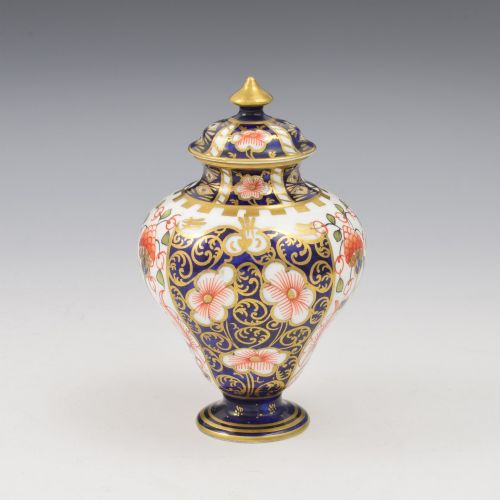


Imari Style Porcelain Urn
An imari style porcelain urn brings deep iron-red and cobalt-blue hand-painted decoration into a room, catching the eye with vibrant floral and geometric motifs.
Imari Style Porcelain Urn
The selection on this page most frequently includes nineteenth-century and early twentieth-century examples, spanning Victorian, Edwardian, and Georgian periods. Makers ranged from English factories like Royal Crown Derby and Chamberlain Worcester to Continental European workshops and Japanese kilns.
How they were made
Potters shaped the base bodies from porcelain and applied fluid glazes before firing at high temperatures. Artisans then built up the characteristic palette using enamel pigments alongside gold leaf, gold gilding, and gilt bronze mounts.
Decoration often involved intricate hand-painted patterns featuring bamboo, fluted body shaping, and distinctive panel designs. Workshops applied gilding to highlight rims, handles, and surface motifs.
Imari Style Porcelain Urn Retail Price Guide 2026
Typical asking prices for imari style porcelain urn among the pieces listed under this phrase on Sellingantiques today, from the lower quarter to the upper quarter. They describe what is for sale here now, not the wider market.
Some nineteenth-century makers painted bamboo patterns so convincingly that buyers try to rustle the leaves.
What varies in quality
The sophistication of the hand-painted enamel work separates ordinary productions from finer examples, with delicate brushwork and rich colour saturation marking superior pieces. Crisp definition in the cobalt blue and iron red demonstrates artisan skill.
The application of gold leaf and gilding also dictates overall merit, as thick, burnished gold creates depth that flat metallic paint lacks. Furthermore, the precision of the porcelain moulding and the inclusion of original covers influence the standing of any given piece.
Royal Crown Derby·Chamberlain Worcester·Samson·Fukagawa·Korango
The Imari Style Porcelain Urn Glossary
- Imari style
- A decorative scheme imitating Japanese export porcelain, typically combining underglaze cobalt blue, iron red, and gilt highlights. This palette became widely adopted by European and British factories.
- Garniture set
- A matched group of vases or urns designed to be displayed together on a mantelpiece or sideboard. These sets usually comprise three or more graduated or matching vessels.
- Ice pail
- A specialised vessel intended for cooling wine or glassware at the dining table, often equipped with liner elements and handles. In porcelain, these double as decorative urn forms.
- Jandiniere
- A large ornamental pot or receptacle designed to hold growing plants or floral arrangements. They frequently share the heavy decorative glazes and forms of large vases.
- Gilt bronze
- Copper alloy cast elements treated with a gold coating to mount or accent ceramic bodies. This material adds structural weight and decorative contrast to the porcelain.
Imari Style Porcelain Urn: Frequently Asked Questions
How do I date an imari style porcelain urn?
Dating relies on examining the porcelain body, glaze characteristics, and any factory marks stamped or painted on the base. Stylistic clues such as Victorian or Edwardian moulding shapes also help narrow down the decade of production.
Comparison with documented pieces from makers like Royal Crown Derby or Chamberlain Worcester provides further chronological context.
Where were these porcelain urns manufactured?
Production locations span both Asian and European workshops, reflecting a long history of cross-continental trade and stylistic imitation. Japanese kilns produced authentic export wares, whilst British and French factories created their own interpretations.
English firms and Continental potteries frequently adopted the distinct palette to satisfy Western tastes.
How should I clean and care for my urn?
Dust the porcelain gently with a soft, dry brush to prevent accumulation in recessed fluting and handles. Avoid harsh chemical cleaners or submersion in water, particularly where gold leaf and delicate enamels are present.
Display the piece away from direct sunlight to preserve the vibrancy of the iron-red and cobalt-blue pigments over time.
What is the difference between Japanese and European imari?
Japanese originals generally feature specific Edo period motifs and distinct paste compositions typical of eastern kilns. European interpretations often blend these decorative tropes with local ceramic shapes like ice pails or garnitures.
European pieces may also carry factory marks characteristic of nineteenth-century British or French manufacturers.