
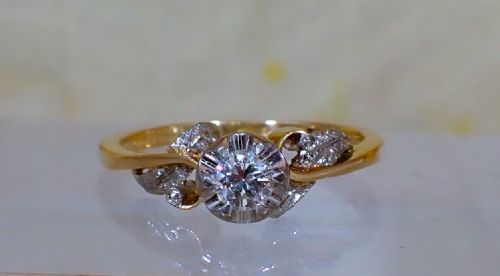


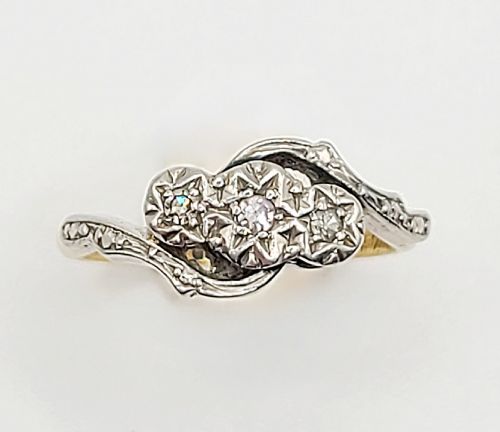


Illusion Setting Ring
An illusion setting ring uses clever metalwork to make a diamond look far larger than it actually is.
Illusion Setting Ring
An illusion setting ring is a piece of jewellery designed to maximise the visual impact of a diamond through specialised mounting. When you search for an illusion setting ring, you encounter designs that combine precious metals with faceted stones to create a bold central presence on the hand.
The pieces listed here span several decades, featuring Victorian, Edwardian, and Art Deco examples alongside mid-century designs. You are most likely to meet 1930s Art Deco rings that pair 18ct gold with platinum mountings.
Solitaire and trilogy forms dominate the selection, functioning primarily as engagement rings or dress rings. The settings use faceted or star-cut plates to reflect light around the stone, tricking the eye into reading a smaller diamond as a much larger gem.
How they were made
Goldsmiths constructed these rings using combinations of 18ct gold, 9ct gold, white gold, and platinum. Platinum frequently appears in Art Deco pieces to hold stones securely while providing a bright white border that merges visually with the diamond.
Techniques relied on precision milling and facet-cut bezels surrounding the main stone. By scoring or cutting the surrounding metal plate to mimic facets, makers amplified the brilliance and spread of the central diamond.
An ingenious Victorian trick to make a modest diamond punch above its weight class.
What varies in quality
Quality in these rings rests on the precision of the metalwork surrounding the stone and the preservation of the illusion plate. Finer examples show crisp geometric engraving and seamless joints between the platinum top and the gold shank.
The choice of materials also divides the range, with heavier 18ct gold and platinum settings representing higher-tier production compared to lighter 9ct gold alternatives. The proportion and weight of the metal directly affect how convincingly the illusion holds.
The Illusion Setting Ring Glossary
- Illusion setting
- A mounting technique where a faceted metal plate surrounds a diamond to enhance its apparent size and brilliance. This method was particularly popular during the early twentieth century.
- Trilogy ring
- A ring featuring three stones set in a row, often symbolising the past, present, and future. These frequently appear in Edwardian and Art Deco designs.
- Transition cut
- A diamond cut used roughly between the old European cut and the modern brilliant cut, bridging antique and contemporary styles. You find these in pieces from the mid-century period.
Illusion Setting Ring: Frequently Asked Questions
What is an illusion setting ring?
An illusion setting ring uses a specially faceted metal plate around a diamond to make the stone appear larger than its actual carat weight. This technique became popular because it offered a grander visual presence without the higher cost of a larger gem.
Most examples you encounter date from the Victorian era through to the mid-twentieth century, with strong representation from the Art Deco period.
How do I care for my ring?
Care for your ring by cleaning the metal and stone gently with warm soapy water and a soft brush to remove everyday oils. Avoid harsh chemicals that might affect the integrity of the antique gold or platinum.
Take the ring off during heavy manual tasks to protect the delicate illusion plates and claws from unnecessary wear or impact.
How do I identify Art Deco pieces?
Art Deco rings show distinct geometric lines, sharp angles, and a strong contrast between yellow gold shanks and platinum-topped settings. The design focuses on symmetry and stylised motifs that reflect the architecture of the 1920s and 1930s.
These pieces often combine platinum with diamond and 18ct gold, creating a crisp white surface that enhances the central diamond.
Can I wear an illusion ring daily?
You can wear these rings daily provided you give them the standard care required for antique and vintage jewellery. The sturdy construction of 18ct gold and platinum makes them resilient enough for regular wear.
Checking the setting periodically ensures the central stone and the surrounding illusion plate remain secure in their mountings.