
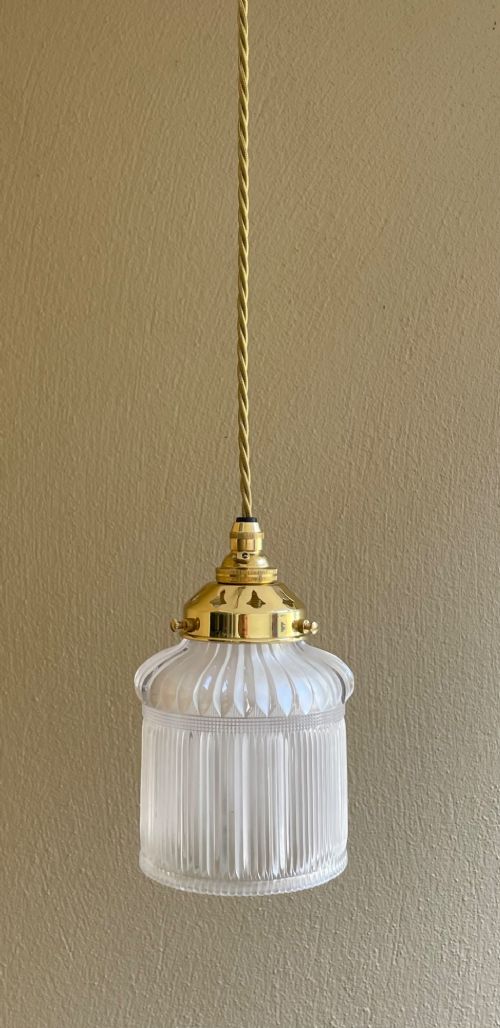


Holophane Glass Light Shade
A holophane glass light shade directs brilliant illumination downwards while softening glare through its scientific ribbed design.
Holophane Glass Light Shade
When you search for a holophane glass light shade, you are looking at utilitarian industrial lighting designed to spread functional illumination evenly across workspaces. These pieces predominantly take the form of pendant lights suspended from galleries.
The versions most likely to meet you on this page date from the Edwardian period, the 1910s, 1920s, and the 1940s. They span styles from straightforward industrial to Edwardian industrial and industrial Art Deco.
Makers and manufacturers produced these in shapes such as the bell pendant, paired with metal components ranging from brass to chrome and cast iron. They serve as both historical artefacts and practical overhead fittings for contemporary interiors.
How they were made
These shades rely upon specialised prismatic glass, moulded with precise vertical or diagonal ribs that refract and diffuse light rather than simply blocking it. This optical engineering formed the core patent of the manufacturer.
Makers paired the glass shades with robust metal galleries and fittings cast from brass, chrome, or cast iron to support the weight and suspend the pendant securely.
Listings span periods from the 19th century through the 1940s, featuring glass, brass, chrome, and cast iron materials.
What varies in quality
Quality rests in the optical clarity of the prismatic glass and the crispness of the moulded ribs that manage the light distribution. Softer moulding or clouded glass alters the intended brightness and visual sharpness of the shade.
The structural integrity and finish of the accompanying metal gallery, whether cast iron, brass, or chrome, distinguish a standard commercial fitting from a heavier, more finely engineered industrial survivor.
The Holophane Glass Light Shade Glossary
- Prismatic glass
- Glass moulded with precise optical ribs on the exterior or interior surface to bend and direct light. This material defines the core function of the shade.
- Gallery
- The metal collar or fitter that grips the top of the glass shade and connects it to the suspension rod or chain. These mounts appear in brass, chrome, and cast iron.
- Bell pendant
- A pendant light featuring a shade shaped like a spreading bell, designed to throw light downwards over a specific area. This form appears frequently in industrial settings.
- Edwardian industrial
- A hybrid style combining the refined proportions typical of the Edwardian era with the robust utility of early factory lighting. It bridges domestic and commercial aesthetics.
Holophane Glass Light Shade: Frequently Asked Questions
How do I hang a pendant light?
These pendant lights suspend from a ceiling hook or rigid rod connected to the metal gallery at the top of the shade.
Ensure the wiring meets modern safety standards before hanging the fixture in your chosen room.
What rooms suit an industrial shade?
Kitchens, hallways, and dining spaces benefit from the downward directional light cast by these ribbed glass pendants.
They pair well with both modern minimalist decors and traditional period spaces.
How do I date an Edwardian shade?
Examine the weight of the glass, the style of the metal gallery, and any patent markings stamped into the rim or fitting.
Edwardian pieces often feature heavier brass or iron components alongside early prismatic moulding.
Why use prismatic glass?
The patterned ribs refract light efficiently to reduce glare while maximising the spread of illumination across a workspace.
This scientific approach to lighting made them popular in early factories and commercial buildings.