


Historic Landscape Oil
Historic landscape oil paintings capture notable places and past eras through pigment and canvas, offering tangible windows into former centuries.
Historic Landscape Oil
A historic landscape oil presents recorded scenery, architecture or genre scenes rendered in oil paint upon canvas, spanning periods from the eighteenth century through to the mid twentieth century. These works frequently depict recognizable British or European settings such as castles, rivers, canals and country estates.
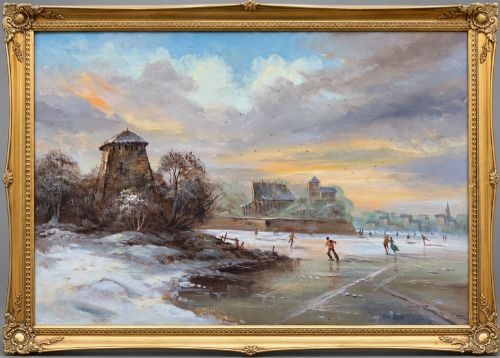
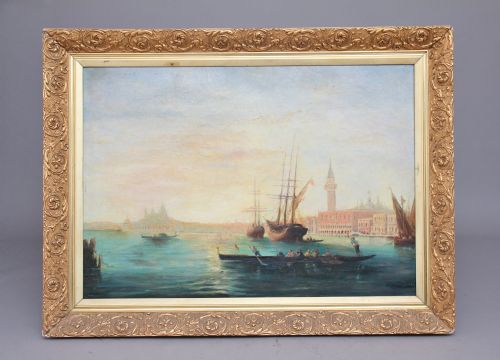
The selection on this page encompasses diverse regional movements, including Dutch winter scenes, Venetian lagoons, English country views and Italianate compositions. Artists employ distinct stylistic approaches ranging from Victorian realism to impressionistic treatments.
Buyers encounter framed works executed by listed painters alongside signed compositions attributed to regional artists. Subject matter varies from maritime and rural environments to historical architectural landmarks.
How they were made
Pigments bound in oil are applied to stretched canvas substrates, allowing for rich blending and varied surface textures. Many canvases are housed within original or period-appropriate wood and gesso frames, often highlighted with gold leaf.
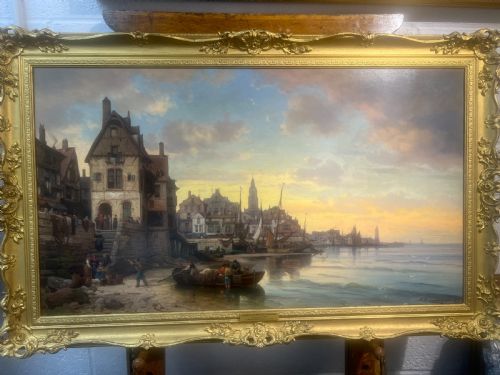
Techniques range from meticulous brushwork capturing architectural detail in nineteenth-century townscapes to looser application seen in later impressionist and landscape interpretations.
Ice skaters animate frozen Dutch canals in winter scenes, preserving centuries of chilly outdoor leisure on canvas.
What varies in quality
The distinction between standard works and superior examples rests in the handling of light, atmospheric depth and compositional balance by the painter. Masterful brushwork brings movement to water, skies and architectural masonry, elevating the visual engagement.
Framing integrity and the preservation of the original canvas surface significantly influence the overall character of the piece. Works retaining their period giltwood frames maintain greater historical continuity.
Charles Euphraisie Kuasseg·Charles William Wyllie·John Sanderson Wells·Frank Moss Bennett·Robert Thomas Buttery·Peter de Wint
The Historic Landscape Oil Glossary
- Canvas
- A heavy woven fabric used as a surface for oil painting. It is typically stretched tightly across a wooden frame before pigment is applied.
- Giltwood
- Wood carved and coated with gold leaf or gold paint. This material is frequently found on the decorative frames enclosing period paintings.
- Gesso
- A paint mixture consisting of a binder mixed with chalk, gypsum, or pigment. It serves as a prepared base for wood and frame mouldings before gilding.
- Genre painting
- The pictorial representation of scenes from everyday life. These works depict ordinary people engaged in common activities or historical pastimes.
Historic Landscape Oil: Frequently Asked Questions
How do I date a landscape oil painting?
Dating relies on stylistic clues, artist signatures, framing methods and canvas stamps. Documentation or biographical records of the artist provide precise timelines.
Changes in fashion, architecture, and painting techniques across the eighteenth, nineteenth, and twentieth centuries further assist in placing the work within a specific era.
What is an Italianate landscape?
An Italianate landscape depicts scenery inspired by the topography, light and architecture of Italy. These compositions often feature classical ruins, villas and calm waters.
Artists working in Britain and Northern Europe frequently adopted this style to evoke a romanticized classical antiquity.
How should I clean an oil painting?
Surface dust can be removed gently with a soft, dry brush. Professional conservators should handle deeper cleaning or varnish removal.
Avoid using water or domestic cleaning products on the canvas or the giltwood frame.
Are all these paintings signed?
Signatures appear on many works, often located in the lower corners. Some pieces remain unsigned or bear initials.
Attributions for unsigned works depend on stylistic analysis, subject matter, and historical provenance.