
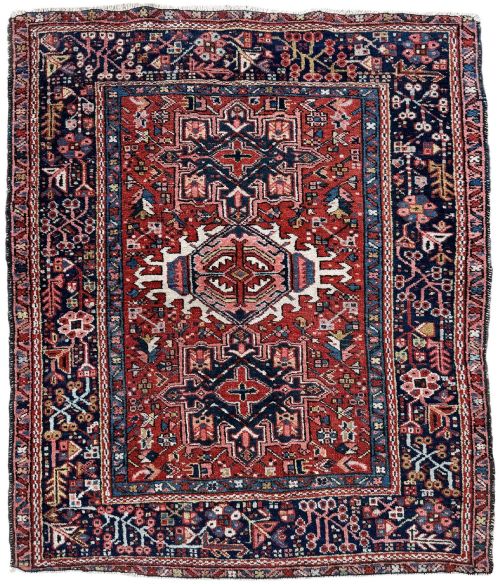


Heriz Style Persian Rug
A heriz style persian rug brings bold geometric patterns and grounded warmth to a room through centuries-old North-West Persian weaving traditions.
Heriz Style Persian Rug
When you search for a heriz style persian rug, you encounter hand-knotted wool floor coverings originating from North-West Persia during the late nineteenth and early twentieth centuries. These pieces encompass large carpets, smaller scatter sizes, hallway runners, and bag faces produced across regional villages.
The selection on this page centres on traditional room-sized carpets and smaller rugs dated from the eighteen-eighties to nineteen-thirty. Alongside direct Heriz pieces, you find related village weaves such as Gorevan, Karaja, Bakshaish, and Sarab sharing the same Northwest Persian provenance.
How they were made
These textiles are constructed using hand-knotted wool pile secured onto cotton foundations. Artisans tied individual knots by hand across warp and weft threads to build dense, durable floor coverings designed for heavy domestic use.
Weavers utilised local wool spun by hand and dyed with natural pigments. The resulting pile provides resilience while allowing the geometric motifs and characteristic palettes to age with soft nuance.
Several pieces preserve small bag faces once tied to pack animals, now repurposed as compact wall or floor art.
What varies in quality
Quality in these rugs rests on the precision of the knotting and the crispness of the geometric drawing. Finer examples display tightly packed piles that keep rectilinear medallions and intricate corner spandrels sharply defined.
The handling of natural dyes also dictates the tier of a piece. Superior village weaving shows depth of colour and subtle abrash where tones shift naturally across the wool.
The Heriz Style Persian Rug Glossary
- Heriz
- A town in North-West Persia known for producing large, durable carpets with bold geometric medallions and rectilinear designs. These rugs often employ a characteristic large central star or hexagonal motif.
- Karaja
- A village in the same weaving region as Heriz that produces smaller rugs and runners. They frequently feature repeated geometric medallions along the central field.
- Bakshaish
- An older village weaving style associated with the Heriz district. These pieces typically display more open, whimsical designs and earthy palettes.
- Abrash
- A natural variation of colour within a field of wool. It occurs when dye batches change slightly during the hand-knotting process, creating subtle horizontal bands of shading.
- Spandrel
- The triangular corner area of a rug border surrounding a central medallion. In this tradition, spandrels often carry contrasting geometric fillers.
Heriz Style Persian Rug: Frequently Asked Questions
Where were heriz style persian rugs made?
These rugs originate from the North-West region of Persia, specifically towns and villages surrounding the town of Heriz. This area includes neighbouring weaving centres like Karaja and Bakshaish.
Production dates from the nineteenth and early twentieth centuries, where local artisans worked in homes and small workshops to create durable floor coverings.
How do I identify a heriz rug?
Look for a strong geometric vocabulary featuring a large central medallion and sturdy corner spandrels. The drawing relies on straight lines and rectilinear patterns rather than curving florals.
Palettes often incorporate rich terracotta, navy blue, and ivory tones. The dense wool pile feels substantial underfoot.
What is the difference between heriz and gorevan?
Gorevan rugs originate from the same district as Heriz and share similar geometric layouts. Gorevan pieces generally feature slightly looser knotting and more open, spacious field designs.
Traditional Heriz carpets tend to be denser, larger, and more tightly detailed in their central medallions and borders.
How do I care for an antique rug?
Vacuum gently using suction only without a rotating brush roll to protect the wool pile. Keep the textile out of direct, harsh sunlight to prevent natural dyes from fading over time.
Rotate the carpet periodically to ensure even wear across high-traffic areas in your home.