

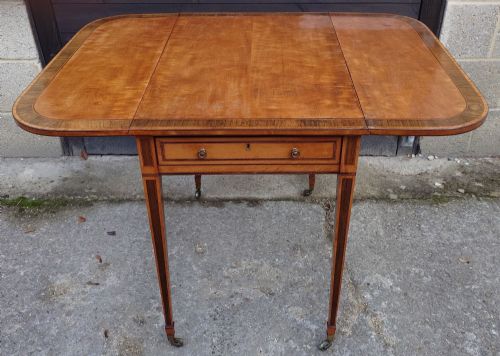
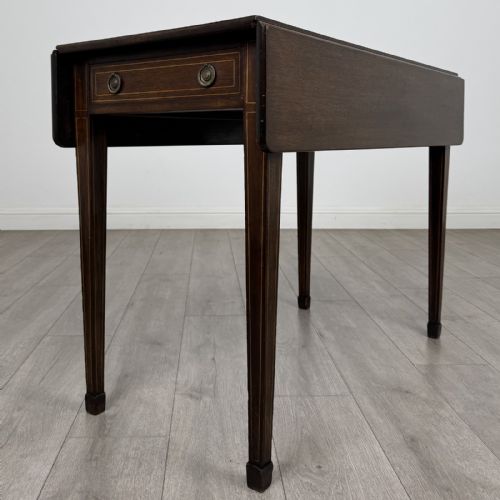
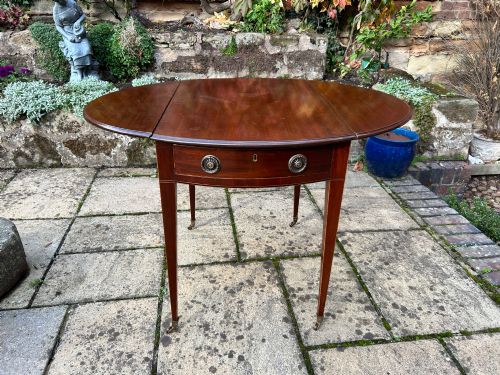

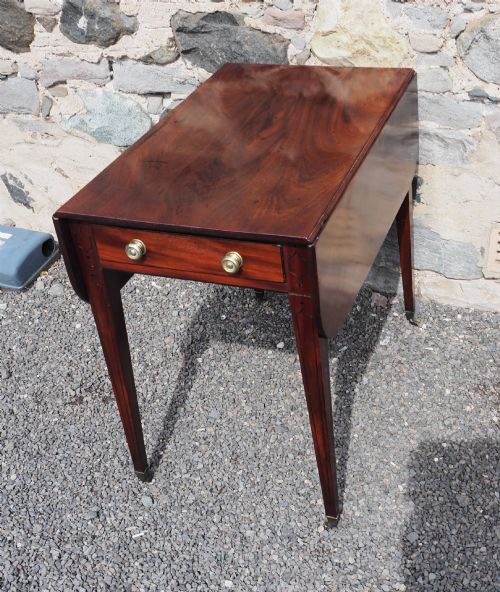


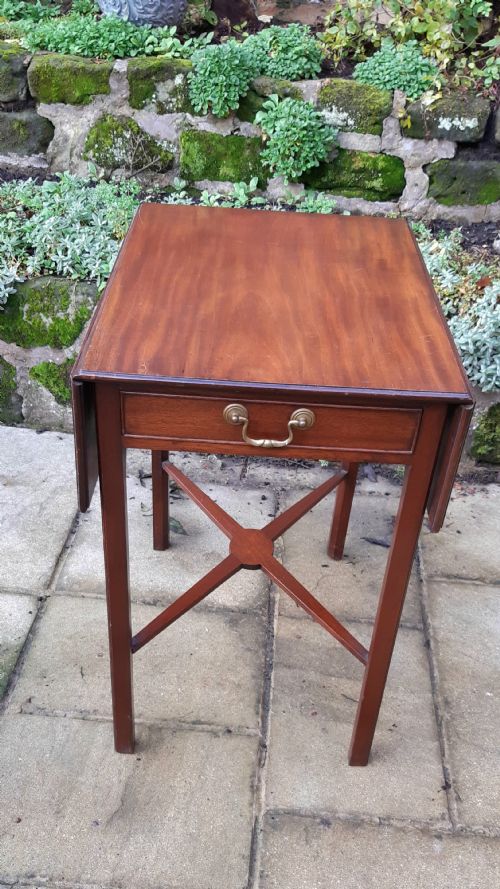


Hepplewhite Mahogany Pembroke Table
A hepplewhite mahogany pembroke table brings drop-leaf versatility and refined lines to a room, offering a clever surface for modest spaces.
Hepplewhite Mahogany Pembroke Table
A hepplewhite mahogany pembroke table is a drop-leaf occasional table defined by slender tapering legs and rectangular or oval folding flaps. These pieces date from the Georgian and 19th Century eras, alongside occasional examples from the early 20th Century.
The versions most commonly met on this page belong to the Georgian and George III periods, displaying the hallmark understated elegance of the style. Buyers encounter rectangular and oval forms, sometimes described as baby pembroke or lamp tables.
Makers utilised rich timber foundations to build these versatile side tables, which served for writing, breakfast, or needlework. The heritage of the form sits firmly in 18th Century and 19th Century English cabinet making.
How they were made
Cabinet makers constructed these tables primarily from solid and veneered mahogany, often selecting fiddleback grain for visual depth on the top surface. The primary timber pairs with contrasting lighter woods for decorative effect.
Makers incorporated satinwood and boxwood inlay to trace borders and oval motifs across the table tops. Brass fittings appear on original hinges and castors, securing the folding leaves and enabling easy movement around the room.
Hepplewhite Mahogany Pembroke Table Retail Price Guide 2026
Typical asking prices for hepplewhite mahogany pembroke table among the pieces listed under this phrase on Sellingantiques today, from the lower quarter to the upper quarter. They describe what is for sale here now, not the wider market.
Certain baby pembroke tables were built on such a diminutive scale they appear ready for a doll's tea party.
What varies in quality
Quality rests in the precision of the boxwood and satinwood inlay and the crispness of the tapering leg profiles. Superior examples display thoughtful grain matching across the mahogany leaves.
The integrity of the structural joinery beneath the flaps dictates the daily utility of the table. Finer pieces retain patination on the timber surfaces built up across the Georgian period.
The Hepplewhite Mahogany Pembroke Table Glossary
- Pembroke table
- A small drop-leaf table with hinged flaps on opposite sides supported by hinged brackets or rule joints. This form gained popularity during the 18th Century for its adaptable footprint.
- Fiddleback mahogany
- A figured variety of mahogany showing a wavy grain pattern that resembles the back of a violin. Cabinet makers prized this timber for high-status decorative surfaces.
- Rule joint
- A moulding technique used on drop-leaf tables where a quarter-round edge on the flap meets a hollow in the fixed top. This design conceals the hinge mechanism when the leaves are raised.
- Inlay
- A decorative technique where contrasting materials such as satinwood and boxwood are set flush into the mahogany surface to form geometric or floral patterns.
Hepplewhite Mahogany Pembroke Table: Frequently Asked Questions
What is a pembroke table used for?
These tables served multiple domestic purposes in Georgian rooms, acting as writing desks, breakfast tables, or side tables depending on the hour. The drop leaves allowed them to stand compactly against a wall until extra surface area was needed.
In modern homes, they function well behind a sofa, as a bedside stand, or as a small desk in a study where space is limited.
How do I identify a Georgian pembroke table?
Look for slender tapering legs, characteristic of the Hepplewhite style, alongside quality mahogany timber and subtle boxwood or satinwood stringing. The construction methods, such as hand-cut dovetails in the drawers, point to 18th Century workshop practices.
Examining the underside reveals the timber ageing and the original hinging methods used to secure the drop leaves.
Are oval and rectangular pembroke tables different?
Oval pembroke tables feature curved drop leaves that soften the silhouette compared to the sharp corners of a rectangular top. Both shapes were produced during the Georgian period to suit different room layouts.
Oval versions frequently incorporate marquetry or elaborate satinwood inlay across the curved top panels.
How do I care for a mahogany pembroke table?
Keep the timber away from direct heat sources and strong sunlight to prevent the mahogany surface and inlay from drying out. Dust regularly with a dry cloth and apply a traditional wax polish sparingly to maintain the finish.
Take care when raising and lowering the drop leaves to protect the rule joints and supporting brackets from undue stress.