





Heavy Copper Kitchen Pot
A heavy copper kitchen pot brings honest warmth to any room, offering the sturdy utility of past centuries.
Heavy Copper Kitchen Pot
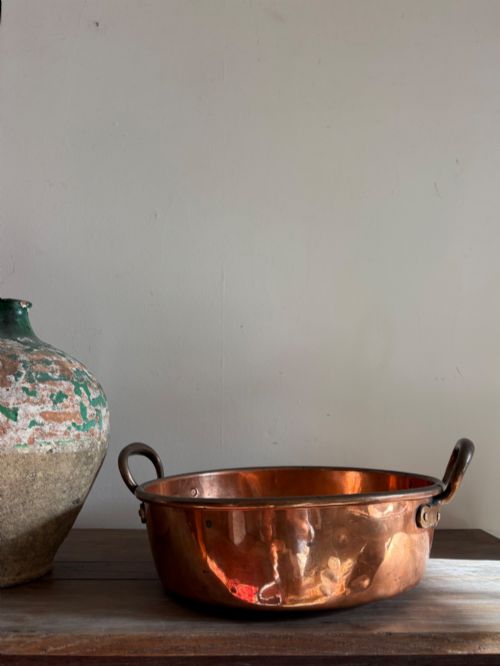
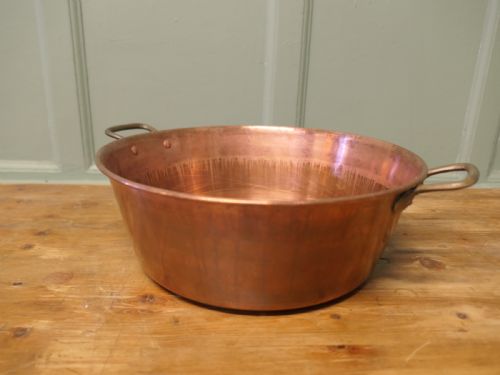
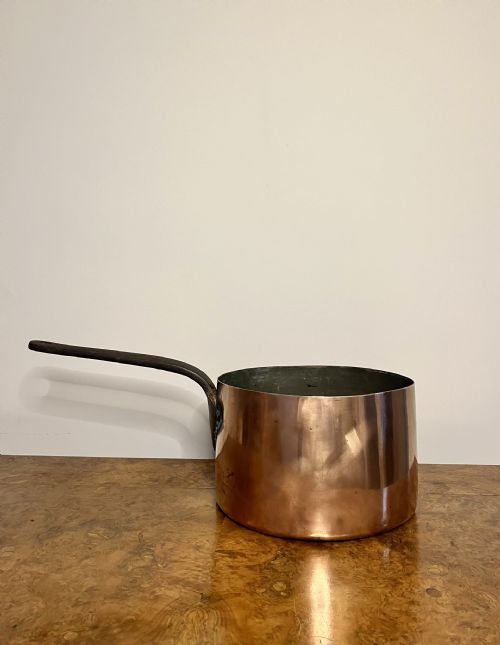
A heavy copper kitchen pot represents robust working cookware designed for serious culinary tasks in busy kitchens. Buyers exploring this phrase find substantial kitchenware shaped from thick metal, often featuring strong brass handles and generous proportions.
The versions most commonly met on this page span the Georgian and Victorian eras, taking the form of preserve pans, jam pans, lidded saucepans, and cream setting pans. These vessels originate from English and French workshops, reflecting traditional country and farmhouse aesthetics.
Each item displays the marks of genuine kitchen use, ranging from simple cooking vessels to stamped pans bearing maker details. The forms remain fundamentally utilitarian, built to conduct heat evenly across open hearths or early stoves.
How they were made
Construction relies on thick sheets of copper beaten and formed into deep vessels, paired with heavy cast brass handles riveted securely to the body. Iron and cast iron elements sometimes appear on specific pans, while interior surfaces typically receive a protective lining of tin.
Makers shaped these pots by hand to withstand intense hearth heat, employing dovetail joints and sturdy seams to hold the heavy walls together. The combination of thick copper and strong brass creates the substantial weight characteristic of these traditional kitchen pieces.
Heavy Copper Kitchen Pot Retail Price Guide 2026
Typical asking prices for heavy copper kitchen pot among the pieces listed under this phrase on Sellingantiques today, from the lower quarter to the upper quarter. They describe what is for sale here now, not the wider market.
Many a jam pan still carries the faint, sweet scent of nineteenth-century fruit preserves baked deep into its hammered surface.
What varies in quality
Quality rests in the thickness of the metal sheet and the integrity of the original construction rather than surface polish alone. Superior examples maintain a heavy, balanced gauge of copper that distributes heat evenly without warping.
The refinement of the brass handles and the precision of the riveting reveal the maker's hand, distinguishing standard utilitarian output from superior workshop production. Marked pieces bearing maker stamps or workshop names often demonstrate a higher grade of craftsmanship.
Hodges And Sons·Liptons
The Heavy Copper Kitchen Pot Glossary
- Preserve pan
- A wide, deep vessel designed for boiling fruit and sugar. These pans feature open tops to allow steam to escape efficiently during long simmering processes.
- Cream setting pan
- A wide, shallow utensil used in dairy work to allow cream to rise to the surface of milk. This form reflects specialised rural domestic tasks.
- Tin lining
- A protective interior coating applied to copper cookware to prevent food from reacting with the metal. Traditional pots require this internal layer for safe food preparation.
- Dovetail joint
- A method of interlocking metal edges used in heavy vessel construction. This technique secures the base and walls before hammering.
- Georgian
- A historical period spanning the eighteenth and early nineteenth centuries. Pieces from this era display early manufacturing techniques and simple utilitarian lines.
Heavy Copper Kitchen Pot: Frequently Asked Questions
What were heavy copper kitchen pots used for?
These vessels served demanding daily tasks such as boiling large quantities of jam, simmering preserves, and heating liquids over open hearths.
Their thick metal walls allowed cooks to manage high heat without scorching sensitive ingredients.
How do I tell a Georgian pot from a Victorian one?
Georgian pieces generally exhibit earlier hand-beaten characteristics and simpler forms, reflecting eighteenth-century kitchen methods.
Victorian versions often incorporate heavier cast handles and more standardised workshop production techniques.
Can I cook with an antique copper pan?
Many antique pans require a fresh interior tin lining before they are used for modern food preparation.
Without this protective layer, copper can react directly with acidic ingredients during cooking.
Why are some copper pans so heavy?
The weight comes from thick gauge metal sheets and robust brass handles chosen to prevent warping under intense heat.
Substantial thickness ensured the vessel could endure decades of heavy domestic service.