




Heavy Brass Door Furniture
Heavy brass door furniture brings substance to an entryway, offering sturdy handles, knockers, and pulls shaped by Victorian and Arts and Crafts hands.
Heavy Brass Door Furniture
Heavy brass door furniture comprises utilitarian hardware designed for domestic and public entrances, appearing primarily as door knockers, handles, finger plates, centre pulls, and letter boxes. When searching for heavy brass door furniture, buyers encounter pieces intended to endure daily physical use while establishing an immediate visual impression on an exterior or interior door.
The items found here span the Victorian, Edwardian, and 1900 periods, alongside the 1800s and broader 19th Century. Styles range from straightforward Victorian designs and Victorian Gothic Revival to Arts and Crafts and Grand Regency interpretations.
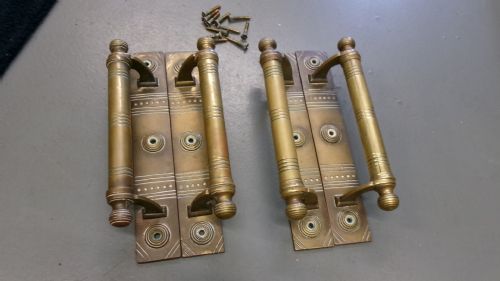
Most examples originate from the Victorian era, offering robust cast forms such as large complete knockers, centre door knobs, and bankers letter boxes. Arts and Crafts pairs of handles and finger plates represent another recurring format across these listings.
How heavy brass door furniture was made
The physical substance of these pieces relies on casting methods utilising brass, solid brass, cast brass, and bronze. Molten metal poured into moulds allowed makers to achieve the substantial heft and tactile weight expected of front door hardware.
What varies in quality in heavy brass door furniture
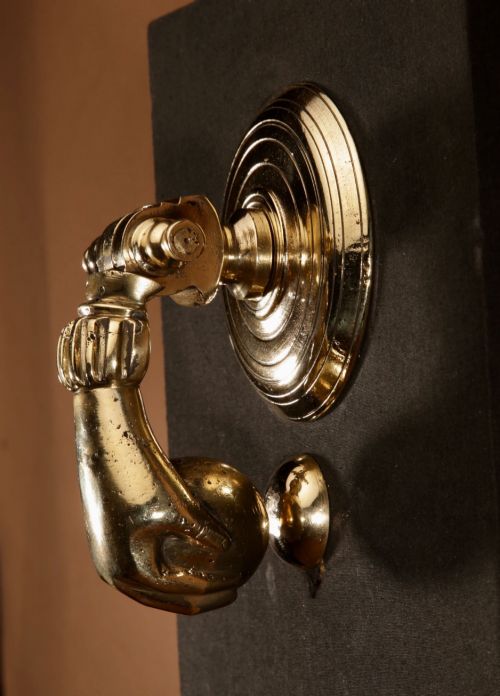
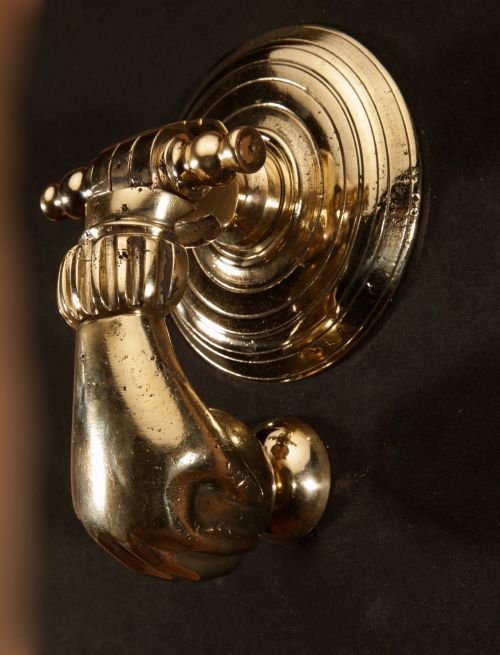
Quality rests in the depth of the casting and the crispness of the modelling, particularly visible in figurative pieces such as hand-shaped knockers or neoclassical and Gothic ornamentation. Superior examples display clean lines and well-proportioned mass without excessive porosity in the metal surface.
The integrity of the mechanism determines the distinction between standard hardware and exceptional examples. Complete sets that retain their original matching plates, bolts, and knobs demonstrate a higher grade of historical completeness than isolated components.
The Heavy Brass Door Furniture Glossary
- Centre Door Knob
- A large, stationary knob mounted centrally on a door, used primarily for pulling the door closed rather than operating a latch. These often feature decorative backplates.
- Finger Plate
- A flat protective plate fastened to a door near the handle to prevent hand oils and wear from soiling the wood surface. Arts and Crafts examples often display integrated geometric patterns.
- Door Knocker
- A striking mechanism fixed to the exterior of a door, comprising a hinged hammer and a striking plate. Historical versions frequently take sculptural forms such as hands or classical motifs.
- Gothic Revival
- A design style drawing inspiration from medieval architecture and ornament, characterised by pointed arches and robust, ecclesiastical detailing. In hardware, this translates to heavy, angular forms.
- Solid Brass
- An alloy of copper and zinc cast in a uniform composition throughout, distinct from plated metals. This material provides the substantial weight required for frequent domestic use.
Heavy Brass Door Furniture: Frequently Asked Questions
How do I clean heavy brass door furniture?
Maintenance depends on whether you wish to preserve the aged patina or restore a bright finish. Gentle washing with warm soapy water removes accumulated surface dirt without stripping the historical character.
Avoid harsh chemical abrasives that can wear away the subtle details of cast ornament. Regular dusting keeps the metal stable in external environments.
Are centre door knobs functional?
Centre door knobs serve to pull heavy doors shut from the outside. They typically do not turn a latch mechanism.
Their substantial weight assists in swinging large entry doors into their frames securely.
What is an Arts and Crafts door handle?
Arts and Crafts door handles reflect a design movement focused on honest materials and visible construction. They often feature hammered textures and simpler geometric forms.
These pieces prioritise utility and straightforward craftsmanship over elaborate historical revival styles.
How do I date Victorian door hardware?
Dating relies on stylistic clues such as Gothic Revival motifs or standard Victorian manufacturing traits. The presence of solid cast brass and heavier proportions generally points to the nineteenth century.
Comparing the form of the backplate and the style of the lettering on letter boxes helps narrow the decade.