

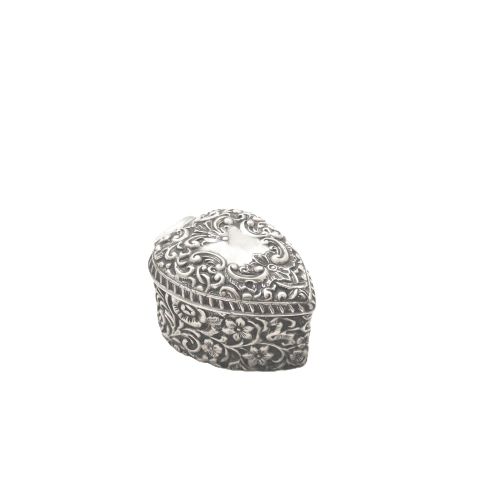
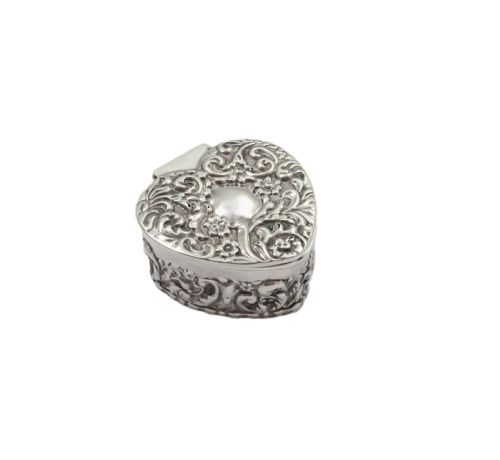


Heart Shaped Vanity Box
These heart shaped vanity box pieces are charming receptacles for keepsakes, offering a touch of late nineteenth and early twentieth century elegance.
Heart Shaped Vanity Box
When you search for a heart shaped vanity box, you encounter small receptacles designed for dressing tables to hold rings, pills, or trinkets. The selection spans the late Victorian and Edwardian eras, with sterling silver and cut glass forming the core of the inventory.
Most examples you meet on this page take the form of small trinket boxes or ring boxes fashioned into the silhouette of a heart. Makers from Birmingham and London produced these pieces during the reigns of Victoria, Edward VII, and George V.
The objects serve as personal storage containers rather than large dressing cases, often featuring hinged lids and fitted interiors. Their compact scale made them popular dressing table accessories throughout the period spanning from eighteen eighty to nineteen fifteen.
Materials and construction
Silversmiths shaped sterling silver into heart outlines, frequently employing piercing techniques to create openwork decorative patterns on the lid or sides. Vermeil interiors occasionally appear, providing a gold wash over the silver surface.
Glasscutters formed heavy bases from cut glass and cut crystal, adding faceted patterns that catch the light beneath metal lids. Silversmiths then mounted silver rims and hinged tops directly onto these glass bodies.
The listings span from eighteen eighty to nineteen fifteen, uniting Victorian, Edwardian, and George V periods.
Evaluating the pieces
Subtlety of form and crispness of detail separate the finer examples from standard production items. Pierced silver work demonstrates the skill of the silversmith through clean edges and balanced symmetry in the openwork design.
The weight and depth of the cut glass or crystal base contribute to the tactile substance of the piece. Crisp hallmarks and tight hinge alignment indicate superior original manufacture and careful preservation over the decades.
William Comyns
The Heart Shaped Vanity Box Glossary
- Sterling silver
- A standard of silver alloy containing ninety-two point five percent pure silver by mass. This material dominates the metal components found in these boxes.
- Vermeil
- Sterling silver coated with a thin layer of gold. It provides a warm interior glow inside the small containers.
- Cut glass
- Glass shaped and patterned by grinding and polishing wheels. It forms the heavy transparent bodies of several items.
- Hallmark
- An official stamp applied to precious metals indicating the standard of purity, assay office, and date letter. These marks help date the silver boxes accurately.
- Pierced work
- Metalwork featuring patterns cut through the sheet to create openwork decoration. Silversmiths utilised this technique on decorative box lids.
Heart Shaped Vanity Box: Frequently Asked Questions
What were these boxes used for?
These small receptacles served on dressing tables to hold precious rings, small trinkets, or medicinal pills.
Their intimate scale made them ideal for personal items kept close at hand in the bedchamber.
How do I date a silver heart box?
You examine the hallmarks stamped onto the silver components, which indicate the assay office and year of manufacture.
Stylistic details such as heavy crystal bases or pierced Edwardian motifs also point to specific decades.
Are glass and silver boxes delicate?
The thick cut crystal and sterling silver mounts are robust, but the hinged lids require gentle handling.
Store them on stable surfaces away from edge hazards to protect the glass bodies and delicate silver joins.
What is the difference between Victorian and Edwardian examples?
Victorian pieces often display heavier cast ornamentation and deeper embossing from the late nineteenth century.
Edwardian items frequently lean towards lighter pierced silver work and combined glass bodies from the early nineteen hundreds.