




Hardwood Jewellery Chest
A hardwood jewellery chest offers both secure storage and exceptional craftsmanship, bringing tangible history and fine regional carving straight to the dressing table.
Hardwood Jewellery Chest
A hardwood jewellery chest provides secure storage through sturdy construction and compartmented interiors designed for precious items. These items range from compact tabletop cabinets and travelling boxes to larger sarcophagus-shaped caskets and floor cabinets.
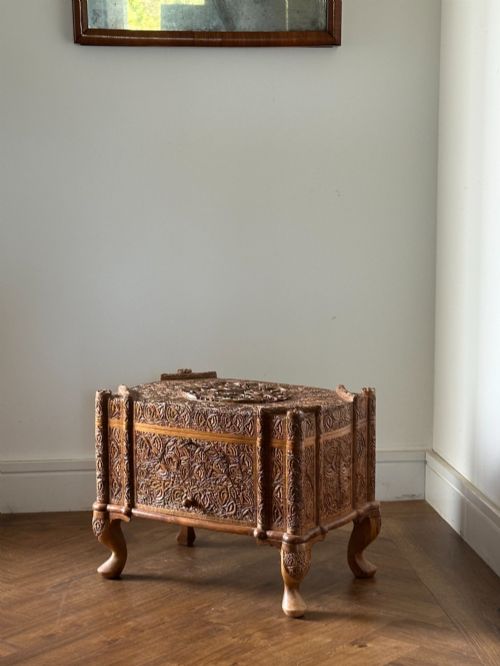
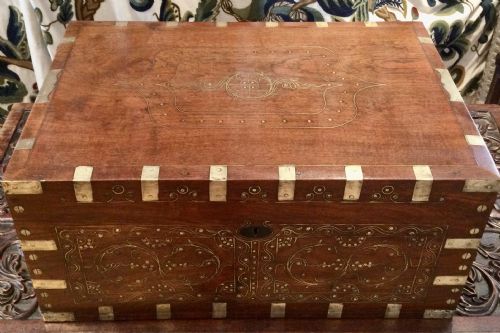
The pieces seen on this page span the nineteenth century and the early twentieth century, incorporating periods such as Victorian, Qing Dynasty, and the Japanese Meiji era. Regional origins stretch widely across Asia, the Middle East, and Europe, including Anglo-Indian, Chinese, Dutch Colonial, and Qajar Iranian workshops.
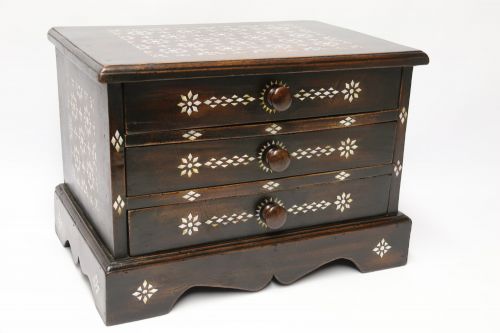
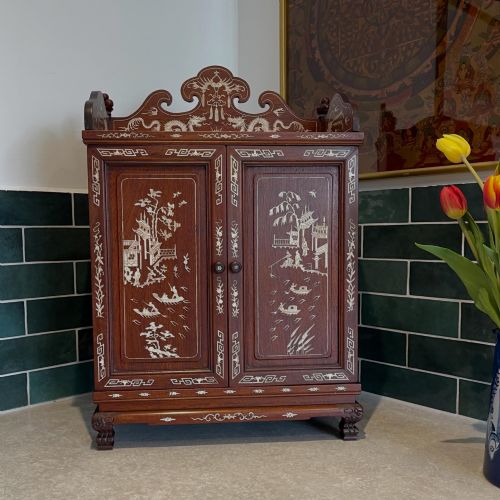
Buyers will most frequently encounter distinctive regional forms such as carved sandalwood caskets, Hongmu travelling boxes, and mother-of-pearl inlaid tabletop cabinets. These objects served both domestic storage and international trade markets, reflecting the diverse global aesthetics of their respective periods.
How they were made
Makers utilised dense timbers including rosewood, walnut, sandalwood, and Hongmu, selecting these woods for structural stability and rich natural grain. These durable materials formed the robust carcasses required for protective storage boxes and cabinets.
Surface decoration relies heavily on meticulous hand carving, deep relief work, and intricate inlay techniques. Artisans integrated contrasting materials such as brass, bone, mother-of-pearl, and bronze to accentuate panels, lids, and mounts.
Some travelling boxes feature clever swing-out cases designed to surprise the owner with hidden compartments.
What varies in quality
Quality depends upon the precision of the joinery and the depth and clarity of the hand carving across the timber surfaces. Superior examples demonstrate tight joints, well-fitted drawers, and crisply defined relief motifs that remain sharp after decades of handling.
The refinement of internal compartments and the quality of applied metalwork or inlay work also distinguish finer items. Pieces featuring intact mother-of-pearl, detailed bronze mounts, or integrated swing-out mechanisms indicate higher standards of original construction.
The Hardwood Jewellery Chest Glossary
- Hongmu
- A dense, heavy tropical hardwood prized in Chinese furniture and box making for its deep reddish-brown tone and durability. It takes a fine polish and resists splitting.
- Sarcophagus
- A coffin-shaped form with a sloping lid, adopted by nineteenth-century cabinet makers for luxury caskets and tea caddies. This shape provides generous internal volume while maintaining an elegant profile.
- Meiji Period
- The era in Japanese history spanning from 1868 to 1912, noted for highly refined metalwork and decorative arts produced for both domestic and export markets.
- Qajar
- Pertaining to the Iranian dynasty ruling from 1789 to 1925, characterised by distinctive decorative motifs and regional craftsmanship seen on carved wooden caskets.
- Dutch Colonial
- A style of furniture and decorative objects produced in territories under Dutch influence, blending European cabinet forms with local tropical timbers and carving techniques.
Hardwood Jewellery Chest: Frequently Asked Questions
What is a hardwood jewellery chest?
A hardwood jewellery chest is a sturdy container built from dense timber, designed to safely store valuable ornaments and small personal items.
These pieces often feature specialised internal compartments, trays, or drawers enclosed by lockable lids and hinged doors.
How were antique jewellery chests used?
Owners utilised these boxes to protect precious gems, rings, and delicate trinkets from dust, moisture, and theft in the home or during travel.
Many examples include portable travelling boxes designed for long journeys, while larger table cabinets remained stationary on dressing tables.
How do I date a wooden jewellery chest?
Dating relies on observing construction methods, timber types, regional decorative styles, and hardware such as hinges and locks.
Comparing the piece to documented examples from periods like the Victorian era or Qing Dynasty helps narrow down its age.
How do I care for antique hardwood boxes?
Protect the timber by maintaining stable humidity levels away from direct heat sources and strong sunlight to prevent cracking.
Occasional light dusting with a dry cloth preserves the polished surface without damaging delicate inlays of mother-of-pearl or bone.