

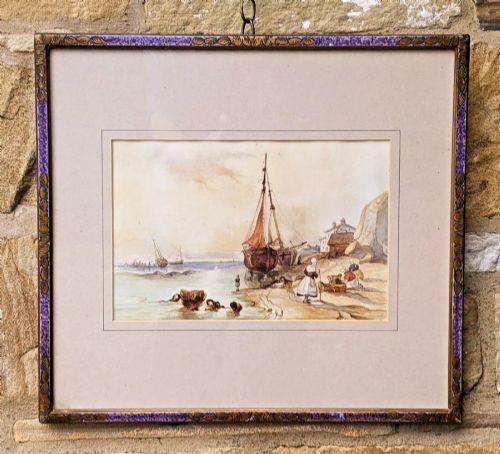


Harbour Boat Wall Picture
A harbour boat wall picture brings the movement of coastal tides and the timber of moored vessels directly into a room.
Harbour Boat Wall Picture
A harbour boat wall picture captures maritime life across centuries, ranging from early nineteenth-century coastal scenes to mid-century British views. These works focus on traditional vessels, from fishing boats and barges to sailing yachts at rest in British and continental ports.
Buyers encounter various formats including original watercolours, oil paintings on canvas or board, pastels, and gouache. The selection spans Victorian realism through to British impressionism and mid-century modern interpretations.
Depicted locations vary from Cornish fishing villages like Polperro and Mousehole to Mediterranean ports and French coastal towns. Each piece records the working life of the shore through different artistic lenses.
Assessing Quality and Execution
Quality rests upon the artist's handling of light, water movement, and structural perspective within the maritime setting. Stronger pieces demonstrate confident brushwork or pigment control that captures the atmosphere of the port rather than merely recording topography.
The integration of the paper, canvas, or board support with the original frame contributes to the overall integrity of the piece. Masterful composition and a distinct handling of marine elements separate standard topographical records from accomplished fine art.
Several artists preferred painting stormy coastal waters with salt spray so thick it practically dampens the room.
Kenneth Cozens·William Lee Hankey·Ernest F. Hill·Alfred Henry Vickers·Edward Henry Holder·Owen Bowen·Micheal Matthews·Frank Myers Boggs·Robert Leslie Howey·Fred Dade·Frank William Scarbrough·John William Gilroy·R Goodhind
The Harbour Boat Wall Picture Glossary
- Watercolour
- A painting method where fine pigment is suspended in a water-based solution and applied to paper. It allows for translucent washes that suit coastal skies and open water.
- Giltwood
- Wood carved and coated with gold leaf or a gold-coloured metallic finish, frequently utilised for traditional picture frames. This finish adds warmth and definition to the surrounding artwork.
- Gouache
- An opaque water-based paint that includes a binding agent, creating solid matte areas of colour. Artists use it alongside watercolour to introduce bright highlights to marine scenes.
- Gouache
- An opaque water-based paint that includes a binding agent, creating solid matte areas of colour. Artists use it alongside watercolour to introduce bright highlights to marine scenes.
- Coble
- A traditional type of open fishing boat developed on the north-east coast of England. These vessels are characterised by a flat bottom and high bow, designed for launching from surf beaches.
Harbour Boat Wall Picture: Frequently Asked Questions
How do I hang a harbour boat wall picture?
Secure picture wire to sturdy wooden frames using appropriate wall fixings that match your wall type. Ensure the height places the centre of the artwork at eye level for optimal viewing.
Keep watercolours and pastels out of direct sunlight to prevent the pigments and paper from fading over time.
Are these paintings original works?
The collection comprises original watercolours, oil paintings, and pastel drawings created by individual artists. Each piece represents a unique hand-painted interpretation rather than a modern reproduction.
Signatures, inscriptions, and exhibition labels on the reverse often provide further context regarding the origin.
How do I care for antique watercolours?
Protect works on paper behind glass by maintaining stable indoor humidity levels to avoid dampness and foxing spots. Professional framing with acid-free mount board preserves the paper support.
Dust wooden frames gently with a dry cloth and avoid using liquid cleaners near exposed paper or canvas surfaces.
What periods do these paintings represent?
The available artworks span from the early nineteenth century through the Victorian era and into the mid-twentieth century. Stylistic shifts reflect broader movements such as British Impressionism and post-war modernism.
Dates are established through artist signatures, biographical records, and stylistic evidence within the composition.