


Handle Top Clock
Handle top clock designs bring together brass, mahogany, and burr walnut in compact forms that sit proudly on any mantel.
Handle Top Clock
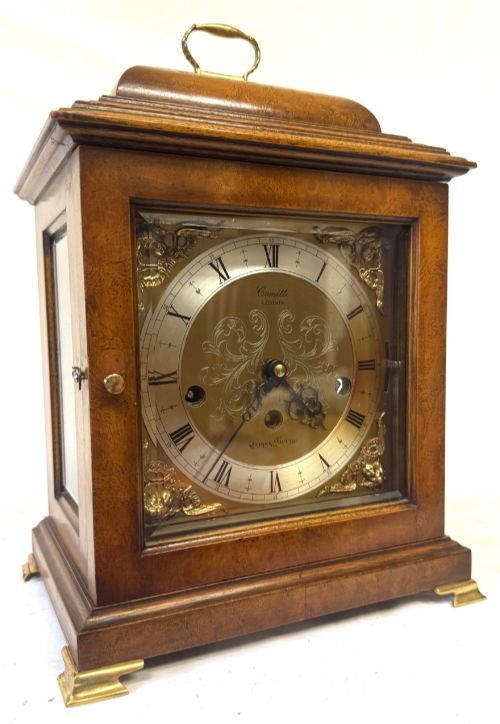
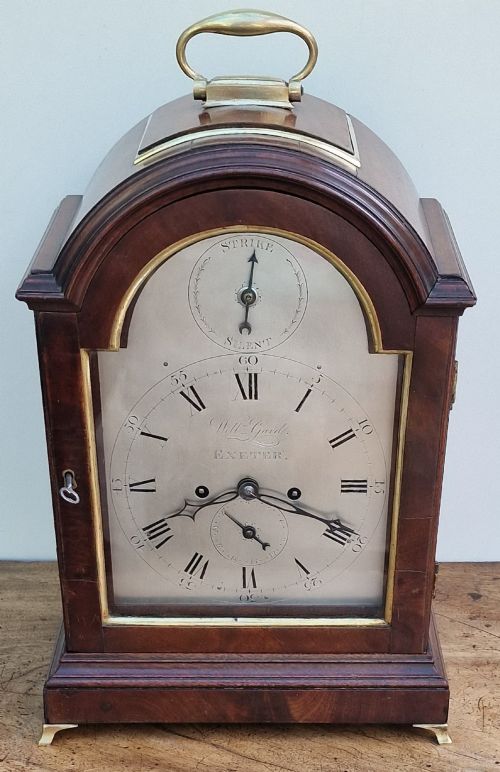
A handle top clock sits as a substantial mantel or table piece, often featuring a distinctive carrying handle atop the case. These timepieces emerge in various forms, from Georgian and Regency bracket clocks to carriage clocks and later revival pieces.
The selections available here span several centuries, reaching from eighteenth-century bell-top and caddy-top designs through to twentieth-century models. Mahogany and walnut cases predominate, housing detailed dials in silvered metal and enamel.
Makers represented on this page include established names such as Comitti of London, William Gard, Mappin & Webb, Perigal & Duterrau, Watson of London, and Joseph Lum. Buyers find both traditional English bracket clocks and compact brass carriage timepieces among the listings.
Materials and construction
Cases utilise rich timbers including mahogany, walnut, ebonised wood, and burr walnut, shaped into bell tops, pad tops, and caddy tops. Brass elements appear extensively in carrying handles, feet, and dial surrounds.
Interior mechanisms employ precise movements, featuring verge escapements, striking trains, and multiple tune configurations housed securely within timber or brass housings.
Listings feature timbers such as mahogany, walnut, and burr walnut alongside brass and glass across periods from the eighteenth century to the twentieth.
Assessing the craftsmanship
The distinction between standard examples and superior pieces rests upon the crispness of the timber carving and the complexity of the internal movement. Finer specimens display harmonious proportions in their bell-top or caddy-top wooden cases alongside finely engraved silvered dials.
Originality of components dictates much of the standing of an antique clock. Retaining early verge escapements and signed brass dial plates elevates the overall integrity of the piece.
Comitti of London·William Gard·Mappin & Webb·Perigal & Duterrau·Watson of London·Joseph Lum
The Handle Top Clock Glossary
- Bracket clock
- A portable spring-driven clock designed originally to sit upon a wall bracket or table. These substantial pieces usually feature carrying handles on top.
- Bell top
- A case style where the wooden top tapers upward in a curved, bell-like silhouette. This classic Georgian form often accommodates a brass carrying handle at the apex.
- Verge escapement
- An early mechanical regulating device used in clocks and watches. It controls the release of power from the gear train to ensure steady timekeeping.
- Silvered dial
- A metal clock face treated with a silver solution to create a bright, legible surface. These dials frequently feature engraved numerals and maker signatures.
- Carriage clock
- A small, spring-driven timekeeper equipped with a handle, originally built for travel. Examples appear in brass frames with glass panels exposing the movement.
Handle Top Clock: Frequently Asked Questions
What is a bracket clock?
A bracket clock is a portable spring-driven timepiece designed to stand on a table, chest, or dedicated wall bracket. They typically feature sturdy carrying handles on top to allow safe movement between rooms.
Historically, these clocks served as the primary timekeepers for affluent households before smaller mantel and desk clocks became common in later centuries.
How do I wind an antique clock?
Winding requires using the correct key on the designated arbours found on the dial face. Care must be taken not to overwind the mainspring.
Consulting the specific movement instructions ensures the escapement and striking train remain in proper working order without placing undue stress on historical gears.
Where should I place a heavy wooden clock?
Position these clocks on a sturdy, level surface away from direct sunlight, dampness, and major draughts. Heavy timber cases require solid support to maintain correct alignment.
Placing the piece on a mantel or heavy sideboard ensures the pendulum or balance wheel operates on a true level for accurate timekeeping.