
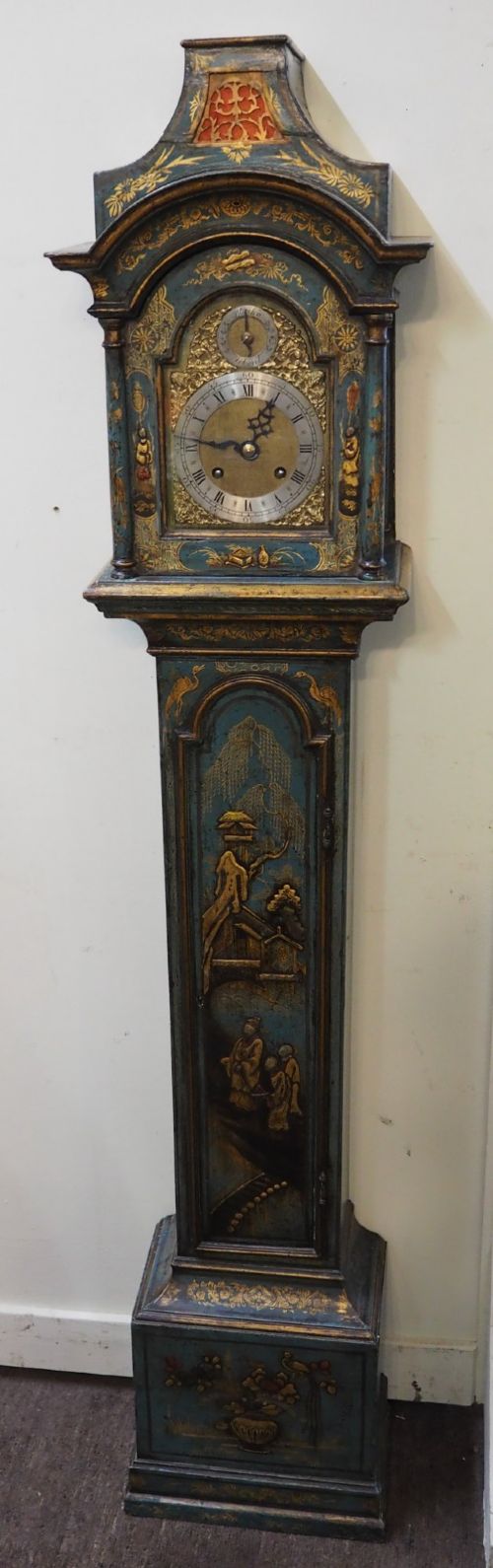


Hand Painted Longcase Clock
A hand painted longcase clock brings movement, colour and mechanical craft to a room, ranging from grand architectural cases to compact grandmother variants.
Hand Painted Longcase Clock
A hand painted longcase clock combines horological movement with decorative cabinet work, appearing across various scales from full-size grandfathers to smaller grandmother clocks and miniature examples. Buyers examining this page encounter pieces spanning the late seventeenth century through to the early twentieth century, reflecting shifting domestic tastes over generations.
Forms vary from robust provincial oak cases to delicate blue, cream and lacquered schemes adorned with gold leaf and detailed dial work. Alongside standard longcase clocks, buyers find specialised variations including moon dial displays, Westminster chimes and Dutch Delftware influences.
How they were made
Cabinet makers constructed the tall wooden housings using timber such as oak, mahogany, pine and lacquered wood, often applying gold leaf detailing to enrich the exterior surfaces. These cases protected the delicate mechanical movements while serving as prominent pieces of furniture within the home.
Clock faces incorporated hand-painted elements, brass components and glass covers to protect the dial and hands. Artisans applied specialised lacquer techniques to achieve Chinoiserie finishes, building up layers of decoration that defined the visual character of the clock.
Listings span multiple centuries, capturing shifts from early Georgian pine and oak through to 19th-century lacquer and 20th-century Chinoiserie grandmother clocks.
What varies in quality
Quality reveals itself in the harmony between the cabinet work and the mechanical movement housed within, distinguishing standard production from exceptional craftsmanship. Finer examples display meticulous hand-painted detail on the dial and case, whereas simpler versions rely on more straightforward execution.
The sophistication of the movement, whether featuring specialised additions like moon dials or Westminster chimes, separates utilitarian timepieces from ambitious works of horology. Material selection also dictates standard, with choice hardwoods and refined lacquer work marking the upper tier of the range.
Edward Shepley of Manchester·John Welsh Luton Bedfordshire
The Hand Painted Longcase Clock Glossary
- Longcase clock
- A tall pendulum clock enclosed in a wooden case, commonly known as a grandfather clock. These timepieces stand directly on the floor and house weights and pendulum within the trunk.
- Grandmother clock
- A smaller, more compact version of the traditional longcase clock, typically produced in the twentieth century. It offers the aesthetic presence of a grandfather clock in a reduced scale.
- Chinoiserie
- A decorative style reflecting European interpretations of Chinese and East Asian artistic traditions. It frequently appears on lacquered clock cases with gold leaf ornamentation.
- Moon dial
- A specialised clock face mechanism that tracks the phases of the lunar cycle alongside the standard time. This feature adds mechanical complexity and visual interest to the dial.
- Delftware
- Tin-glazed earthenware originating from Dutch traditions, influencing miniature decorative pieces and clock designs. It introduces distinctive blue and white ceramic elements to horological objects.
Hand Painted Longcase Clock: Frequently Asked Questions
What is a grandmother clock?
A grandmother clock is a scaled-down version of the traditional longcase clock, designed to fit rooms with lower ceilings or smaller proportions.
Despite their reduced size, these clocks retain the mechanical movements and tall wooden cabinetry associated with larger grandfather clocks.
How do I date a longcase clock?
Dating relies on examining the style of the wooden case, the materials used, and the signature or location of the maker inscribed on the dial.
Georgian pieces show different cabinet proportions compared to later nineteenth or twentieth-century interpretations.
What is Chinoiserie decoration?
Chinoiserie is a decorative European style inspired by Asian art, featuring painted scenes, figures and landscapes often rendered in lacquer and gold leaf.
This technique creates highly ornate surfaces on the exterior body of the clock case.