


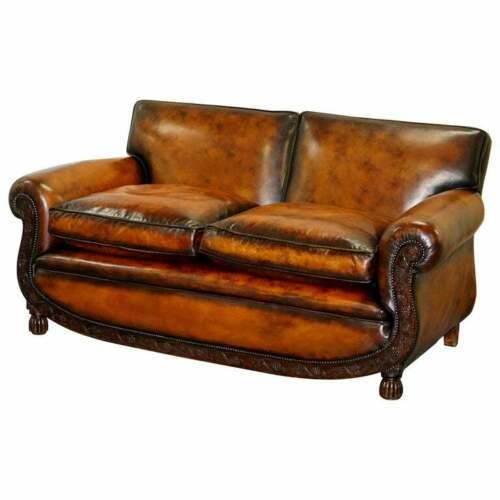


Hand Dyed Leather Settee
A hand dyed leather settee brings rich texture and enduring comfort to a room through traditional craft.
Hand Dyed Leather Settee
A hand dyed leather settee is a substantial seating piece defined by traditional upholstery styles and rich, coloured leather hides. When you search for a hand dyed leather settee, you encounter large seating forms originating from the nineteenth century up through the nineteen thirties.
The selections here comprise classic Chesterfield sofas alongside wing back forms, serpentine fronted designs, and drop arm knoll pieces. Victorian examples sit alongside Edwardian and nineteen thirties English country house pieces, offering deep seats and robust proportions.
How they were made
Makers built these frames using sturdy timbers such as mahogany and assorted hardwoods, ensuring structural longevity beneath the upholstery. Metal and brass elements often reinforce the construction, whilst internal padding relies on traditional materials like horsehair.
The exterior surfaces feature leather hides that receive hand applied dye treatments to achieve tones ranging from whiskey brown to amethyst. Upholstery methods include tufting and fully loose coil springing to deliver both resilience and comfort.
Hand Dyed Leather Settee Retail Price Guide 2026
Typical asking prices for hand dyed leather settee among the pieces listed under this phrase on Sellingantiques today, from the lower quarter to the upper quarter. They describe what is for sale here now, not the wider market.
Listings feature pieces spanning the Victorian period, nineteenth century, nineteen tens, nineteen twenties, and nineteen thirties.
What varies in quality
Quality depends upon the integrity of the underlying hardwood frame and the depth of the upholstery work. Pieces featuring fully loose coil springing and traditional horsehair filling demonstrate superior construction methods.
The finish of the leather surface dictates the visual appeal, where skilled hand dyeing creates nuanced colour variation across the hide. Maker attribution, such as work originating from established Pall Mall firms, also elevates the standing of a piece.
Hampton and Sons
The Hand Dyed Leather Settee Glossary
- Chesterfield
- A traditional sofa style characterised by rolled arms and a back of the same height, typically featuring deep button tufting. This form remains a staple of English seating design.
- Horsehair
- A traditional stuffing material utilised in upholstery for its resilience and ability to hold shape over decades of use. It provides firm support within the interior layers.
- Knoll sofa
- A seating design featuring adjustable drop arms that can be lowered on one or both sides. This mechanism allows the piece to function as a sofa or a daybed.
- Serpentine front
- A furniture silhouette featuring a wavy, concave-convex front edge that adds visual movement and sophistication to the piece. This shaping requires expert carpentry.
- Tufting
- An upholstery technique where buttons or stitches are pulled deep into the padding to secure the filling and create a distinctive geometric pattern on the surface.
Hand Dyed Leather Settee: Frequently Asked Questions
What is a hand dyed leather settee?
A hand dyed leather settee is a traditional upholstered seating piece finished with bespoke colour treatments applied directly to the leather hide. These pieces typically date from the Victorian era through the early twentieth century.
Such sofas feature sturdy hardwood frames and classic silhouettes like the Chesterfield or wing back design. They serve as primary seating options that combine robust construction with rich surface patination.
How do I care for dyed leather?
Maintaining dyed leather involves keeping the material away from direct heat sources and strong sunlight to prevent fading or drying out. Regular dusting with a soft cloth preserves the surface.
Applying specialised leather conditioners periodically helps maintain the suppleness of the hide. Avoid harsh chemical cleaners that can strip the hand applied colour.
Where were these settees made?
These settees originate primarily from British workshops and firms operating during the nineteenth and early twentieth centuries. Many reflect traditional English country house aesthetics.
Maker workshops ranged from provincial cabinet makers to prominent London establishments situated in areas like Pall Mall. Their output defined domestic comfort across multiple historical periods.
How do I identify a Victorian settee?
A Victorian settee typically displays dense hardwood construction, deep button tufting, and generous proportions designed for formal reception rooms. Stylistic details often include hand carved floral motifs or serpentine front shaping.
Materials such as mahogany framing and horsehair stuffing point firmly to this nineteenth century origin. The upholstery technique also provides strong clues regarding the period of manufacture.