
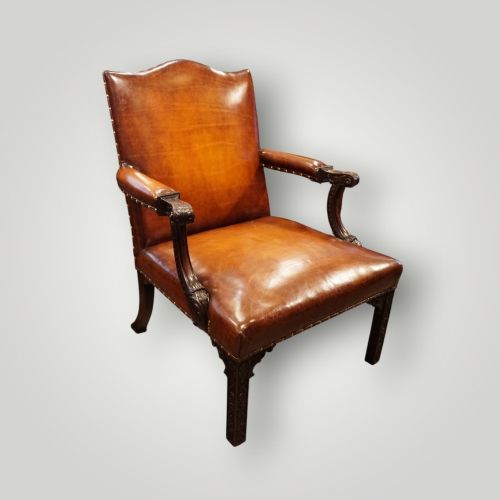


Hand Dyed Leather Chair
A hand dyed leather chair brings tactile warmth and deep history to a room through rich hides and traditional frames.
Hand Dyed Leather Chair
A hand dyed leather chair spans robust library armchairs, generous wing backs, and carved carver forms originating across Georgian, Victorian, and Edwardian periods. Buyers encounter substantial seating finished in distinct hides, from deep navy and green to classic brown tones.
The selection ranges from large Gainsborough and Chesterfield armchairs down to dining carvers and sets of club chairs. Victorian and Edwardian examples dominate the offerings, frequently incorporating deep buttoning and wing back designs suited to traditional interiors.
How they were made
Frames rely on solid timbers such as mahogany and assorted hardwoods, providing the structural skeleton for substantial seating. Artisans shape these woods into robust arms, legs, and supportive backs, often employing detailed carving techniques like blind fretwork.
Upholstery combines English hide leather secured with brass tacks and brass hardware details. Hides undergo hand dyeing processes to achieve varied hues before application to armchairs, sofas, and carvers.
What varies in quality
Quality rests in the depth and execution of the hand dyeing process across the hide, alongside the integrity of the underlying timber frame. Finer examples show careful colour absorption and rich patination rather than flat, uniform surfaces.
Joinery and decorative carving dictate distinction at the upper end, where solid mahogany and precise detailing elevate standard forms into library and Gainsborough armchairs of notable presence.
Gillows·Thomas Chippendale
The Hand Dyed Leather Chair Glossary
- Gainsborough armchair
- A wide, open-armed seat originating in the 18th century, designed with a padded back and seat for desk or parlour use. These chairs frequently feature mahogany frames and upholstered armrests.
- Wing back armchair
- A high-backed seat featuring protective side panels designed to shield the occupant from drafts. This form appears across Georgian and Victorian periods in hand dyed leather.
- Carver chair
- An armchair intended for the head of a dining table, featuring supportive armrests integrated into the wooden frame. They often pair with matching side chairs.
- Brass tacks
- Small decorative metal nails used to secure leather upholstery edges to wooden frames. They provide a traditional visual accent alongside functional fastening.
- Chesterfield
- A heavily upholstered seating style characterised by deep button tufting and rolled arms of equal height to the back. Versions in this inventory take the form of armchairs, club chairs, and sofas.
Hand Dyed Leather Chair: Frequently Asked Questions
How do I clean a hand dyed leather chair?
Wipe surfaces gently with a soft, dry cloth to remove dust. Avoid harsh chemical cleaners that strip the hand applied dye.
Condition the hide periodically with appropriate leather balms to maintain flexibility and rich colour depth over years of use.
What is a club chair?
A club chair is a deep, low-slung armchair designed for comfort and relaxation. Originating in French and English clubs, they feature supportive padded arms.
In these listings, they appear upholstered in hand dyed leather with buttoned or smooth finishes.
Are these chairs comfortable for daily use?
These pieces combine sturdy hardwood frames with generous padding designed for extended sitting. Their ergonomic proportions suit studies, libraries, and living rooms.
Victorian and Edwardian iterations offer deep seats and supportive backs built for enduring physical comfort.
How do I distinguish a Georgian chair from a Victorian one?
Georgian pieces often display refined mahogany framing with classical carving details, reflecting 18th-century proportions. Victorian examples tend to be heavier, frequently utilising deep buttoning and more robust silhouettes.
Examining the timber type, joinery style, and upholstery method helps clarify the period of origin.