
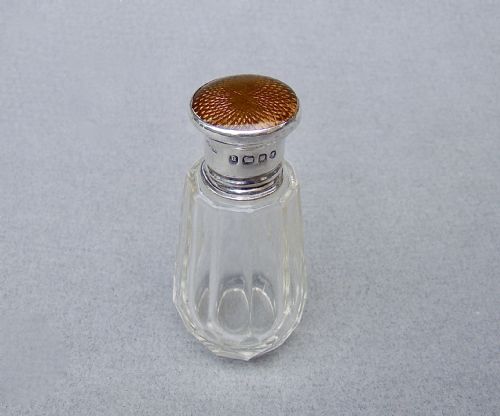


Guilloche Enamel Vanity Bottle
These guilloche enamel vanity bottle pieces combine precision-turned metalwork with translucent glass to bring colour and elegance to any dressing table.
Guilloche Enamel Vanity Bottle
When you search for guilloche enamel vanity bottle, you are looking at small containers designed for scent, perfume, or dressing table storage. The pieces listed here span several decades from the early twentieth century, including the 1910s, 1920s, 1930s, and 1940s. They take the form of scent bottles, perfume bottles, and lidded vanity jars.
You are most likely to meet Art Deco and Edwardian examples featuring sterling silver collars and tops paired with glass or cut glass bodies. French Belle Epoque and Mid-Century British pieces also appear, demonstrating a range of compact vanity items. Each object combines a functional glass reservoir with a decorative metal and enamel lid or top.
The materials recorded in the evidence centre on sterling silver, enamel, guilloche enamel, glass, and cut glass. Makers such as Henry Perkins, Mappin & Webb, and the Goldsmith's and Silversmith's Co. created these items in London and other workshops. Whether formed as a tall lidded jar or a small scent bottle, they represent portable luxury from the first half of the twentieth century.
How they were made
The construction of a guilloche enamel vanity bottle relies on combining heavy glass or cut glass bases with metalwork tops. Sterling silver forms the structural collars and screw caps, providing a secure mount for the glass bodies. Glass blowers and cutters shaped the reservoirs with flutes, panels, or smooth walls to hold perfumes and lotions.
The distinctive enamel decoration involves mechanical engraving of the metal surface beneath translucent coloured glass powder. Craftsmen used a rose engine lathe to cut precise geometric or radial patterns into the silver before firing the enamel layers in a kiln. This technique creates a shimmering patterned depth visible through the coloured surface.
Materials paired with guilloche enamel in these records include both clear cut glass and sterling silver mountings produced by prominent silversmiths in London.
What varies in quality
Quality in a guilloche enamel vanity bottle rests upon the crispness of the engine-turned engraving beneath the enamel and the clarity of the colour. Finer examples display intricate, deep machine patterns that catch the light evenly without interruption or pooling in the fired glass layer. The thickness and purity of the sterling silver mounts also indicate the standard of the maker's workshop.
The integration between the glass reservoir and the silver top marks another distinction in grade. Superior pieces feature well-fitted collars that align precisely with the glass neck and retain secure closures. The weight and depth of the cut glass base contribute further to the substantial feel of the finished object.
Henry Perkins·Mappin & Webb·Goldsmith's and Silversmith's Co.
The Guilloche Enamel Vanity Bottle Glossary
- Guilloche Enamel
- A decorative technique where a metal surface is mechanically engraved with repetitive geometric patterns and then covered with translucent enamel. This allows the underlying pattern to show through with luminous depth.
- Sterling Silver
- An alloy of silver containing 92.5 percent pure silver and 7.5 percent other metals, usually copper. This standard composition provides the durability required for vanity bottle collars and lids.
- Cut Glass
- Glass shaped and patterned by holding it against a rotating abrasive wheel. It adds weight, sparkle, and tactile grip to the lower reservoirs of scent bottles.
- Art Deco
- A design style prevalent in the 1920s and 1930s characterised by sleek geometric shapes, streamlined forms, and bold symmetry. It heavily influences the aesthetic of many surviving vanity items.
- Belle Epoque
- A period of French history spanning the late nineteenth century to the start of the First World War. It is associated with refined decorative arts and ornate luxury goods.
Guilloche Enamel Vanity Bottle: Frequently Asked Questions
What is a guilloche enamel vanity bottle?
It is a small container made from glass or cut glass featuring a sterling silver top decorated with machine-turned enamelling. These items were designed to hold perfume or cosmetics on a dressing table.
They combine practical storage with decorative metalwork characteristic of twentieth-century dressing accessories.
How do I identify the date of my bottle?
Dating relies on hallmarks stamped into the sterling silver mounts, which indicate the assay office, metal standard, and date letter. Stylistic markers such as Art Deco geometry or Edwardian forms also help narrow down the period.
Makers' marks stamped alongside the assay marks provide further clues to the specific year of production.
Were these bottles used for perfume?
Yes, many were made specifically as scent or perfume bottles with stoppers or screw caps to contain liquid fragrances. Others served as lidded vanity jars for powders, creams, or pins.
The glass bodies were sealed with metal collars to prevent evaporation of the contents.
How should I clean my silver and enamel?
Cleaning requires gentle care using a soft cloth to avoid scratching the delicate glass or the fired enamel surface. Silver polish should be kept away from the enamel to prevent dulling or chemical damage.
Store the items in a stable environment away from direct sunlight and extreme humidity to protect the materials.