




Grey Architectural Watercolour Art
Grey architectural watercolour art captures historic facades and city views through washes of tone, offering buyers a glimpse into past urban spaces.
Grey Architectural Watercolour Art
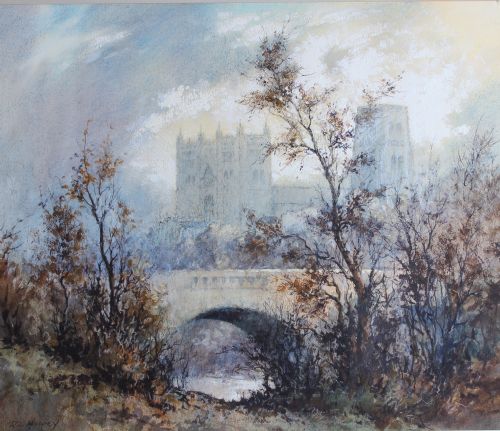
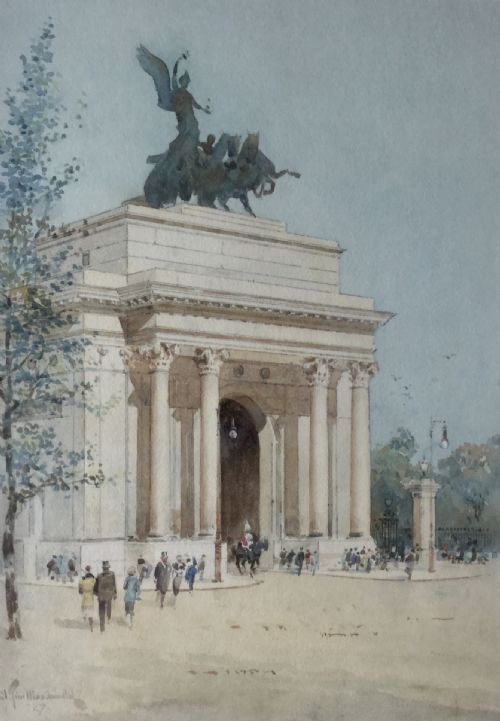
Grey architectural watercolour art encompasses original works on paper depicting buildings, monuments, and urban scenes rendered primarily in monochrome or muted grey tones. These works capture specific locations ranging from northern cathedrals to Venetian canals, executed during the nineteenth and twentieth centuries.
Buyers encountering this selection will frequently find townscapes and architectural studies originating from British and European hands. The works span Edwardian periods through to the mid-twentieth century, reflecting changing documentation of urban environments.
The style often intersects with landscape and topographical painting, where structural forms take precedence over pure scenery. Such pieces range from detailed studies of specific historic arches to broader atmospheric views of riverbanks and market crosses.
Materials and Construction
These works are created using water-soluble pigment applied to paper supports, occasionally supplemented by ink lines to define structural edges. The primary components recorded are watercolour paint, ink, and paper.
Artists utilise fluid washes to build up shadows and architectural depth, relying on the white of the unpainted paper for highlights. Framing materials commonly include wood and glass to protect the delicate paper surface.
Listings feature works executed on paper using watercolour and ink across the nineteenth and twentieth centuries.
Evaluating Quality
Quality in these watercolours depends upon the sureness of the draughtsmanship and the artist's ability to render perspective and structural mass with economy of line. Stronger pieces demonstrate confident handling of monochrome washes to establish light and shadow across stone facades.
The degree of atmosphere and the precision in capturing the specific character of a monument or street scene dictate the distinction between routine topographical records and accomplished works of fine art.
Robert Leslie Howey·Stanley Orchart·Vittore Zanetti Zilla·Hercules Brabazon Brabazon·Noel Harry Leaver·Sonia Lawson·Fred Lawson·Cuthbert Crossley·Tom Dudley
The Grey Architectural Watercolour Art Glossary
- Monochrome
- Painting or drawing carried out in a single colour or shades of a single colour, such as grey. This restriction places emphasis on tone and form rather than hue.
- Wash
- A thin, fluid layer of watercolour paint applied across paper to achieve smooth, even areas of tone or atmospheric background effects.
- Support
- The underlying material, such as paper, upon which the watercolour pigments and inks are applied.
Grey Architectural Watercolour Art: Frequently Asked Questions
How should I frame an old watercolour?
Old watercolours require conservation framing with acid-free mounts and UV-filtering glass to protect the paper and pigments from environmental degradation.
Keep these works away from direct sunlight and damp environments to prevent fading and foxing on the paper surface.
What subjects appear in these paintings?
The subjects include cathedrals, market crosses, street scenes, and specific architectural landmarks across Britain and Europe.
Artists frequently recorded recognisable cityscapes and historic buildings during their travels or within their local regions.
How do I date a paper watercolour?
Dating relies upon stylistic markers, signatures, artist biographical records, and sometimes watermarks embedded within the paper itself.
Edwardian and mid-twentieth-century pieces often carry specific stylistic traits characteristic of their decade of creation.
Are these works original paintings?
The selection primarily consists of unique original watercolours and drawings created by hand rather than mass-produced mechanical reproductions.
Each original artwork displays individual brushwork, pigment variation, and paper texture unique to that specific creation.